
Saudi Arabia Teleradiology Market Size and Forecast 2025–2033
How Digital Imaging, Vision 2030, and Remote Diagnostics Are Transforming Radiology Across the Kingdom

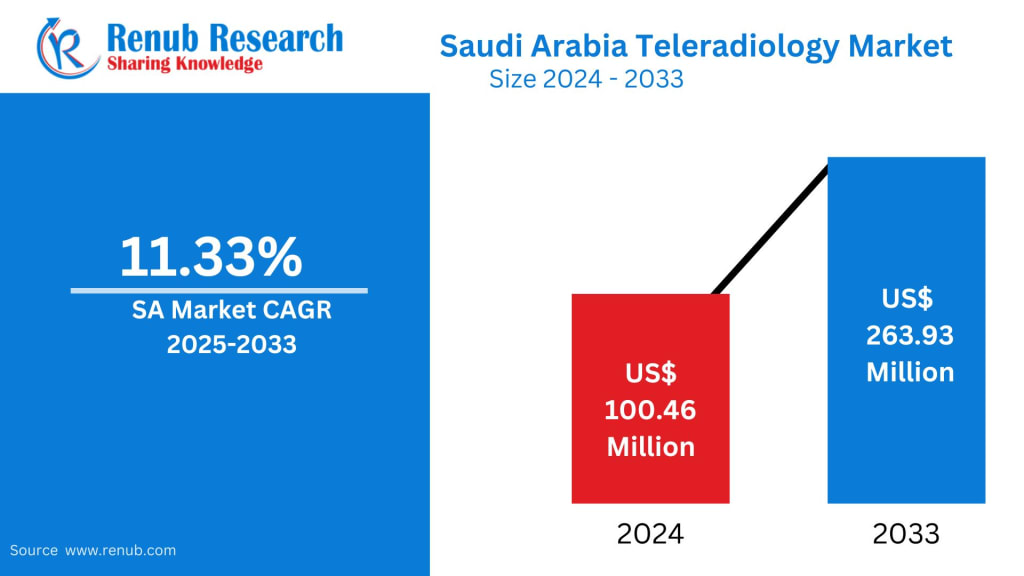
Saudi Arabia Teleradiology Market Outlook
The Saudi Arabia Teleradiology Market is undergoing a period of rapid transformation, driven by the Kingdom’s ambitious healthcare digitalization agenda and the increasing need for faster, more accurate diagnostic services. According to Renub Research, the market is projected to grow from US$ 100.46 million in 2024 to US$ 263.93 million by 2033, registering a strong CAGR of 11.33% during 2025–2033.
This impressive growth trajectory reflects Saudi Arabia’s broader push toward technology-enabled healthcare under Vision 2030, which emphasizes accessibility, efficiency, and quality of care. Teleradiology—allowing medical images to be transmitted, interpreted, and reported remotely—has emerged as a critical solution to address radiologist shortages, rising imaging volumes, and geographic disparities in healthcare access.
By leveraging high-speed connectivity, cloud platforms, artificial intelligence (AI), and secure data-sharing frameworks, teleradiology is reshaping how diagnostic imaging services are delivered across the Kingdom, particularly in rural and underserved regions.
Saudi Arabia Teleradiology Market Overview
Saudi Arabia’s vast geography and uneven distribution of healthcare professionals have long posed challenges to equitable diagnostic care. Teleradiology directly addresses these issues by enabling hospitals and diagnostic centers to transmit X-rays, CT scans, MRIs, and other imaging studies to radiologists located anywhere in the country—or even internationally—for timely interpretation.
The integration of cloud computing, AI-powered image analysis, and Picture Archiving and Communication Systems (PACS) has significantly enhanced reporting accuracy and turnaround times. Hospitals are increasingly adopting teleradiology to manage growing workloads, support emergency and trauma cases, and ensure 24/7 radiology coverage without relying solely on on-site specialists.
Government-led initiatives promoting telemedicine, digital infrastructure investment, and public–private partnerships further reinforce market expansion. While challenges such as data security, workforce shortages, and initial setup costs remain, the long-term benefits of efficiency, scalability, and improved patient outcomes continue to accelerate adoption across Saudi Arabia.
Key Factors Driving the Saudi Arabia Teleradiology Market
1. Better Access to Specialist Radiologists
One of the most significant advantages of teleradiology in Saudi Arabia is its ability to bridge geographic gaps. Rural and remote regions often lack access to subspecialty radiologists, resulting in diagnostic delays. Teleradiology enables instant image sharing with experts in urban centers like Riyadh and Jeddah, ensuring consistent diagnostic quality nationwide.
This remote connectivity reduces patient travel, shortens diagnosis timelines, and supports second opinions and multidisciplinary collaboration—ultimately improving clinical decision-making and healthcare equity across the Kingdom.
2. Growing Need for Rapid Diagnostics
Saudi Arabia has witnessed a rise in emergency cases, trauma incidents, and chronic disease burden, all of which demand fast and reliable imaging interpretation. In critical scenarios such as strokes, accidents, or cardiac events, minutes can make a life-saving difference.
Teleradiology supports real-time or near-real-time reporting, allowing emergency departments and intensive care units to initiate treatment without delay. As hospitals face increasing imaging volumes, remote reporting solutions are becoming indispensable for maintaining speed and accuracy under pressure.
3. Expanding Healthcare Infrastructure
Massive investments in new hospitals, specialty clinics, and diagnostic centers are reshaping Saudi Arabia’s healthcare landscape. Many of these facilities are being designed as “digital-first” environments, integrating advanced imaging equipment with remote reporting capabilities from the outset.
Teleradiology allows healthcare providers to scale services efficiently, offer round-the-clock coverage, and optimize radiologist workloads—without requiring permanent on-site specialists at every location. This flexibility aligns perfectly with national digital health strategies and fuels sustained market growth.
Challenges in the Saudi Arabia Teleradiology Market
Shortage of Trained Professionals
Despite technological advancements, human expertise remains essential. Saudi Arabia faces a shortage of radiologists skilled in remote image interpretation, as well as IT professionals capable of managing PACS, cybersecurity, and cloud-based systems.
This skills gap can lead to reporting delays, operational inefficiencies, and increased error risk. Addressing the challenge requires targeted training programs, professional certifications, and incentives to attract and retain qualified talent within the Kingdom.
High Initial Setup Costs
Implementing teleradiology infrastructure involves significant upfront investment, particularly for smaller hospitals and rural clinics. Costs include advanced imaging hardware, PACS platforms, secure cloud storage, encrypted communication networks, and staff training.
While long-term savings and efficiency gains are substantial, initial financial barriers may slow adoption. Government subsidies, reimbursement support, and public–private partnerships are expected to play a key role in overcoming these hurdles.
Saudi Arabia Teleradiology Market Regional Analysis
Urban centers lead teleradiology adoption due to stronger infrastructure and specialist availability, while rural regions are gradually catching up as connectivity improves.
Dhahran
Dhahran is emerging as a key teleradiology hub, supported by advanced healthcare infrastructure and proximity to leading institutions such as Johns Hopkins Aramco Healthcare. Strong digital connectivity enables efficient handling of high imaging volumes and complex cases. Continued investment in cybersecurity and standardized reporting will further strengthen Dhahran’s position.
Riyadh
As the capital and healthcare epicenter of Saudi Arabia, Riyadh dominates the teleradiology market. Major government and private hospitals rely heavily on remote imaging solutions to manage demand and ensure rapid turnaround times. Integration with hospital information systems and workforce development remain ongoing priorities to sustain leadership in digital diagnostics.
Jeddah
Jeddah’s role as an economic and healthcare gateway to western Saudi Arabia has accelerated teleradiology adoption. Hospitals in the city increasingly collaborate with remote radiologists to serve not only local patients but also neighboring regions such as Mecca and Medina. Ensuring consistent reporting standards and robust data security remains a focus area.
Saudi Arabia Teleradiology Market Segmentation
By Imaging Techniques
X-Ray
Computed Tomography (CT) Scan
Magnetic Resonance Imaging (MRI)
Ultrasound
Nuclear Medicine
Others
By Technology
Hardware
Software
Services
By End-Users
Hospitals
Ambulatory Surgical Centers
Diagnostic Centers
Others
By States
Dhahran
Riyadh
Khobar
Jeddah
Dammam
Others
Competitive Landscape and Company Analysis
The Saudi Arabia teleradiology market features a mix of global technology leaders and healthcare solution providers. Key players covered in the report include:
FUJIFILM Corporation
Koninklijke Philips
General Electric Company
Oracle Corporation
Siemens AG
GE Healthcare
McKesson
Each company is analyzed based on overview, key leadership, recent developments, SWOT analysis, and revenue performance, offering a comprehensive view of the competitive dynamics shaping the market.
Future Outlook
Looking ahead, the Saudi Arabia teleradiology market is poised for sustained double-digit growth through 2033. Continued investment in AI-assisted diagnostics, cloud-based imaging platforms, and nationwide broadband connectivity will further enhance service quality and scalability.
As regulatory frameworks mature and workforce training expands, teleradiology will move beyond a support function to become a core pillar of Saudi Arabia’s healthcare delivery model—supporting faster diagnoses, better outcomes, and more equitable access to care.
Final Thoughts
The rise of teleradiology in Saudi Arabia reflects a broader transformation toward digitally enabled, patient-centric healthcare. With strong government backing, expanding infrastructure, and rapid technological innovation, the market is set to play a crucial role in achieving the Kingdom’s Vision 2030 healthcare goals.
From urban hospitals managing high imaging volumes to rural clinics gaining access to specialist expertise, teleradiology is redefining diagnostic care across Saudi Arabia—making healthcare smarter, faster, and more accessible for all.
About the Creator
Diya Dey
Market Analyst
Day 4 of Quitting
If this is how sobriety feels, maybe it’s better to go through life a little buzzed… this, along with other hits like, I want to kill myself, I wish I was dead, and I’m going to throw myself off a bridge have been the only thoughts on rotation these past few days. I promise myself that if, in a month, I still feel like this (‘this’ meaning despondent, full of rage, and simultaneously numb) I can go back to smoking. Until mid-February though? Nicotine is off the table.
By sleepy drafts4 days ago in Longevity
The New Food Pyramid
For decades, the food pyramid has been a familiar symbol of healthy eating in American households. From classroom posters to nutrition labels, it shaped how generations understood balanced diets. However, as science advances and public health challenges grow more complex, nutrition experts and policymakers are rethinking old assumptions. The conversation around the new food pyramid reflects this shift, especially as discussions around the dietary guidelines for Americans 2026 begin to take shape. This evolving model is not just a visual update—it represents changing priorities in health, sustainability, and chronic disease prevention. A Brief Look at the Old Food Pyramid The old food pyramid, introduced in the early 1990s, emphasized carbohydrates as the foundation of daily nutrition. Bread, rice, cereal, and pasta dominated the base, while fats and oils were placed at the very top, signaling they should be consumed sparingly. While well-intentioned, critics argue that the model oversimplified nutrition. It did not distinguish between refined and whole grains, nor did it adequately address added sugars or ultra-processed foods. Over time, rising rates of obesity, diabetes, and heart disease led experts to question whether the old food pyramid vs new approach needed a fundamental rethink. Why the Food Pyramid Is Being Reimagined The push for a new food pyramid 2025 and beyond comes from several factors: New research on metabolic health and inflammation Increased awareness of processed food risks Greater focus on food quality over calorie counting Public demand for transparency in dietary guidelines Nutrition science now recognizes that not all carbohydrates, fats, or proteins are created equal. This understanding has influenced proposals for the food pyramid 2026, which aim to reflect real-world eating patterns rather than idealized charts. The New Food Pyramid 2026: Core Principles The new food pyramid 2026 shifts emphasis from quantity to quality. Instead of focusing solely on food groups, it highlights food sources, preparation methods, and long-term health outcomes. At its foundation, the new model prioritizes whole foods—vegetables, fruits, legumes, nuts, seeds, and high-quality proteins. Refined grains and added sugars move further up the pyramid, signaling moderation rather than daily staples. This structure aligns closely with broader new dietary guidelines 2026, which encourage personalized nutrition rather than one-size-fits-all advice. RFK Jr and the Dietary Guidelines Debate Public discussions around nutrition have gained attention due to high-profile voices. RFK Jr dietary guidelines proposals, for example, emphasize reducing ultra-processed foods and increasing transparency around food additives. While not official policy, the RFK new food pyramid concept has influenced online debate about the future of American nutrition standards. Supporters of the RFK Jr food pyramid argue that modern guidelines should address food industry practices and long-term health risks. Critics caution that any new model must be grounded in peer-reviewed science rather than ideology. Regardless of political perspective, these discussions have helped renew public interest in how dietary guidelines are formed and updated. The Role of Media Figures in Nutrition Conversations Public figures such as Dr Oz have also contributed to discussions about food, wellness, and prevention. While media personalities do not set policy, their influence reflects a growing public desire for clearer, more practical nutrition advice. This cultural shift has played a role in shaping conversations around new food guidelines 2026, especially among audiences seeking alternatives to outdated models. Old Food Pyramid vs New: What’s Changed? The contrast between the old food pyramid vs new is striking: Old model: High emphasis on refined grains New model: Focus on whole, minimally processed foods Old model: Limited distinction between fat types New model: Encourages healthy fats from natural sources Old model: Generic serving sizes New model: Flexibility based on lifestyle and health needs The food pyramid 2025 and food pyramid 2026 concepts are designed to be adaptable, reflecting the diversity of modern diets and cultural preferences. Dietary Guidelines for Americans 2026: What to Expect The upcoming dietary guidelines for Americans 2026 are expected to continue moving away from rigid structures. Instead, they may emphasize patterns of eating rather than strict daily targets. Key themes likely include: Reduced intake of ultra-processed foods Greater emphasis on nutrient density Sustainable food systems Prevention of chronic illness through diet These ideas are consistent with the broader vision behind the new food pyramid, which seeks to educate rather than dictate. Why the New Food Pyramid Matters Nutrition guidance shapes school lunches, healthcare advice, and public health policy. A clearer, more evidence-based new food pyramid could help individuals make better-informed decisions without confusion or guilt. As food environments grow more complex, updated models like the rfk food pyramid discussions—whether adopted or not—highlight the importance of ongoing dialogue. The goal is not perfection, but progress toward healthier populations. Final Thoughts The evolution of the food pyramid reflects more than changing science—it mirrors society’s growing awareness of how food impacts long-term health. While debates around rfk jr dietary guidelines and public figures will continue, the broader movement toward updated dietary guidelines for Americans 2026 signals a meaningful shift. The new food pyramid 2026 is not about rejecting the past, but learning from it. By focusing on whole foods, balance, and sustainability, the next generation of dietary guidance aims to meet modern health challenges with clarity and compassion.
By Saboor Brohi 3 days ago in Longevity



Comments
There are no comments for this story
Be the first to respond and start the conversation.