
Saturn in Astrology: The Great Teacher of Discipline and Growth
Exploring Saturn’s symbolism from ancient myth to Jungian psychology.

When astrologers speak of Saturn, they rarely describe it as “easy.” Unlike the bright optimism of Jupiter or the charm of Venus, Saturn carries weight. It is the planet of time, limits, and responsibility. For many, it symbolizes frustration, delay, and hard lessons. And yet, those who study astrology deeply come to see Saturn as one of the most essential forces in the chart.
Saturn is called the Great Teacher not because its lessons are pleasant, but because they are transformative. Its work is slow, methodical, often uncomfortable—but always aimed at growth. To understand Saturn is to understand the necessity of structure, the dignity of discipline, and the wisdom that comes only from confronting fear.
From mythology to modern psychology, Saturn reflects both the shadow and the strength of the human experience. This article explores Saturn’s symbolism, history, and meaning in astrology: from the myths of Kronos to Jung’s archetypes, from natal chart interpretation to the Saturn Return, and from individual challenges to collective cycles that shape civilizations.
Saturn in Myth and Symbolism
Kronos: Devourer of Time
In Greek mythology, Saturn was known as Kronos, the Titan who devoured his children out of fear they would overthrow him. This brutal image has haunted Western imagination for centuries: time consuming all it creates. Philosophers and poets alike have seen in Kronos the reminder that nothing escapes aging or death.
But Kronos was not only a devourer. He was also linked to cycles of agriculture and harvest. His scythe symbolized both the cutting of life and the gathering of crops—the paradox of endings that create sustenance. The figure of Saturn therefore carries a dual symbolism: fear and limitation, but also fertility and continuity.
Saturnalia: The Festival of Inversion
In Rome, Saturn became associated with the festival of Saturnalia, a celebration of release and reversal. Social roles were inverted: slaves dined as masters, rules were suspended, and joy replaced order. Paradoxically, the planet of rules and restrictions was honored with a momentary suspension of all boundaries.
This contrast highlights a profound truth: Saturn’s strict order is necessary precisely because life also contains chaos. Without limits, freedom cannot exist. Without discipline, celebration loses meaning.
Archetypal Meaning
On the archetypal level, Saturn represents:
- Time (chronos): the inevitable march of aging and decay.
- Boundaries: the walls that protect and the obstacles that frustrate.
- Fear: of failure, loss, rejection.
- Wisdom: earned through patience and discipline.
Saturn is therefore both feared and revered—an archetype that teaches us that life is finite, but within that finitude lies meaning.
Saturn in the Natal Chart
By Sign
Saturn’s position by sign colors how discipline, responsibility, and fear are experienced.
- Saturn in Aries: lessons in patience and measured action.
- Saturn in Cancer: challenges in emotional security and family ties.
- Saturn in Libra: lessons in relationships, fairness, and balance.
- Saturn in Capricorn: amplified ambition, responsibility, but fear of failure.
Each sign highlights a different “style” of Saturn’s teaching—sometimes restrictive, sometimes constructive.
By House
Saturn’s house placement shows the area of life where lessons unfold.
- 1st House: lessons in self-identity, confidence, and personal boundaries.
- 7th House: challenges in partnerships, requiring patience and maturity.
- 10th House: delays in career recognition, but eventual authority and respect.
- 12th House: hidden fears, isolation, spiritual discipline.
Saturn here is not punishment but a curriculum—the life area where growth is demanded through effort and persistence.
The Saturn Return
Every ~29 years, Saturn returns to the place it occupied at birth. Known as the Saturn Return, this period is one of the most talked-about in astrology.
First Saturn Return (ages 28–30)
This is the transition into true adulthood. People face career decisions, marriage or separation, financial responsibilities, and a deeper awareness of mortality. Many describe it as a crisis—but astrologically, it is a rite of passage.
Second Saturn Return (ages 57–60)
At midlife’s closing, Saturn asks again: What is essential? What must be let go? This return often coincides with retirement, children leaving home, or a new phase of legacy and wisdom.
Third Saturn Return (late 80s)
For those who reach it, the third Saturn Return is a confrontation with time itself. It brings reflection on mortality, but also a deepened peace with life’s cycles.
Saturn Returns are not about destruction—they are checkpoints. They ask whether we are living authentically, whether we have built lives that can endure.
Saturn in Psychology
Liz Greene: A New Look at an Old Devil
In 1976, Liz Greene revolutionized astrology with her book Saturn: A New Look at an Old Devil. She argued that Saturn is not merely malefic but a profound symbol of fear, responsibility, and growth. For Greene, Saturn’s difficulties force us to confront the parts of ourselves we would rather avoid.
Jung and the Shadow
From a Jungian perspective, Saturn resonates with the Shadow archetype—the hidden, often repressed aspects of the psyche. Jung noted that true individuation requires engaging with the Shadow, integrating fear and limitation rather than denying them.
Saturn, in this sense, is not the enemy but the guide to wholeness. Its restrictions compel us to slow down, confront ourselves, and mature.
Hillman and Archetypal Psychology
Psychologist James Hillman also explored Saturn as the archetype of depth and melancholy. He suggested that Saturnian moods—though heavy—are essential for creativity, reflection, and authenticity. To experience Saturn is to touch life’s seriousness, and in that seriousness lies meaning.
Collective and Historical Cycles
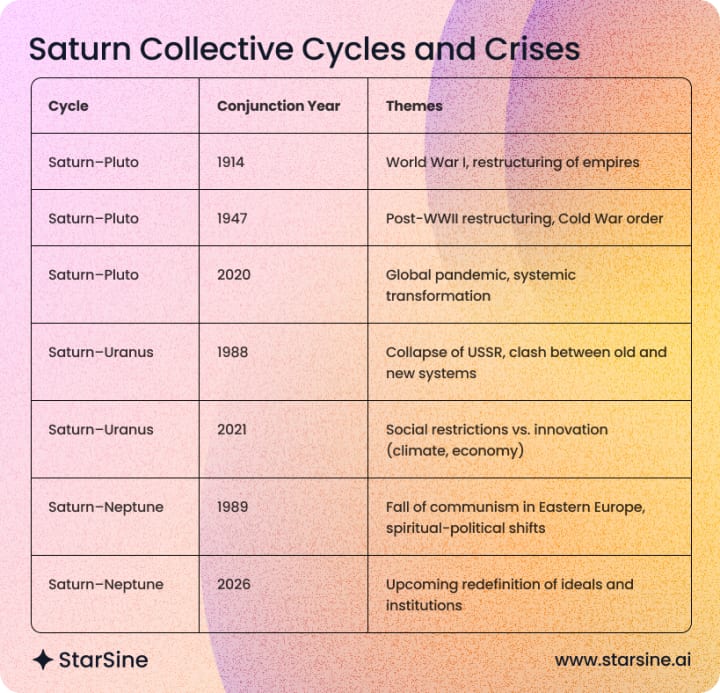
Saturn is not only personal; it also marks collective time. Its cycles with outer planets often correspond with major societal shifts.
- Saturn–Pluto cycles: linked to historical crises, restructuring, and rebirth (e.g., 1982 conjunction → economic shifts; 2020 conjunction → global pandemic and systemic transformation).
- Saturn–Uranus cycles: tension between tradition and revolution.
- Saturn–Neptune cycles: dissolution of structures, spiritual renewal, reimagining ideals.
Saturn teaches societies as much as individuals: civilizations, too, must confront limits, reorganize, and mature.
Living with Saturn Consciously
To live with Saturn is to accept that growth requires effort. We cannot bypass time, skip struggle, or ignore responsibility. But Saturn’s lesson is not cruelty—it is dignity.
- Face fears directly rather than avoid them.
- Build slowly, trusting that long-term effort yields lasting results.
- Respect limits as guides, not enemies.
- Honor cycles of time, recognizing that maturity cannot be rushed.
In personal astrology, Saturn offers the gift of resilience. In collective astrology, it offers the wisdom of patience.
Conclusion
Saturn may not bring the sweetness of Venus or the brilliance of Jupiter, but its gifts are lasting. Through Saturn, we learn that struggle shapes character, that time reveals truth, and that wisdom is born not from avoiding hardship but from embracing it.
Saturn is not the enemy—it is the patient mentor that shows us how to grow into the person we are meant to become. To learn where your Saturn is in your birth chart you can get it for free in StarSine.
About the Creator
StarSine
StarSine is a digital astrology platform bringing zodiac insights, playlists, and modern interpretations of the birth chart to curious readers around the world. You can see my website: starsine.ai
Day 4 of Quitting
If this is how sobriety feels, maybe it’s better to go through life a little buzzed… this, along with other hits like, I want to kill myself, I wish I was dead, and I’m going to throw myself off a bridge have been the only thoughts on rotation these past few days. I promise myself that if, in a month, I still feel like this (‘this’ meaning despondent, full of rage, and simultaneously numb) I can go back to smoking. Until mid-February though? Nicotine is off the table.
By sleepy drafts11 days ago in Longevity


Comments
There are no comments for this story
Be the first to respond and start the conversation.