
Mexico Point of Care Diagnostics Market Size and Forecast 2025–2033
Rapid Testing at the Frontline of Healthcare Transformation

Mexico Point of Care Diagnostics Market Outlook
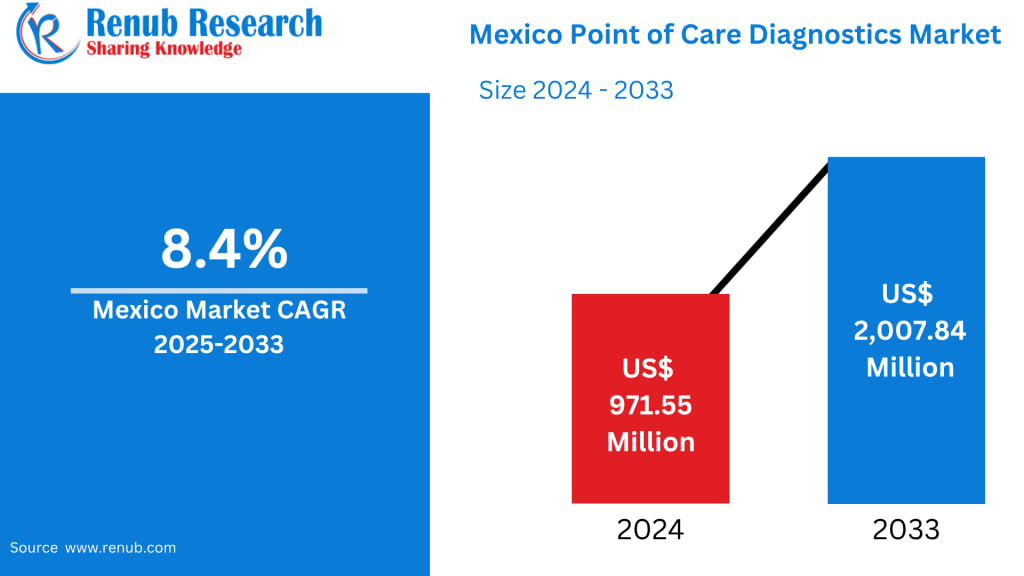
The Mexico Point of Care Diagnostics Market is entering a phase of sustained expansion as the country’s healthcare ecosystem increasingly prioritizes speed, accessibility, and early diagnosis. According to Renub Research, the market was valued at US$ 971.55 million in 2024 and is expected to reach US$ 2,007.84 million by 2033, growing at a CAGR of 8.4% from 2025 to 2033.
This strong growth trajectory reflects a convergence of critical factors, including the rising prevalence of chronic and infectious diseases, the demand for rapid diagnostic results, and the expansion of healthcare services into rural and underserved regions. Point of Care Diagnostics (POC) have emerged as a vital solution, enabling healthcare providers to perform tests at or near the patient location, significantly reducing diagnostic delays and improving clinical decision-making.
In Mexico, where healthcare access remains uneven across regions, POC diagnostics play a transformative role by decentralizing testing services and strengthening frontline healthcare delivery.
Mexico Point of Care Diagnostics Market Overview
Point of Care Diagnostics refers to medical testing conducted outside traditional laboratory settings, such as hospitals, clinics, pharmacies, ambulances, or even patients’ homes. These tests provide fast and actionable results, allowing physicians to initiate treatment immediately.
In Mexico, the growing burden of diabetes, cardiovascular diseases, infectious illnesses, and maternal health challenges has intensified the need for timely diagnostics. Urban hospitals are adopting POC technologies to reduce patient congestion and turnaround times, while rural healthcare centers rely on them to overcome infrastructure limitations.
The COVID-19 pandemic further accelerated adoption, highlighting the importance of rapid, decentralized testing during public health emergencies. As a result, POC diagnostics are no longer viewed as supplementary tools but as essential components of modern healthcare systems.
Additionally, the integration of telemedicine, mobile health platforms, and digital diagnostics is enhancing the reach of POC devices across Mexico, enabling remote monitoring and improved patient outcomes.
Key Factors Driving the Mexico Point of Care Diagnostics Market Growth
Rising Prevalence of Chronic Diseases
Mexico faces a growing epidemic of chronic illnesses such as diabetes, hypertension, and cardiovascular disease, which continue to place immense pressure on the healthcare system. Diabetes alone affects millions of Mexicans and requires frequent glucose monitoring and long-term disease management.
According to national health statistics, cardiovascular diseases have emerged as the leading cause of mortality, surpassing cancer, COVID-19, and diabetes combined in recent years. This alarming trend has increased demand for real-time diagnostic monitoring, a need effectively met by POC devices.
Point of care glucose monitors, lipid analyzers, coagulation testing systems, and cardiometabolic monitoring kits allow patients and healthcare professionals to track health parameters regularly, improving disease control and reducing hospital admissions.
Government Initiatives to Strengthen Disease Surveillance
The Mexican government has intensified efforts to improve public health preparedness and early disease detection, especially following the COVID-19 pandemic. National healthcare reforms emphasize preventive care, decentralized diagnostics, and universal health coverage.
The expansion of the IMSS Bienestar program aims to provide free healthcare services to over 53 million uninsured citizens, particularly in rural and marginalized communities. This initiative includes:
Completion of previously unfinished hospitals
Deployment of 24/7 surgical teams in rural facilities
Investment in diagnostic infrastructure
POC diagnostics align perfectly with these objectives by enabling rapid testing in resource-limited settings, improving maternal health outcomes, controlling infectious diseases, and strengthening epidemiological surveillance.
Growing Demand for Rapid and Decentralized Testing
One of the strongest growth drivers for the Mexico Point of Care Diagnostics Market is the rising need for immediate test results. Traditional laboratory diagnostics often involve long wait times, sample transportation, and logistical constraints.
POC diagnostics address these challenges by delivering results within minutes, making them particularly valuable in:
Emergency departments
Primary healthcare clinics
Rural health posts
Mobile medical units
During infectious disease outbreaks, rapid testing plays a critical role in containment and treatment decisions, further boosting demand for POC solutions. Urban healthcare facilities are also adopting POC devices to enhance patient throughput and reduce diagnostic bottlenecks.
Challenges in the Mexico Point of Care Diagnostics Market
Lack of Awareness and Education
Despite their advantages, POC diagnostics face adoption challenges due to limited awareness among patients and healthcare professionals, especially in rural regions. Many practitioners remain unfamiliar with newer POC technologies and their diagnostic accuracy.
Similarly, patients may not actively seek POC testing due to a lack of understanding about its benefits. Addressing this challenge requires education campaigns, training initiatives, and outreach programs to promote trust and utilization of POC diagnostics across healthcare settings.
Limited Training for Healthcare Providers
Proper use and interpretation of POC diagnostic devices require technical expertise and standardized procedures. In many underserved areas, healthcare workers lack formal training in operating these devices, increasing the risk of inaccurate results.
Without adequate training, the full potential of POC diagnostics cannot be realized. Investment in capacity-building programs, workshops, and digital training modules is essential to ensure accurate testing and improved patient outcomes.
Recent Developments in the Mexico Point of Care Diagnostics Industry
In 2024, the Mexican government launched a door-to-door senior healthcare initiative, deploying medical teams to visit elderly citizens at home. The program focuses on:
Routine health screenings
Early disease detection
Basic medical treatment
This initiative significantly boosts the demand for portable and easy-to-use POC diagnostic devices, particularly in rural and underserved communities where elderly patients face mobility challenges.
Such programs highlight the growing role of point of care diagnostics in community-based healthcare delivery.
Mexico Point of Care Diagnostics Market Segmentation
By Product
Glucose Monitoring Kits
Infectious Diseases Kits
Pregnancy & Fertility Testing Kits
Hematology Testing Kits
Cardiometabolic Monitoring Kits
Urinalysis Testing Kits
Cholesterol Test Strips
Drugs of Abuse Testing Kits
Others
Glucose monitoring kits dominate the market due to Mexico’s high diabetes prevalence, while infectious disease kits continue to gain traction.
By Technology
Lateral Flow
Agglutination
Flow Through
Solid Phase
Biosensor
Others
Lateral flow technology remains widely used for its affordability, simplicity, and rapid results, particularly in pregnancy and infectious disease testing.
By Mode of Prescription
Prescription-Based Devices
Over-the-Counter (OTC)-Based Devices
OTC-based devices are gaining popularity due to increasing health awareness and the shift toward self-monitoring and home-based care.
By End Users
Professional Diagnostic Centers
Research Laboratories
Home Care
Others
Home care is emerging as a high-growth segment, supported by aging demographics, chronic disease management needs, and telehealth integration.
Competitive Landscape: Company Analysis
The Mexico Point of Care Diagnostics Market is moderately consolidated, with global players competing alongside regional distributors. Key companies covered include:
Sysmex
Abbott Laboratories
Becton Dickinson and Company
Danaher Corporation
Quidel Diagnostics
F. Hoffmann-La Roche Ltd
Thermo Fisher Scientific Inc.
Bio-Rad Laboratories Inc.
Key Focus Areas of Leading Players
Product innovation and miniaturization
Expansion of distribution networks
Strategic partnerships with healthcare providers
Investment in training and awareness programs
Global manufacturers are increasingly tailoring products to meet Mexico’s regulatory environment and healthcare infrastructure needs.
Future Outlook: What Lies Ahead
The Mexico Point of Care Diagnostics Market is set to play a central role in reshaping the country’s healthcare delivery model. As healthcare policies emphasize prevention, early diagnosis, and decentralized care, POC diagnostics will become indispensable.
Technological advancements in biosensors, digital connectivity, and molecular diagnostics are expected to enhance test accuracy and expand applications. Combined with government initiatives and growing patient awareness, these trends position the market for long-term growth.
Final Thoughts
The Mexico Point of Care Diagnostics Market represents a compelling growth opportunity driven by rising disease burden, healthcare reforms, and the demand for faster, more accessible diagnostic solutions. With the market projected to more than double by 2033, point of care diagnostics are poised to become a cornerstone of Mexico’s evolving healthcare landscape.
As innovation continues and access expands, POC diagnostics will not only improve clinical outcomes but also contribute to a more efficient, inclusive, and resilient healthcare system across the country.
About the Creator
Diya Dey
Market Analyst
Day 4 of Quitting
If this is how sobriety feels, maybe it’s better to go through life a little buzzed… this, along with other hits like, I want to kill myself, I wish I was dead, and I’m going to throw myself off a bridge have been the only thoughts on rotation these past few days. I promise myself that if, in a month, I still feel like this (‘this’ meaning despondent, full of rage, and simultaneously numb) I can go back to smoking. Until mid-February though? Nicotine is off the table.
By sleepy drafts4 days ago in Longevity
United States Endobronchial Ultrasound Biopsy Market Size and Forecast 2025–2033
United States Endobronchial Ultrasound Biopsy Market Overview The United States Endobronchial Ultrasound (EBUS) Biopsy Market is poised for steady growth over the next decade as healthcare providers increasingly prioritize minimally invasive diagnostic solutions. According to Renub Research, the market is expected to expand from US$ 246.82 billion in 2024 to US$ 356.2 billion by 2033, registering a compound annual growth rate (CAGR) of 4.16% from 2025 to 2033.
By Marthan Sir2 days ago in Longevity
Bruce Lee and The God of War: Kuan Ti
It starts with love.. The Power to the God Of War and Wealth Walk into a Chinese restaurant (even in Oklahoma, USA), a Chinese police station, a kung fu martial arts studio or even a Chinese temple and you often see a red faced warrior holding a heavy quan-do (spear like weapon).
By WILD WAYNE : The Dragon King4 days ago in Chapters


Comments
There are no comments for this story
Be the first to respond and start the conversation.