
How Do You Decide Which Training Program Is Going to Give You Maximum Gains? (Part 2)
This is the Part 2 of the two part series about how to decide which training program is going to give you maximum gains.

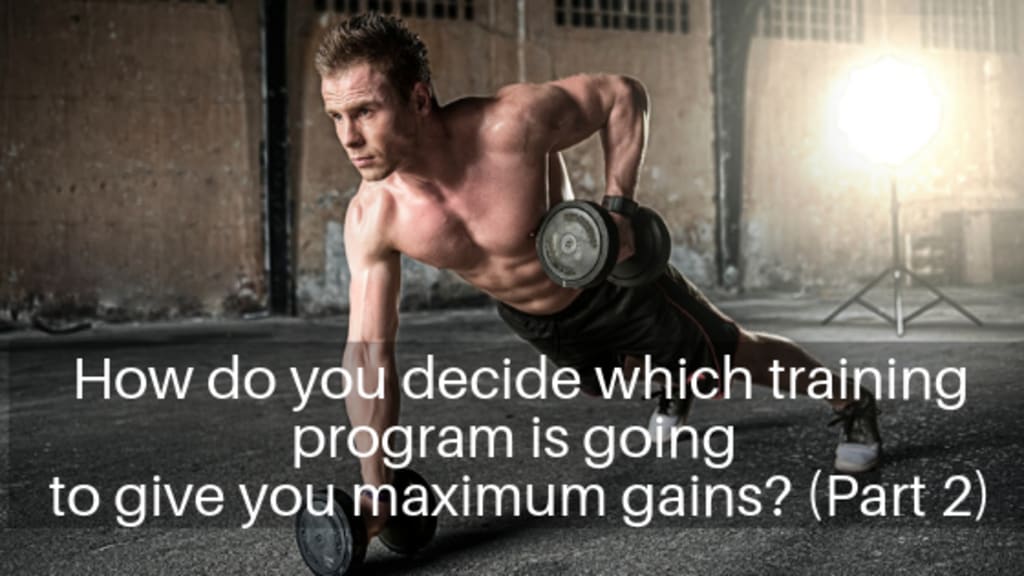
In this part I'm going to give you information about High Intensity Training.
High-Intensity Training Principles
Johnnie Jackson HIT (High Intensity Training) consists of doing one all-out, balls-to-the-wall set of three to eight reps using maximum weight.
HIT training also includes forced reps, negatives, and partial reps to push the limits of muscular failure.
The theory behind HIT is that by going beyond muscular failure, you will be creating enough muscle damage and stress to rapidly stimulate muscle growth. The HIT principle relies on elements of the progressive overload theory, which involves the continual increasing of weights for each workout.
By increasing the amount of weight moved, two physiological actions occur. The first is the increased neurological recruitment in the muscle itself. Every muscle fiber contains a motor neuron connected to the motor unit. By overloading the muscle during heavy weight training, you develop and recruit more motor units.
Now you're probably wondering what this has to do with building muscle. In fact, this is extremely important, because the more motor units and neurons you can recruit, the stronger you will become.
The second physiological action that occurs is the thickening of the muscle fibers themselves. When the muscle is overloaded, the actin and myosin filaments found within the muscle fibers are put under a lot of stress.
When this occurs, the muscle will adapt to that stimulus by becoming thicker, or, in other words, growing bigger. Now you know why countless bodybuilders love this program so much, because they are able to build super-dense muscle, and become as strong as an ox at the same time.
The HIT program has extremely long periods of recovery between training sessions anywhere from four to ten days. So if you trained arms on a Monday, you wouldn't train arms again for another four to ten days.
During HIT sessions, the intensity is extremely high. The fact is, you are trying to move maximum weight every set. This can cause extreme mental fatigue, due to the overwhelming amount of focus and concentration required to move such massive poundage.
HIT does have its benefits, though. The big one is that you won't be in the gym pounding the weights for hours. The sessions are fierce, but they're quick. Generally, HIT sessions can be completed in less than an hour.
Many bodybuilders who preach HIT training believe that your muscles will be shocked into growth every time you train, because of the extreme intensity and stress placed on the muscle.
As this is a very high intensity training, you should regularly consume the proper amount of water everyday.
Also you should drink pure water purified by a non-electric water purifier. Here is a list of the best water purifier for borewell water.
Pros and cons of each training theory
Pros
- Hits muscles from every angle possible
- Gorges the veins with blood via huge muscle pumps
- Maximizes muscle stimulation
- Taxes the muscle to exhaustion
- Saves time with shorter, more intense workouts
- Accounts for recovery time between workouts (four to ten days)
Cons
- Is extremely extensive and requires a lot of time to complete
- Can lead to over-training
- Is physically fatiguing
- Provides only a minimal pump
- Can leave bodybuilders unfulfilled and feeling the workout isn't extensive enough
- Has only limited exercises available
- Is mentally fatiguing
What Is the Next Logical Step?
According to Branch Warren and Johnnie Jackson implementing these training theories isn't hard; however, choosing one can be. The best way to assess if these training theories will work for you is to experiment with them.
You can find more HVT and HIT routines in many different bodybuilding publications, as well as on the web. Follow some routines, and give your body at least six to eight weeks to see results. Record your gains in muscle size by using a tape measure, and also by measuring your body-weight.
The key here is to listen to your body to figure out which program is right for you. You might find that certain body parts respond better to one program, while others respond better to the other.
If this happens, you can create a hybrid program that incorporates both. Bodybuilders will debate these two theories forever.
However, the only way you'll know which one works best for you is to try them for yourself.
About the Creator
Akash Sharma
Akash Sharma is a blogger from India. He like to write on various topics like parenting, family, health, child care etc.
Keep reading
More stories from Akash Sharma and writers in Longevity and other communities.
Day 4 of Quitting
If this is how sobriety feels, maybe it’s better to go through life a little buzzed… this, along with other hits like, I want to kill myself, I wish I was dead, and I’m going to throw myself off a bridge have been the only thoughts on rotation these past few days. I promise myself that if, in a month, I still feel like this (‘this’ meaning despondent, full of rage, and simultaneously numb) I can go back to smoking. Until mid-February though? Nicotine is off the table.
By sleepy drafts9 days ago in Longevity
Global Anemia Treatment Market Analysis (2025–2033): Innovation, Access, and the Next Phase of Patient Care
Introduction Anemia, a condition marked by a shortage of healthy red blood cells or hemoglobin, remains one of the most widespread public health challenges worldwide. Affecting people across age groups and geographies, anemia reduces the blood’s capacity to carry oxygen, leading to fatigue, weakness, and in severe cases, life-threatening complications. While once considered primarily a nutritional disorder, modern medicine now recognizes anemia as a complex clinical condition tied to chronic diseases, genetic disorders, infections, and healthcare access.
By jaiklin Fanandish8 days ago in Longevity
Miss Persephone's Manual to a Seemingly Ordinary Life
Miss Persephone was found at the dining table, her blue eyes swollen, her tears arriving and retreating like the tides of the ocean. Earlier that day, her family had visited her in the retirement home where she had lived for eight years. It was her eightieth birthday.
By Imola Tótha day ago in Fiction


Comments
There are no comments for this story
Be the first to respond and start the conversation.