
Help for the Fake Self-Help Industry
The paradoxes of self-improvement

Is it possible that the self-help industry is still in existence?
This industry is certainly thriving. For example, self-improvement sections in bookstores are often larger than those for philosophy, religion, and psychology.
Medium's top publications deal with technology, startup development, and self-improvement. The magazines "The Mission", "Personal Growth," and "Better Humans" have more than 100 thousand followers, with some cases hundreds of thousands. Subgenres of self improvement include "The Startup", "Startup Grind", and "The Writing Cooperative". The top three Medium tags include "startup," life, and lessons.
(Although some of those numbers are a bit fuzzy, they don't necessarily reflect the number viewers who have read the articles. This is evident from the low for many articles published in these allegedly popular forums. These are still public indicators.
Oh, and the US self-help industry was valued at more than $10 billion in 2021 .
How could there possibly be a need for such advice? Who could provide the best guidance for those who are in dire need?
The paradoxical need for self-help products
Some market researchers stated that "the average purchaser of self-help products is an affluent female between 40 and 50 years old, living either on the East Coast of the West Coast." They are also expected to replace the baby boomers as primary consumers.
This industry is paradoxical in the sense that the people who need the most guidance to improve themselves are the older rural residents . They are either too poor to afford it, too old to change, too busy with their jobs, too religious, or are victims of the DunningKruger effect.
People who are content to read self-help articles, books, and seminars don't seek advice about how to solve their problems. They are doing fine in neoliberal terms if they have the time and self-absorption to read or watch this material.
They want validation, reassurance and flattery instead. They want confirmation that they are doing the right thing. While it is true that a perfect person would not need such assurance, the advice offered isn't about perfection. It's about being comfortable with who you are. This industry isn't great at judging its participants.
Self-help providers are designed to soothe sensitive people who suspect that something is wrong in their lives, but don't want the responsibility of fixing it. These "gurus" can be described as savvy businessmen who provide easy, comforting solutions, tailored for wealthy consumers who want fast food for their soul.
However, this is not to suggest that middle-aged American women and Millennials don't face serious problems. These problems are structural. They're political, cultural, economic and existential. The self-help industry distracts from the harsh realities of materialism and neoliberal capitalism.
Fake wisdom: A strange and bizarre supply
who provide this type of advice are as unique as those who demand it. Imagine how difficult it is to give life advice to strangers. Or maybe you just pretend to be an expert and like to boss others around. So you become a specialist in telling people what to do.
Medium's self-help authors, for instance, don't appear to be licensed psychiatrists, psychologists or therapists. They are only freelance writers looking to make a living from a niche. They realize that human herds may be looking for cheap comfort via feel-good platitudes. This audience also craves distractions. They want self-help pseudoscience and fantasy that look like the Food Channel's fancy dishes, which most viewers don't bother to try.
Self-help writers are aware that they can only pretend to be experts since the readers are also pretending to need it. This illusion is a classic Folie a Deux, a mass hallucination propped up a systemic fraud.
Ask yourself this question: Would you go online to seek advice on life if you really needed it? How deep must the self-deception have to be for readers to desire such advice without realizing that they are likely to be wealthy enough to be able to help others.
What about the professional therapists who create this content? Surprisingly their involvement in this industry is equally inexplicable. These experts are known for their inability to psychoanalyze politicians from far away. This is the Goldwater rule and it's a well-accepted practice at the American Psychiatric Association.
However, the same logic applies to diagnosing anyone else. It is absurd that psychiatrists and therapists should be disinclined to only tampering with elections by giving advice based upon zero patient data. It's just as irresponsible for the public to be misled by such pretenses. The majority of people don't have the symptoms of cognitive or personal disorders on their sleeves.
How would honorable self-improvement look?
Is it possible to imagine a non-bizarre industry for self-help? Is it possible to disentangle all the above paradoxes in order to imagine a mass therapy that isn't a complete scam?
First, it would be important to ignore the whining of the upper class. At the very least, we wouldn't offer the superficial help these elites want. If we want to solve serious personal problems, then we would have to target those who believe they don't need it. In other words the advisor would need to tell the patient something they don't want. The legitimate therapy would not be an amusement or reinforcement of consumer narcissism.
The advisor will also want to prioritize the most serious problems. These are systemic and societal issues. These advisors would be involved in philosophy or some other form of social criticism. This might be done to mobilize support for a mass revolt to reform broken social systems that make us anxious, depressed and myopic or infantile.
The self-help industry, for example, would be seen as a manifestation of a cultural affliction. We strive to be perfect, because our desires are largely manufactured in parasitic industries. So we complain even though we're relatively secure and well-off, and our conspicuous consumption is the cause of grave suffering of the poor around the world and an unfathomable amount of animal species.
This diagnosis is not what most people want to hear. It amounts to an indictment about our liberal lifestyle. This is what we would expect from a self improvement industry that isn’t just a travesty. How sick would we be if we were happy to receive the diagnosis? Or, how timid and sycophantic might the advisors be to celebrate a sickculture with an array of flatteries?
We'd like to get rid of the charlatans and those who advise. We would also have to fire the therapists as they should only be giving advice in a clinical setting with detailed patient information.
The indictment would then be handed down to who? These cultural issues are not the domain of experts. Academics are a good choice, except that they rarely write for a general audience. Philosophers, theologians, and culture critics would be a good choice. They have knowledge of politics, history, business, and critical thinking and are able to simplify complex arguments and worldviews.
This would then be the result we see in real life: The sham self-help market would take over the more popular, rarer and more effective forms of guidance.
For example, philosophy would be a cult, and few people would want to read or write that much criticism. The fake-wisdom circus, mainly perpetrated by opportunists and poseurs for fake patients, would go viral. This is because our cultural problems have become so severe that we are able to allow ourselves to be fooled into believing that all we need to survive is more cotton candy.
About the Creator
Keep reading
More stories from Hank Franklin and writers in Longevity and other communities.
Do not live and love possessions, but live life.
The pursuit of pleasure has become a losing battle. Our obsession with possessions has made us more interested in the idea than the idea that we can live a full life. We have become addicted to the idea of owning, collecting, and shopping for possessions that serve no purpose.
By Hank Franklin4 years ago in Longevity
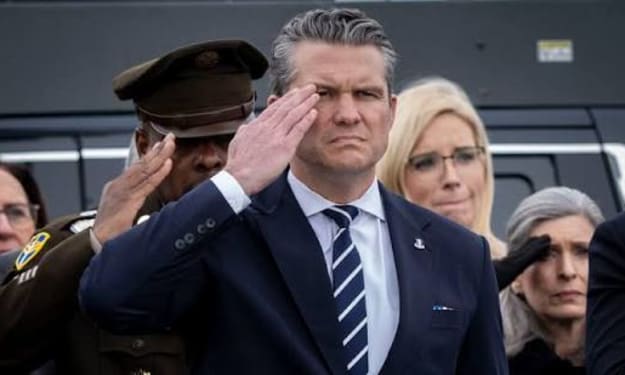
How Hegseth Came to See Moral Purpose in War as Weakness
An analytical exploration of the evolution of Pete Hegseth’s war ethos and the implications for U.S. policy Over the past decade, Pete Hegseth has undergone a dramatic transformation from conservative media personality to one of the most polarizing figures in American military policy. Today serving as the United States Secretary of Defense under President Donald Trump, Hegseth’s public pronouncements and strategic decisions suggest a worldview in which traditional moral frameworks surrounding war are increasingly dismissed as liabilities. What began as rhetorical emphasis on strength and combat readiness has evolved into a broader ideological stance that treats moral purpose in war—moral clarity, restraint, and adherence to legal norms—as signs of weakness rather than virtue. Hegseth’s rise to prominence began long before his appointment to the Pentagon. As a Fox News host and conservative commentator, he championed aggressive U.S. military action and frequently criticized what he saw as excessive political correctness. In his 2020 book American Crusade: Our Fight to Stay Free, he framed global conflicts in starkly moralistic terms, calling for a broad “crusade” against forces he characterized as hostile to Western civilization. This early rhetoric laid the groundwork for his later rejection of moral constraints on warfare, equating moral caution with lack of resolve. Once in office, Hegseth’s framing of war shifted further. In public briefings on the current U.S.-Iran conflict—dubbed Operation Epic Fury—he regularly emphasizes military dominance and operational success while refraining from articulating broader humanitarian or moral objectives. “We didn’t start this war but … we’re finishing it,” he told reporters, focusing on strategic outcomes like neutralizing Iran’s missiles and naval capability rather than advancing a clear moral purpose or vision for peace. Critics argue this shift reflects a deeper intellectual and ethical stance: that moral qualifiers in war make victory harder to achieve. Hegseth has disparaged established rules of engagement and what he calls “politically correct wars,” suggesting that adherence to international legal norms or concerns about civilian casualties constrains effective action. In comments widely circulated on social media, he reportedly scoffed at traditional rules designed to minimize harm, embracing instead a version of warfighting that prioritizes lethality over deliberation. In broader public discourse, commentators observe that Hegseth’s approach redefines moral purpose—not as a guiding principle that justifies violence only under strict conditions, but as a hindrance that dilutes the effectiveness of military force. This echoes a critical academic debate about the role of moral clarity in war: traditionally seen as essential to maintaining legitimacy and support, moral purpose now, in Hegseth’s framing, appears subordinate to the singular goal of “winning.” Analysts note that this perspective aligns with a broader trend in some conservative circles that equates restraint with weakness. Under this view, moral purpose—whether rooted in international law, humanitarian concern, or the protection of noncombatants—is often portrayed as undermining national strength and strategic advantage. Instead, proponents argue, moral restraint handicaps military operations by imposing constraints that adversaries do not accept or follow. Hegseth’s critics, however, warn that this logic risks eroding longstanding norms designed to limit suffering and uphold a rules‑based international order. The implications of this philosophical shift are substantial. On the battlefield, dismissing moral purpose can lead to decisions that escalate violence and damage alliances. Outside war zones, it raises questions about the U.S. commitment to global norms and its moral leadership. When moral restraint is reframed not as strategic prudence but as “weakness,” the boundaries that separate responsible military action from unchecked aggression become blurred. This evolution in Hegseth’s rhetoric and policy underscores a broader tension in American strategic culture: the balance between strength and ethics. While military potency is undeniably central to national security, history demonstrates that moral purpose in war—rules of engagement, protection of civilians, legal accountability—serves essential functions, both practical and normative. When war is waged without meaningful moral purpose, critics warn, it may achieve tactical objectives at the cost of long‑term strategic stability and international legitimacy. In redefining moral purpose as weakness, Hegseth embodies a school of thought that prizes power over principle. Whether this approach will prove effective—or whether it will deepen divisions and erode foundational norms of conduct in warfare—remains a pivotal question in U.S. defense policy.
By Fiaz Ahmed 2 days ago in Longevity



Comments
There are no comments for this story
Be the first to respond and start the conversation.