
Hawaiian Plants and Their Sustainability Uses
The Stories of Polynesian-Introduced Plants and Their Uses

Seven Plants We See in Hawaii
Hawaiians have traditionally used plants for food and medicine, describing the practice Laʻau Lapaʻau. Around UH Hilo campus alone, you will likely find seven plants that Hawaiians view as key for their first aid kits: Ki, or ti leaf; Awapuhi and ‘Olena; Noni; Niu; Hau; Mai’a; and Kalo.
Ki (ti leaf) - cordyline fruticosa
The Ti leaf plant grows wild throughout the tropical Pacific and Southeast Asia, having orginated in Asia and Australia. The earliest Polynesian settlers introduced this plant to Hawaiians. Hawaiians traditionally planted ti leaf, or “Ki,” around home and churches for good luck and protection from harm. Ki was also planted around the lo'I, or taro patch. Ki was considered sacred to Hawaii’s Gods Lono and Laka.
Kahu, or Hawaiian priests, have also traditionally used Ki to bless a person, a home, or otherwise significant place. The ti leaf has also been used to wrap foods or as a band aid over a wound. Wrap a damp ti leaf around the forehead to relieve headaches or a fever. Drink the water from boiled green ti leaves for nerve and muscle relaxation. The young ti leaf are used for eye drops.
Ti leaves have been used for clothing — as hula skirts, or pa'u, and as rain capes. Ti leaves have been used to make rope and lei. The leaves are also used as party decorations. They cover the luau (party) tables and are the greenery in floral arrangements.
The pleasantly fragrant flowers of ti leaves are used for asthma. Also, children have used the shoots of the ti leaf to make whistles. The ti leaf and plant is common, and everyone recognizes throughout Hawaii nei. Ti leaf is not only used by Hawaiians, but also Tahitians, Samoans, Melanesians, Polynesians, and Micronesians.
Noni – Morinda citrifolia
People believed Noni was brought here centuries ago by Polynesian settlers. Noni is a native of the Pacific Islands, Asia, and Australia. This plant grows in anywhere where there is sun and the fruits can bloom. The noni is diluted to make medicines to treat diabetes, heart troubles, and high blood pressure. Noni is also thought to cure other illnesses, including cancer, especially skin cancer. Noni has traditionally been served as a drink, before eating food, with a blessing by a Kahu of Laʻau Lapaʻau, or a doctor of natural medicine. It is best to drink it naturally, but in reality, people drink it with mixed juices. Young noni is believed to cure broken bones and muscle aches. Pound the noni and cover affective areas, and wrap them with ki. Leave on for 30 minutes or longer. Although the smell can be pungent, Hawaiians believe that the very reference to the noni’s smell could exacerbate existing health problems. Also, the noni juice is used to get rid of ukus (lice), and should be applied to the hair with ginger shampoo, or water. Noni is a kinolau (physical manifestation) of Kū, the Hawaiian god of war. Hawaiians have added noni in the bath tub with warm water to relieve mosquito bites. It has also been used to extract sickness, or even hewa (bad trouble) from a person. Noni will always be the main medicine in Kahuna Lāʻau lapaʻaū. Today, Americans use this plant as an energy drink, mixed up with mango, coconut, green tea and presented as a smoothie. They sell noni for “immunity” and “energy.”
Niu — (Coconut) Cocos Nucifera
Coconut originated from Polynesia, and is the most easily recognized, best-known palm in the world. Traditionally, coconut palm is planted at the birth of kamaʻāina. The palm is the most useful plant of the tropics. The coconut fruit can be drunk, and the meat inside can be eaten. The coconut has been used for shampoo, skin care, and to make crafts and implements (for hula). The coconut shell can be a bowl, or a hula dancer’s bra. Palm fronds have been used for house thatching, hats, baskets, furniture, mats, cordage, clothing, charcoal, brooms, fans, and ornaments.
Hawaiians recommend chewing the meat of the coconut to aid with indigestion or constipation. Hawaiians makes haupia, a dessert from coconut meat and juice. Donʻt drink too much of the coconut water, Hawaiians say, or you’ll get diarrhea. The bark of the palm tree is used to make a pahu, or drum for hula. Hawaiians believe that the coconut is a symbol of a love. The coconut tree husk is used as a “Shoo away hand broom” to cast away negative energy. Coconuts are not only used by Hawaiians, but also Tahitians, Samoans, Filipinos, Thai, Chinese, and Americans.
Hau — Hibiscus Tiliaceus
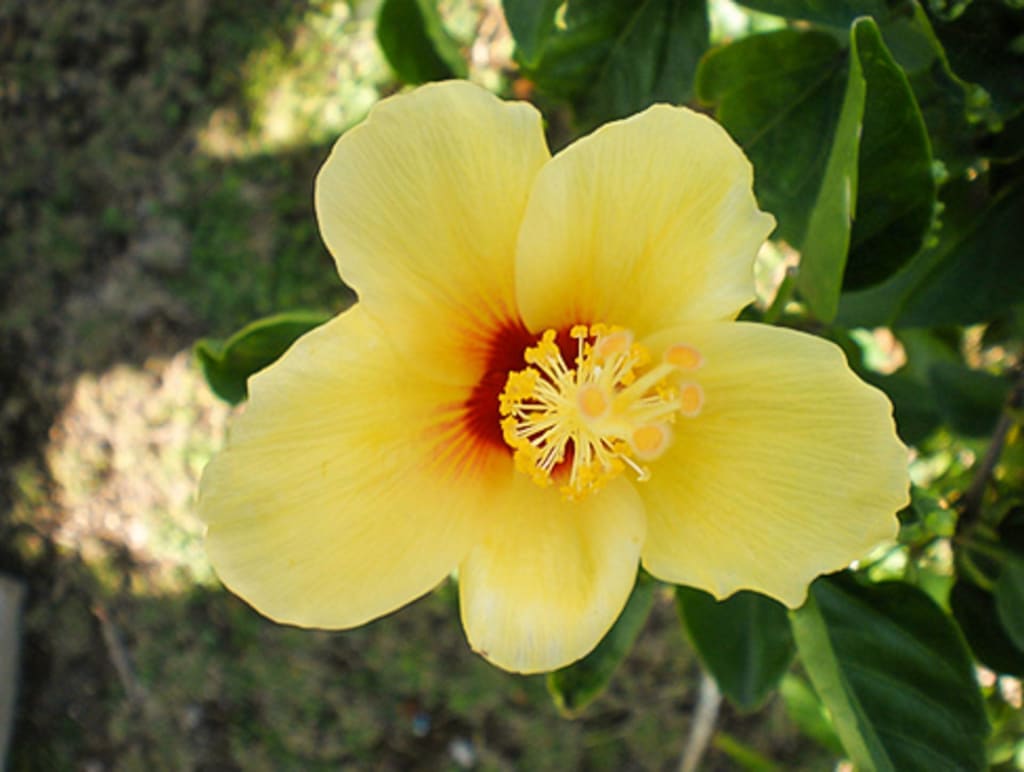
Hau grows wild in all Pacific areas, including, Melanesia, Micronesia, and Polynesia. Hau is often used for make canoe outriggers. Traditionally, Hau was planted along the shoreline where fishing was kapu (forbidden). Cork-like Hau wood pieces have been used as floats on fishnets; its soft wood has also been used to make flower. The flower is a true hibiscus. Slimy juicy saps found in the dome of the flower bud and in the bark have been used as medicine. The buds of the flowers are chewed and eaten for a dry throat. The bark has been used for chest congestion. Hau has also aided in childbirth. Hau, according to Hawaiian mythology, is the sister of Hina. Tahitians believe that Hau is the grandchild of Heaven and Earth. Hau represents transitory nature of human life.
Mai'a — Banana- Musa paradisiaca
The banana originated from India, but has traditionally been a staple food for Hawaiians, having been brought here in the earliest canoes of Polynesian settlers. The banana has been at the heart of myths, and was said to have been a plant that grew in the biblical Garden of Eden. The banana is a considered essential to Pacific island life. There are many uses for the banana tree. Bananas are considered high quality good source of potassium and vitamins A, B and C. They are all fair source phosphorus and contain some calcium and iron. Bananas were kapu for a woman to eat under penalty of death until early of 1800s. The peel of the banana has been used for skin rashes and bites, since there are oils and minerals on the peel. Banana leaves are used for roof of the houses, raincoats, hats, imu covers, tablecloths, lei needles and as temporary mats. The dried trunk is used to support a person with a fractured limb. Medicinally, bananas have been used for asthma, and the ripe banana fruit peel can be smashed and taken for constipation. The peel of ripe bananas can be pounded and used as an antibiotic for open cuts and skin care. Samoans cook Vazhaipoo, a type of curry that is one of their staple dishes, out of bananas.
Kalo — Taro-Colocasia Esculenta Antiquorum
Kalo grows wild only in Hawaii, having originated from the Hawaiian people and their ancestral Polynesian settlers. Hawaiians believe that kalo, or taro, formed from the first born son of sky father Wākea and Ho'okūokalani, Papa and Wākea’s daughter. Halōanakalaukapilili was actually a stillborn that the couple buried, and kalo grew from the burial site. Kalo grows in a Lo'I, or taro patch. The taro patch needs lots of water and a clean pond of mud. Hawaiians consider kalo to be the greatest life force of all foods. There are many uses for Kalo plants. It must be fully steamed cook. Kalo is used to make such dishes such as as poi and kūlolo, which are chunks of kalo mixed with sugar cane. Today people make taro chips that are similar to potato chips. The leaf and stem are used to make fish lau lau. The leaf is similar to spinach. The kalo leaf was traditionally used as a healing medicine for deep big wounds.
Awapuhi (ginger) and ‘Olena (Turmeric) — both members of Zingiberaceae family
Both plants originated in India, and circulated throughout Polynesia, introduced to these islands by early settlers. The Hawaiians uses leaves and stalks of both ginger and turmeric, which are both fragrant, used for baking in the imu (underground oven). The spicy and smelling roots have many uses — crushed ginger and turmeric have been used for toothaches, stomach aches, and in spa care. Ginger regrows hair on bald spots. The sap of both ginger and turmeric relieves pain in ear. The ginger flower was used as hair decorations and leis for hula dancers. Ginger and turmeric are also used as spices for dishes, and beverages like teas. People use ginger and turmeric to soothe sore throats and other sickness. ʻOlena has a yellow color root that can dye tapa cloths. Since both ginger and turmeric come from the same family, they are considered one.
About the Creator
Keep reading
More stories from writers in Longevity and other communities.
Day 4 of Quitting
If this is how sobriety feels, maybe it’s better to go through life a little buzzed… this, along with other hits like, I want to kill myself, I wish I was dead, and I’m going to throw myself off a bridge have been the only thoughts on rotation these past few days. I promise myself that if, in a month, I still feel like this (‘this’ meaning despondent, full of rage, and simultaneously numb) I can go back to smoking. Until mid-February though? Nicotine is off the table.
By sleepy drafts12 days ago in Longevity
5 Vegetables Hidden in Your Kitchen That Act Like Natural Penicillin
In 1928, Alexander Fleming returned from a holiday to find a mold growing in a petri dish that had killed the surrounding bacteria. That happy accident gave the world penicillin, a discovery that revolutionized modern medicine. But long before we had convenient blister packs and pharmacy counters, nature was already providing us with its own potent defense mechanisms.
By Health For You3 days ago in Longevity
How to Succeed at the Benson Directory®
Congratulations and welcome to the Benson Directory® employee #22391! As our newest call handler, you will have the privilege of speaking with dozens of unique and interesting people on a daily basis as well as the opportunity to earn bonuses for high performance. Contained within this handbook you will find a set of ease to follow instructions designed to help you settle in to your new role and begin paving the way to success.
By S. A. Crawford3 days ago in Fiction




Comments
There are no comments for this story
Be the first to respond and start the conversation.