
Europe Infant Formula and Baby Food Market Size & Forecast 2025
A Rapidly Expanding Market Driven by Premiumization, Working Parents, and Nutritional Innovation

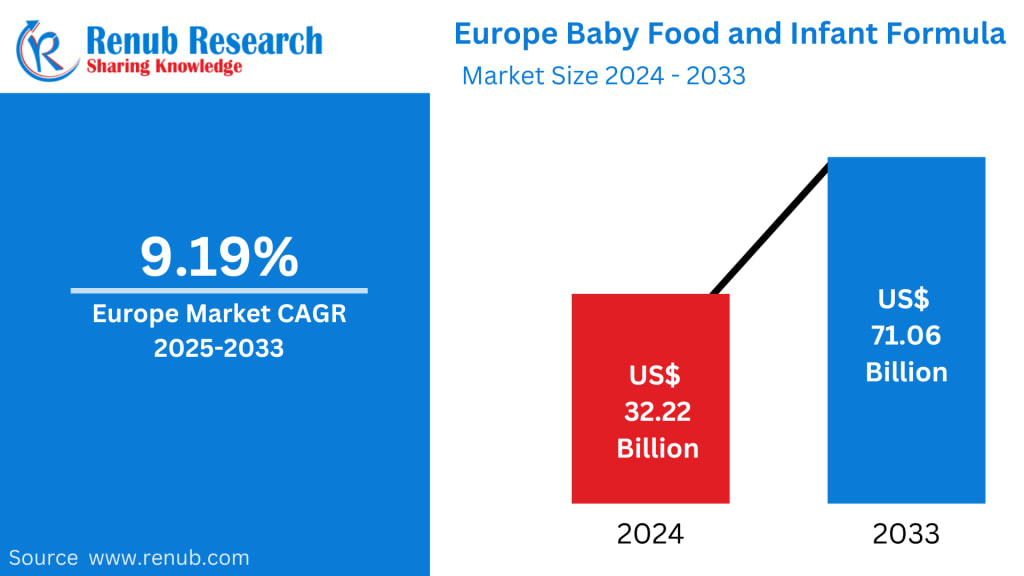
The Europe infant formula and baby food market is undergoing a dynamic transformation—shaped by changing parental lifestyles, increasing nutrition awareness, rapid retail expansion, and a strong shift toward organic, clean-label products. According to Renub Research, the market—valued at US$ 32.22 billion in 2024—is projected to more than double, reaching US$ 71.06 billion by 2033, registering an impressive CAGR of 9.19% between 2025 and 2033.
This steep rise reflects Europe’s evolving consumer landscape, where parents are prioritizing convenience without compromising nutritional integrity. The surge in working mothers, the adoption of premium and customized formulas, and heightened trust in regulated baby nutrition products have collectively strengthened market momentum.
Below is an in-depth look at the major drivers, challenges, segment insights, and country-level dynamics shaping Europe’s booming baby food and infant formula industry.
Europe Baby Food and Infant Formula Market Outlook
Baby food—ranging from pureed fruits, vegetables, cereals, snacks, and ready meals—and infant formula—scientifically crafted to replicate breast milk—play a vital role in modern childcare across Europe. With stricter European Food Safety Authority (EFSA) regulations ensuring high quality, parents increasingly rely on formula and packaged baby food either to supplement or replace breastfeeding, especially in dual-income households.
The region is witnessing strong adoption of nutritional innovations like prebiotics, probiotics, plant-based proteins, lactose-free formulations, organic ingredients, and allergen-friendly blends. The ongoing shift toward transparency and sustainability has also pushed brands to focus on eco-friendly packaging and cleaner supply chains.
Key Growth Drivers in the Europe Baby Food & Infant Formula Market
1. Rising Demand for Organic and Natural Baby Products
European parents are more health-conscious than ever, displaying a strong preference for organic, non-GMO, preservative-free, and minimally processed baby food. Concerns over artificial additives, pesticides, and allergens have led many to shift toward trusted organic brands.
The organic trend is now mainstream—and manufacturers are racing to innovate.
A major example came in September 2024, when Bobbie, a female-founded pediatric nutrition company, expanded its USDA Organic, European-style formulas into 500 Whole Foods Market stores across the U.S., signaling global momentum for high-quality organic infant formula and the rising appeal of European standards. Such launches reinforce Europe’s reputation for strict quality assurance in baby food production.
2. Increasing Workforce Participation Among Women
The rise of working mothers is one of the strongest catalysts driving demand for ready-to-use baby food options. With less time for breastfeeding or preparing homemade baby meals, European families turn to formula, pouches, cereals, and pre-prepared meals.
According to Eurostat data from 2024, the EU gender employment gap remains at 10.7 percentage points, yet more women enter the workforce annually. Nations like Lithuania and South Finland already report higher female employment rates than men—indicating a societal tilt toward dual-income households and consequently, convenience-driven childcare solutions.
As more women achieve financial independence, demand for reliable baby food brands—especially premium and specialized formulas—continues to rise.
3. Technological Advancements in Product Formulation
Europe remains a global leader in next-generation infant nutrition technologies.
Innovations include:
Human milk oligosaccharides (HMOs)
Probiotics & prebiotics
Plant-based protein blends
DHA- and ARA-enriched formulas
Allergen-friendly and hypoallergenic solutions
These improvements bring formula closer to mimicking the nutritional structure of breast milk and appeal to parents seeking scientifically validated nutrition.
A notable example occurred in July 2022, when Organix, a U.K.-based organic baby food company, launched 29 new products, including Baby Meals and the Organix Kids range. The company’s expansion demonstrates how innovation continues to fuel market competitiveness.
Key Market Challenges
1. Tight Regulatory Requirements
Europe’s baby nutrition sector is one of the most strictly regulated globally—ensuring unparalleled safety but also increasing operational costs for manufacturers. Small and mid-sized brands often struggle to meet stringent EFSA, national food authority, and organic certification standards, which can slow innovation and restrict market entry.
While regulations protect consumers, they also create barriers that may limit product diversity.
2. Consumer Mistrust and Safety Concerns
Past product recalls and contamination incidents have led some parents to remain cautious. Trust is essential in the baby food sector—brands must prioritize:
Transparent ingredient lists
Rigorous quality control
Sustainable sourcing
Honest communication
Companies that fail to maintain these standards face long-term reputational damage.
Segment Analysis of the Europe Infant Formula & Baby Food Market
1. Milk Formula
Milk formula remains the backbone of Europe’s infant nutrition ecosystem. Various formulations—starting, follow-on, and toddler milk—ensure proper nourishment for every developmental stage. Continuous innovation in lactose-free, goat-milk-based, and plant-based formulas is expanding the segment further.
2. Dried Baby Food
Dried cereals, porridges, and powdered fruit and vegetable mixes remain highly popular due to their shelf life, nutrient fortification, and ease of preparation. With busy lifestyles, parents often prefer these options for quick yet nutritious meals.
3. Prepared Baby Food
Ready-to-eat meals, pouches, and jars are rapidly gaining traction. These foods offer maximum convenience for on-the-go families and align perfectly with modern eating habits.
4. Others (Snacks, Finger Foods, Specialized Diets)
This segment includes fast-emerging products such as:
Organic puffs and teething snacks
Allergen-friendly blends
Vegan or vegetarian infant foods
Gut-health or immune-boosting nutritional products
This category is expected to expand significantly as parents embrace diversified nutrition.
Distribution Channel Insights
Supermarkets and Hypermarkets
Still the leading distribution channel, supermarkets offer accessibility, wide product assortments, and competitive pricing. Families often prefer these outlets for bulk purchases and the convenience of one-stop shopping.
Pharmacies
Pharmacies dominate the specialized nutrition segment. They offer:
Hypoallergenic formulas
Medical or doctor-recommended alternatives
Lactose-free and allergen-specific options
Parents trust pharmacy brands more for sensitive infant needs, especially in cases of dietary restrictions.
Convenience Stores
As European lifestyles grow busier, convenience stores increasingly serve as quick-access points for emergency formula purchases and ready meals. This segment is particularly strong in urban regions.
Online & E-Commerce (Growing Rapidly)
While not explicitly separate in traditional segmentation, online sales are skyrocketing—driven by subscription models, doorstep delivery, and wider product variety.
Country-Level Market Overview
1. Germany
Germany stands as one of Europe’s leading baby food markets, driven by rising disposable incomes, urban lifestyles, and strong consumer trust in regulated nutrition.
A pivotal development occurred in 2022, when Danone launched a plant-and-dairy blend infant formula catering to vegetarian and flexitarian families—reflecting the country’s shift toward plant-forward feeding.
2. France
France’s strong culinary culture extends to infant nutrition. French parents often prefer organic, clean-label, and gourmet-inspired baby food varieties. As working mothers increase and nutritional awareness grows, the market continues to expand at a healthy pace.
3. United Kingdom
The U.K. is a thriving hub for innovation in baby nutrition. Health awareness, premium preferences, and rising employment among mothers all fuel demand.
A major milestone was reached in November 2023, when Else Nutrition launched its plant-based toddler drink in the U.K., backed by strong distributor partnerships. This marked the company’s first entry into Europe’s billion-dollar nutrition market.
4. Italy
Italy demonstrates strong demand for both traditional and organic baby foods. As more Italian women enter the workforce, convenience foods and fortified formulas are gaining popularity. Brands focusing on authentic ingredients, regional flavors, and healthier formulations outperform competitors.
5. Spain & Others
Spain, along with smaller European nations, is contributing to steady regional growth through rising awareness, supportive healthcare infrastructure, and increased availability of premium baby food products.
Key Players in the Europe Infant Formula & Baby Food Market
Major companies shaping the competitive landscape include:
Abbott Laboratories
Nestlé S.A.
Danone S.A.
Hain Celestial Group
HiPP GmbH & Co. Vertrieb KG
Organix Brands Company
H. J. Heinz Company
Ella’s Kitchen (Hain Celestial Group)
Oliver’s Cupboard Brand Ltd
Holle Baby Food GmbH
Each player competes across five core dimensions:
Company Overview, Key Personnel, Recent Developments, Revenue Performance, and Product Strategy.
Final Thoughts
The rapid rise of the Europe infant formula and baby food market is a reflection of broader societal shifts—more working parents, greater emphasis on nutrition science, heightened safety standards, and the booming organic food movement. With the market on track to surpass US$ 71.06 billion by 2033, opportunities for innovation are vast.
Brands that commit to transparency, sustainability, and advanced nutritional research will be the clear winners in the coming decade. As European parents prioritize high-quality feeding solutions, the region will remain at the forefront of global infant nutrition.
About the Creator
Keep reading
More stories from Aaina Oberoi and writers in Longevity and other communities.
3D Printing Powder Market Trends & Summary
The global 3D printing powder market is positioned for remarkable expansion, fueled by rapid advancements in additive manufacturing and its adoption across major industries. According to Renub Research, the world market for 3D printing powder is expected to surge from US$ 2.04 billion in 2024 to US$ 8.05 billion by 2033, growing at a CAGR of 16.52% during 2025–2033. This incredible growth trajectory underscores how essential powdered materials have become in producing lighter, stronger, and more complex components — a capability that traditional manufacturing simply cannot match.
By Aaina Oberoiabout a month ago in Longevity
Day 4 of Quitting
If this is how sobriety feels, maybe it’s better to go through life a little buzzed… this, along with other hits like, I want to kill myself, I wish I was dead, and I’m going to throw myself off a bridge have been the only thoughts on rotation these past few days. I promise myself that if, in a month, I still feel like this (‘this’ meaning despondent, full of rage, and simultaneously numb) I can go back to smoking. Until mid-February though? Nicotine is off the table.
By sleepy drafts12 days ago in Longevity
The Hidden Danger of Visceral Fat
Did you know that carrying excess body fat can dramatically increase your risk of serious diseases—even if you appear slim? Research has shown that women with higher body fat over 13 years had a three-fold increase in breast cancer risk. And it’s not just breast cancer—visceral fat has been linked to 14 other cancers, from colon to ovarian to prostate. This is the fat that hides deep inside your body, around your organs, quietly sabotaging your health.
By Edward Smith5 days ago in Longevity




Comments
There are no comments for this story
Be the first to respond and start the conversation.