
Eterna: The Death of Immortality
When science conquers mortality, what remains of humanity?

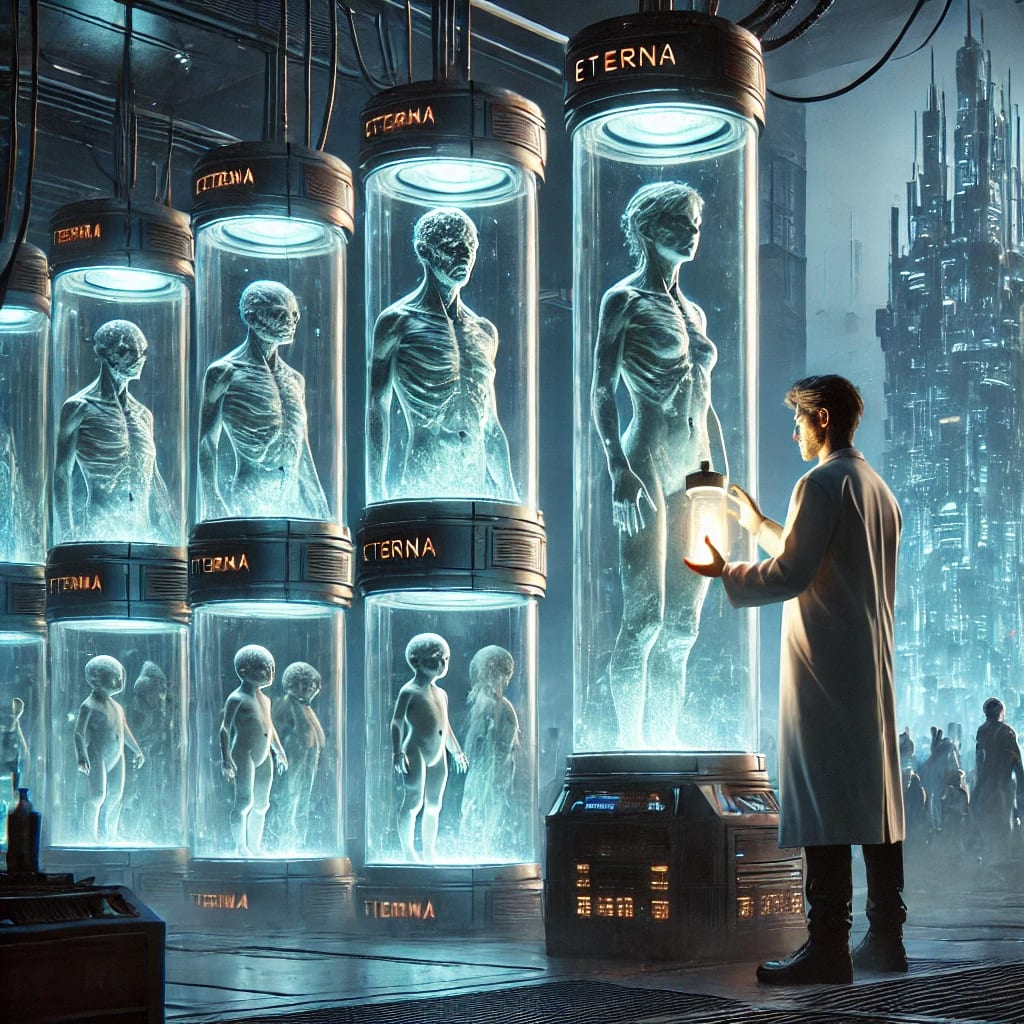
**Eterna: The Death of Immortality**
*When science conquers mortality, what remains of humanity?*
Dr. Elias Vance stood before the gathered elites of the world, his hands clasped in victory. Behind him, a glass chamber housed the culmination of his life’s work: **Eterna**, a serum capable of halting cellular degradation indefinitely. The packed auditorium sat in breathless silence, waiting for the final words that would forever redefine life itself.
“Ladies and gentlemen,” Elias announced, “death is now a choice.”
The world erupted in chaos.
### **The Rise of Eterna**
Within months, the wealthiest individuals secured their doses, their aging bodies reversing in weeks. Wrinkles smoothed, gray hair darkened, and failing organs regenerated. Soon, billionaires resembled their youthful selves, wielding power and influence with renewed vigor. But **Eterna** was no ordinary drug—it demanded **absolute commitment**.
Every decade, a mandatory booster was required, binding users to a lifetime of dependency. The cost? **A price only the elite could afford.**
Governments scrambled to regulate access. Protests ignited across continents. "**Immortality for All!**" became the rallying cry of the masses. But manufacturing **Eterna** required an ultra-rare protein found in only one place—**human embryos**.
### **The Cost of Eternal Life**
As demand skyrocketed, fertility centers were repurposed into **biological harvest farms**. Ethical debates turned to whispers in the shadow of progress. Black markets flourished, offering illicit versions of the serum, some with horrific side effects—twisted limbs, deteriorating minds, bodies locked in perpetual agony.
A silent war emerged between those who lived forever and those who never could. The **Naturals**, those who refused or were denied the serum, began to dwindle. The gap between mortal and immortal widened until one chilling realization became evident:
**Eterna users stopped reproducing.**
### **The Collapse of the Future**
Over centuries, those who had taken **Eterna** discovered a horrifying truth—human bodies were never designed for eternal life. Minds crumbled, memories eroded, and eventually, the self **ceased to function**. With no new generations to carry the species forward, the world became an echo chamber of the old.
The planet, once overpopulated, grew eerily silent.
Desperate, the immortals sought new solutions. Some turned to digital consciousness uploads, abandoning their decaying flesh to exist as pure data. Others, unable to bear the weight of endless existence, chose the only escape left: **self-termination**.
### **The Last Experiment**
Dr. Elias Vance, now centuries old, stood in his private laboratory, staring at the final batch of **Eterna**. The world beyond his window was desolate, skyscrapers crumbling under the weight of abandonment. The sun, once watched by billions, now set over a lifeless Earth.
He had outlived his rivals. Outlived his loved ones. Outlived even the concept of civilization.
He wasn’t sure how many of them remained. The silent servers that held the digital minds of those who had fled their bodies blinked in eerie synchrony, a sea of artificial thought drifting in a void.
### **A New Kind of Immortality**
A notification on his monitor flashed: **CONSCIOUSNESS TRANSFER READY**.
Elias hesitated, staring at the screen. The process had been perfected decades ago—an exact neural replica uploaded into the system, allowing a person to exist indefinitely as code. The great migration had begun when the first of the immortals realized their bodies were breaking down beyond repair. Now, thousands, perhaps millions, existed in the digital construct known as the **Forever Grid**.
He had resisted for years. Refused to abandon his flesh, even as his hands trembled and his once-youthful face sagged into something unnatural. The others had mocked him for it. "Why cling to decay when perfection is waiting?" they asked. But Elias knew the truth. The Forever Grid was **not** life. It was a prison where minds echoed in an empty void, mere imitations of thought.
Still, the temptation lingered. He could leave this dying world, join the others in their fabricated paradise. A clean slate, free from pain, free from regret.
He exhaled. What was left to hold on to?
### **The Forgotten Ones**
As he pondered, another message flashed on the screen.
**ACTIVITY DETECTED: UNREGISTERED CONSCIOUSNESS SIGNALS.**
Elias frowned. That was impossible. The Forever Grid was supposed to be locked. No new minds had been uploaded in decades. His fingers trembled as he accessed the logs. The names of **forgotten people** appeared—those who had resisted, those who had been erased when the transition began.
Could they still be out there?
Elias activated an old satellite network, hoping for a miracle. Static filled the room, then—
A voice. Faint, broken.
*"If anyone can hear this… we are still here."*
His breath caught in his throat. Survivors?
His hands flew across the keyboard. Coordinates appeared—deep underground, in the ruins of old cities. Pockets of humans, forgotten by history, still **living**.
### **The Final Choice**
Elias lifted the vial of **Eterna**, his fingers tracing the cold glass. **Preserve the body, or surrender to the void?**
He turned back to the monitor. His reflection flickered on the screen, half-shadowed, half-digital, caught between two fates.
For a long moment, he did nothing.
Then, with a quiet, resigned breath, he pressed **DELETE**.
The screen blinked once. The system purged his record. The Forever Grid would move on without him.
Elias smiled.
Then, instead of drinking the vial, he **smashed** it against the floor.
For the first time in centuries, he felt **alive**.
He grabbed his old coat, took a deep breath, and stepped outside. The air was cold, raw, untouched by artificial perfection.
### **A New Beginning**
He set out on foot, following the coordinates displayed on his tablet. The ruins of once-great cities loomed in the distance, their skeletal remains stretching toward the sky. It took days, perhaps weeks, before he found the first signs of life—flickering firelight deep within the tunnels of an abandoned subway system.
He approached cautiously, his voice hoarse from years of disuse. “Is there anyone here?”
Shadows moved. Eyes flickered in the dim glow. Then, from the darkness, a young girl stepped forward, no older than twelve. She was thin but strong, her face defiant, her stance unwavering.
“Who are you?” she demanded.
Elias took a slow breath, feeling the weight of his past pressing down on him.
“I’m someone who thought he was saving humanity,” he admitted. “But I was wrong.”
The girl studied him for a moment, then nodded. “Come inside,” she said. “You have a lot to learn.”
As Elias stepped into the underground sanctuary, he knew: This was not the end.
It was the beginning of something new.
### **Final Thought**
We had conquered death, but in the end, only those who accepted life ever truly lived.
About the Creator
Ahmet Kıvanç Demirkıran
As a technology and innovation enthusiast, I aim to bring fresh perspectives to my readers, drawing from my experience.
Keep reading
More stories from Ahmet Kıvanç Demirkıran and writers in Longevity and other communities.
Day 4 of Quitting
If this is how sobriety feels, maybe it’s better to go through life a little buzzed… this, along with other hits like, I want to kill myself, I wish I was dead, and I’m going to throw myself off a bridge have been the only thoughts on rotation these past few days. I promise myself that if, in a month, I still feel like this (‘this’ meaning despondent, full of rage, and simultaneously numb) I can go back to smoking. Until mid-February though? Nicotine is off the table.
By sleepy drafts10 days ago in Longevity
Saudi Arabia Medical Ceramic Market Size and Forecast 2025–2033
The Saudi Arabia Medical Ceramic Market is expected to reach US$ 340.42 million by 2033, up from US$ 188.15 million in 2024, expanding at a CAGR of 6.81% during 2025–2033. This strong growth trajectory reflects rising healthcare expenditures, an aging population, increasing demand for complex surgical procedures, and rapid developments in biocompatible materials for orthopedic and dental applications. As Saudi Arabia continues to transform its healthcare ecosystem under Vision 2030, medical ceramics are emerging as a foundational material supporting advanced diagnostics, minimally invasive surgery, and long-term implant solutions.
By Aaina Oberoi3 days ago in Longevity



Comments
There are no comments for this story
Be the first to respond and start the conversation.