
Dental Implant Market Trends & Summary: A Global Shift Toward Advanced Oral Restoration
Aging populations, cosmetic dentistry trends, and breakthrough technologies are reshaping the future of dental implants worldwide.

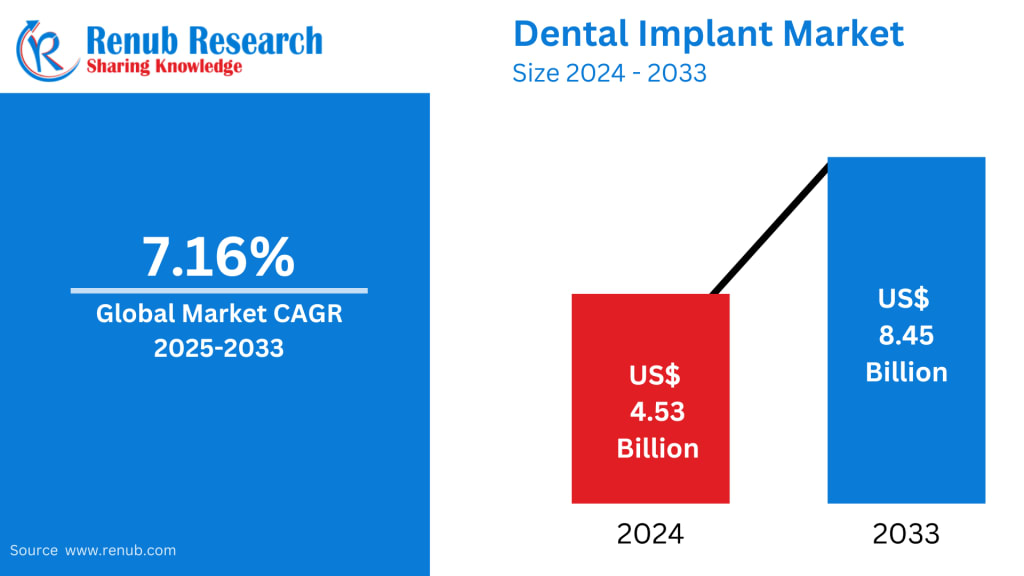
The global dental implants market is undergoing a remarkable transformation, driven by rising oral health awareness, cutting-edge technological advancements, and increasing preference for cosmetic dental solutions. According to Renub Research, the global dental implants market share is projected to reach approximately US$ 8.45 billion by 2033, up from US$ 4.53 billion in 2024, growing at a CAGR of 7.16% during 2024–2033. This surge reflects shifting consumer priorities, aging demographics, and the widespread adoption of minimally invasive and aesthetically superior restorative procedures.
Renub’s Global Dental Implant Market & Forecast provides extensive coverage based on material type, design, implant type, end-users, regional adoption, and competitive analysis spanning 2025–2033. Together, these insights illustrate a rapidly evolving market where dental implants are becoming the preferred solution for millions worldwide.
Understanding the Role of Dental Implants in Modern Dentistry
Dental implants represent one of the most advanced solutions for tooth replacement, offering durability, natural aesthetics, and superior functionality. The procedure typically involves inserting a small titanium or zirconium post into the jawbone, which integrates through osseointegration, establishing a stable foundation for crowns, bridges, or dentures.
Unlike traditional alternatives such as removable dentures, implants prevent bone loss, maintain facial structure, and provide unparalleled comfort. Their versatility allows applications in single-tooth replacements, multiple missing teeth, and even full-mouth restorations, transforming both oral function and confidence for patients.
With success rates exceeding 95%, implants have earned their place as a gold standard for permanent dental restoration. As populations grow older and prioritize long-term oral health, demand is projected to continue climbing in the years ahead.
Key Growth Drivers in the Dental Implant Market
1. Aging Populations Fueling Demand Globally
One of the strongest contributors to market growth is the rising global elderly population. Tooth loss is highly correlated with age due to chronic dental decay, periodontal disease, and systemic health conditions.
The World Health Organization reports:
The number of people aged 60+ will rise from 1 billion (2020) to 1.4 billion by 2030.
This count will reach 2.1 billion by 2050.
The population aged 80+ is expected to triple to 426 million by 2050.
Older adults increasingly desire long-lasting, functional solutions rather than removable prosthetics, making implants the top choice for tooth replacement. This demographic trend alone ensures solid market expansion throughout the forecast period.
2. Technological Advancements Strengthening Outcomes
Technology is redefining the implant landscape, making procedures faster, safer, and more precise.
Breakthroughs include:
3D imaging & cone-beam CT scans for enhanced diagnostics
Computer-guided implant surgery for optimal placement
Robotics-assisted implant procedures improving accuracy
Digital dentistry for personalized treatment planning
New biomaterials including zirconia and titanium alloys
Together, these innovations help reduce recovery times, improve aesthetics, and broaden the candidate pool for implant surgery.
Additionally, the rise of cosmetic dentistry technologies—including clear aligners, veneers, and advanced teeth-whitening—has indirectly boosted implant demand by creating a larger culture of aesthetic oral care.
3. The Rising Popularity of Cosmetic Dentistry
Cosmetic dentistry is no longer limited to celebrities or wealthy individuals. With improved affordability and greater societal emphasis on appearance, more people than ever are choosing dental procedures to enhance their smile.
Implants are highly sought after because they:
Look and feel like natural teeth
Provide stronger bite force
Support facial structure
Improve long-term oral health
Younger adults increasingly opt for implants following sports injuries, accidents, or congenital dental defects, while middle-aged adults pursue implants to restore dental aesthetics and confidence.
This rising trend contributes significantly to global market growth.
Market Challenges Limiting Wider Adoption
Despite strong market momentum, certain obstacles continue to impact adoption rates.
1. High Cost of Dental Implant Procedures
The biggest barrier remains the high upfront cost, which includes:
Implant hardware
Surgical fees
Diagnostic imaging
Crown fabrication
Post-operative care
In many developing nations, dental insurance does not adequately cover implant procedures, making them inaccessible for lower-income populations.
Even in developed markets, insurance often covers only a portion—if at all—forcing patients to shoulder substantial expenses. As a result, price sensitivity remains a serious challenge to global expansion.
2. Risk of Surgical Complications and Implant Failure
Although implants boast high success rates, complications may occur, including:
Infection
Failure to osseointegrate
Peri-implantitis
Insufficient bone density
Gum recession
Nerve damage (rare)
Patients with diabetes, autoimmune disorders, or smoking habits face higher risks, which may discourage adoption.
Additionally, the procedure requires skilled professionals not available in all regions. The shortage of implant-trained clinicians in emerging markets can reduce adoption rates and impact patient perception of the procedure’s safety.
Market Overview by Key Segments
Renub’s detailed segmentation reveals meaningful insights across multiple dimensions.
1. Material Types
Titanium Implants
Zirconium Implants
Titanium remains dominant due to durability and strong osseointegration, while zirconium gains traction for its metal-free and aesthetic properties.
2. Design
Parallel-Walled Implants
Tapered Implants
Parallel-walled implants offer increased stability and are widely used for various clinical conditions.
3. Types of Implants
Endosteal Implants
Subperiosteal Implants
Transosteal Implants
Endosteal implants dominate the global market due to high success rates and broad clinical compatibility.
4. End-Users
Hospitals
Dental Clinics
Others
Dental clinics remain the largest end-user segment because of patient preference for specialized, professional care.
Regional Insights: Market Performance Across Countries
United States Dental Implant Market
The U.S. remains one of the most mature markets due to:
High awareness of cosmetic dentistry
Strong healthcare infrastructure
High disposable incomes
Presence of skilled practitioners
Rapid adoption of digital dentistry tools
The American Academy of Implant Dentistry reports that 3 million Americans currently have dental implants, with 500,000 new implants placed every year—a trend expected to accelerate.
Germany Dental Implant Market
Germany is a leader in Europe’s dental implant industry, driven by:
A robust dental care system
Highly trained dental professionals
Strong focus on technological innovation
Widespread use of digital tools such as 3D imaging
Germany’s aging population and increasing interest in cosmetic dentistry further support implant demand.
Japan Dental Implant Market
Japan stands at the forefront of the Asia-Pacific implant industry. Key strengths include:
High healthcare standards
A rapidly aging population
Rising aesthetic dentistry culture
Growth in minimally invasive procedures
Japan’s commitment to advanced biomaterials and digital workflows enhances both patient satisfaction and procedural success.
United Arab Emirates Dental Implant Market
The UAE has emerged as a dental tourism hub due to:
World-class healthcare facilities
Skilled dental specialists
High disposable incomes
Growing aging population
Strong interest in cosmetic dentistry
Patients worldwide travel to the UAE for high-quality, technologically advanced implant procedures at competitive prices.
Countries Covered in the Global Market Analysis (25 Viewpoints)
North America
United States
Canada
Europe
France
Germany
Italy
Spain
United Kingdom
Belgium
Netherlands
Turkey
Asia Pacific
China
Japan
India
Australia
South Korea
Thailand
Malaysia
Indonesia
New Zealand
Latin America
Brazil
Mexico
Argentina
Middle East & Africa
South Africa
Saudi Arabia
UAE
Key Companies Covered (3 Viewpoints Each: Overview, Recent Developments, Revenue Analysis)
Danaher Corporation
Dentsply Sirona
Institut Straumann AG
Zimmer Biomet
Kyocera Corporation
Henry Schein, Inc.
Biocon LLC
Osstem Implant
These companies continue to shape the future of dental implant innovation through technological advancements, product launches, and expansion into high-growth markets.
Final Thoughts
The global dental implant market stands at an exciting turning point. With technological breakthroughs, rising cosmetic dentistry trends, increasing elderly populations, and expanding digital workflows, implants are rapidly becoming the preferred tooth replacement solution worldwide. Despite challenges such as high cost and surgical risks, ongoing innovations and broader global accessibility are expected to reshape the market landscape over the next decade.
As Renub Research forecasts a steady climb to US$ 8.45 billion by 2033, the dental implant market will remain one of the fastest-growing segments in the oral healthcare sector—driven by patient demand for long-term, natural, and functional tooth restoration.
About the Creator
Diya Dey
Market Analyst
Day 4 of Quitting
If this is how sobriety feels, maybe it’s better to go through life a little buzzed… this, along with other hits like, I want to kill myself, I wish I was dead, and I’m going to throw myself off a bridge have been the only thoughts on rotation these past few days. I promise myself that if, in a month, I still feel like this (‘this’ meaning despondent, full of rage, and simultaneously numb) I can go back to smoking. Until mid-February though? Nicotine is off the table.
By sleepy drafts11 days ago in Longevity
Cloud's advice
A Conversation with the Cloud Friday, 5 January 2018 By Javed Iqbal Dark clouds had spread across the sky. They were so thick and heavy that even during the daytime, it felt as if night had fallen. Zeeshan was walking quickly toward his fields. He was worried that if it started raining, the bundles of wheat lying in the open would be damaged. He wanted to cover them with plastic sheets before the rain arrived.
By Sudais Zakwan3 days ago in Longevity




Comments
There are no comments for this story
Be the first to respond and start the conversation.