
Cane-Chrono Walk
How an elderly man’s glowing cane gives strangers a second chance to rewrite tiny regrets

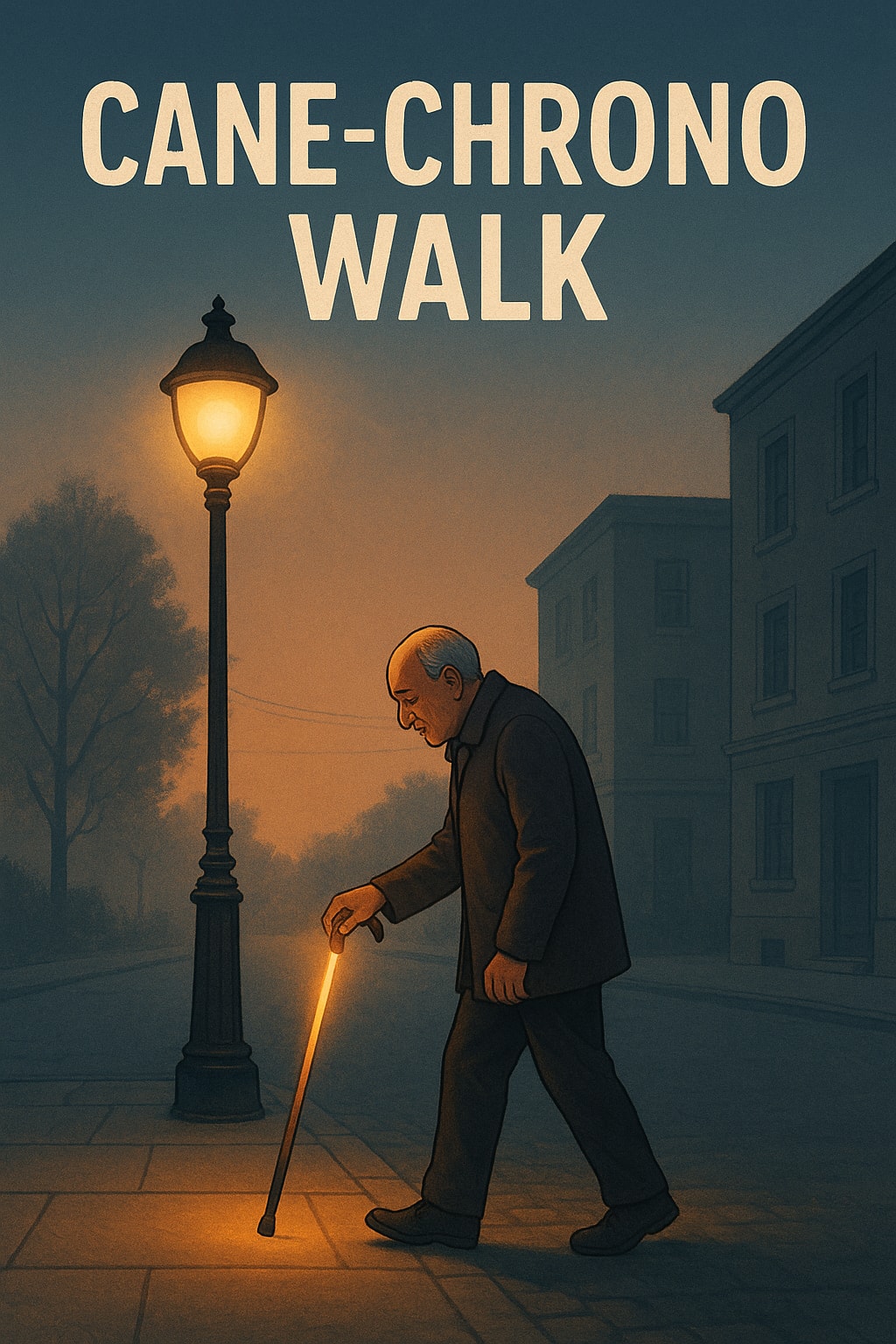
The city was barely awake when Mr. Harun began his morning walk—the same route he had taken for years, the same slow rhythm of cane-tap, breath, cane-tap. Dawn’s first light brushed the pavement in soft strokes, as if the morning itself were still deciding what kind of day it wanted to be.
The cane, a simple walnut stick topped with an old brass handle, had belonged to his father. Harun had polished it weekly for decades, admiring how the metal caught the sun like a held breath. It wasn’t until his seventies that the brass began to glow on its own.
Not brightly. Not dramatically. Just a faint, warm pulse—like a heartbeat—whenever he stood beneath a streetlamp.
The first time it happened, he thought it was a trick of the eye. The second time, he blamed nostalgia. But the third time, the world shifted.
He had paused at the corner of Rosewater and Main, waiting for the walk signal, when the cane flickered under the streetlamp’s halo. A young woman hurried past him, her face tight and tired. She crossed the street, reached the curb—then froze, her eyes widening with regret.
“Not again,” she whispered.
The cane glowed brighter. The air thickened, as if someone had pulled a velvet curtain across the moment. The cars, the birds, the distant rumble of a bus—everything slowed, softened, rewound by seconds. The woman blinked and found herself back at the bakery door she’d rushed past.
She exhaled, stepped inside, and returned with a little paper bag—still warm, still fragrant.
“My dad loves these,” she said to no one in particular. “I almost forgot.”
Harun said nothing. He simply lifted his cane in a small nod, as if saluting the morning.
And so began the Cane-Chrono Walk.
Every day, Harun moved along the streetlamps like beads on a rosary. Every day, the brass handle pulsed with possibilities.
At the third lamp, a man chasing a bus dropped his wallet. The cane shimmered, time folded like soft cloth, and the man found himself bending down just in time.
At the sixth lamp, a teenage boy hesitated before entering school, fear written across his shoulders. The cane brightened, the world slipped backward, and the boy remembered the sketch rolled in his pocket—the one he’d wanted to give his art teacher but lost the courage to share. He smiled, tugged it out, and walked inside with a steadier spine.
At the ninth lamp, an exhausted nurse almost stepped into traffic, her mind lost in night-shift fog. The glow caught her, lifted the moment gently, rewound it like ribbon, and placed her safely back on the sidewalk. She gasped, checked the light again, and whispered a shaky, “Thank you” to the air.
Harun never spoke of what the cane could do. He wasn’t even sure why it had chosen him. But he understood this much: life rarely offered grand miracles, only small chances—the kind people overlook because they seem too ordinary to matter.
He was merely giving mornings a chance to breathe again.
One cold morning, Harun reached the final streetlamp on his route—the one outside his own apartment. The cane glowed, but not at anyone else. It glowed at him.
He felt a tightness in his throat, the kind he’d carried for years. There was no passerby, no stranger in need. Just an old man and a closed window two stories up—the window to the room he had once shared with his wife.
She had died five years earlier. He had never said goodbye in the way he needed to. A regret so small most people would never notice—but it had lived quietly in him like a held breath.
The brass handle brightened, warm as a hand being taken.
The world softened. Tilted. Slipped backward.
And for a few seconds, he stood in that room again—sunlight on the curtains, her soft laughter still hanging in the air. He didn’t change anything. Didn’t touch anything. He simply whispered, “Thank you for the years,” and felt the weight in his chest loosen.
When time returned, the city was still quiet. The cane’s glow faded.
Harun tapped it once on the pavement, steady and gentle.
Then he continued walking, giving the morning one more chance to begin again.
About the Creator
LUNA EDITH
Writer, storyteller, and lifelong learner. I share thoughts on life, creativity, and everything in between. Here to connect, inspire, and grow — one story at a time.
Keep reading
More stories from LUNA EDITH and writers in Longevity and other communities.
Sweeping Poem
I used to think my job was simple: sweep the street, empty the bins, keep the sidewalk clean enough for people to forget someone like me had been there at all. Most mornings, I moved like a shadow—quiet, invisible, just a man with a broom and a shift that started before the sun respected the sky.
By LUNA EDITH3 months ago in Humans
4 Surprising Truths About Nanoparticles In Your Soda
The Unseen World in Your Grocery Cart Imagine grabbing a can of soda or a packaged snack from your pantry. It's a simple, everyday act. Yet, hidden within that familiar fizz and sweetness is a technological frontier most of us never consider: the world of nanomaterials. Current research reveals that many of the foods and drinks we consume may contain engineered or unintentionally formed particles so small they are invisible to the naked eye. This article will explore four of the most surprising and impactful facts we are learning about nanotechnology in our food system, based on current research and analysis.
By The INFORMER4 days ago in Longevity
Pearl
1980 something. we all hung out at Pearl and you and i were nothing special, or so i thought. i mean we all danced, drenched in our own sweat, our own saline solution of fear, too many beers, shots, laughter, tears, fucks in the bathroom and i don't know when we began to be afraid. do you?
By ROCK aka Andrea Polla (Simmons)4 days ago in Fiction


Comments
There are no comments for this story
Be the first to respond and start the conversation.