
Breathing Through Resistance: Finding Calm in the Moments You Want to Escape
the Moments You Want to Escape


There are moments we all wish we could skip. The awkward conversation, the creeping anxiety before sleep, the heavy silence after disappointing news. These are the moments when the body tenses, the breath shortens, and the mind looks for the nearest exit. But what if, instead of fleeing discomfort, we breathed through it? What if calm wasn’t something we had to chase, but something waiting on the other side of resistance?
Meditation often gets framed as a way to feel good — to relax, to center, to get rid of the “bad” stuff. But what if its true strength lies in its ability to help us stay? Not to feel better, but to simply feel, fully and honestly. When we meet discomfort with presence — through the breath — something begins to shift. Not by force, but by staying.
Understanding Resistance
Resistance is a natural part of being human. It arises as protection, a survival instinct wired deep into our nervous system. When something feels emotionally overwhelming — grief, shame, uncertainty — we instinctively pull away. Sometimes we numb out. Sometimes we scroll, binge, sleep, argue. It’s not weakness. It’s habit.
But resistance isn’t the enemy. It’s a signal — one that says, “This matters. This hurts. This needs care.” Learning to sit with resistance is like learning a new language. At first, it’s awkward and unfamiliar. But with practice, we become more fluent in discomfort, more grounded in moments we’d once flee from.
The Breath as Anchor
When everything in us wants to run, the breath is the one thing that stays. Unlike thoughts, which scatter, or emotions, which rise and crash, the breath is always present. It’s rhythm. It’s anchor. And when we direct our attention to it — especially in hard moments — we access a kind of steadiness that doesn’t require the outside world to change.
Try this: the next time you feel yourself wanting to escape — from a feeling, a thought, a situation — pause. Feel your feet on the floor. Bring your hand to your chest or belly. And simply notice: where is your breath? Is it shallow? Is it stuck? Can you invite it to deepen, just a little?
Not to fix the feeling. Not to erase the discomfort. But to be with it, breath by breath.
Meeting the Edge
Meditation is not about always feeling peaceful. In fact, some of the most powerful practice happens when we feel anything but peaceful. When we meet the edge — the part of ourselves that says “No, I can’t do this” — and stay just one breath longer, something softens. We realize we don’t have to fight the feeling, nor do we have to disappear into it. We can simply be with it.
It’s like sitting beside a storm, rather than being inside it. You feel the pressure, the weight of the clouds — but you’re also witnessing. You’re breathing. You’re still here.
Compassion, Not Control
One of the most radical shifts in meditation is moving from controlling experience to compassionately witnessing it. When resistance arises, we don’t scold ourselves. We don’t push harder. Instead, we offer the breath like an open hand: “You’re allowed to be here. And so am I.”
Compassion doesn’t make pain disappear. But it does make space for it — and in that space, we find something unexpected: calm. Not the glossy, Instagrammable kind. But a quiet steadiness, rooted in truth. The kind of calm that says, “Even this, too.”
A Practice for Breathing Through Resistance
Here’s a simple meditation you can try when resistance shows up:
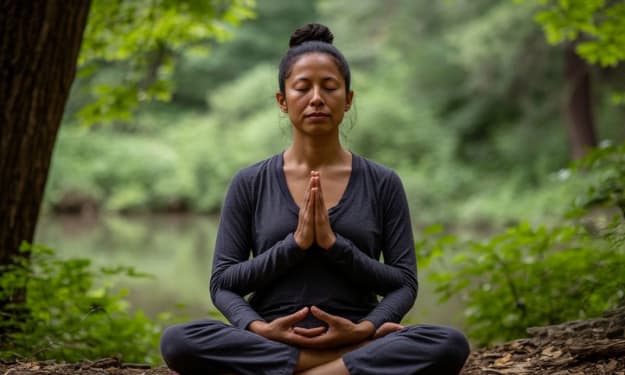
Find a comfortable seat or lie down. Let your body rest naturally, without trying to be perfect.
Close your eyes, or soften your gaze. Begin by simply noticing the breath — without changing it.
Name what you feel. “Tightness.” “Fear.” “Tension in my jaw.” Let the truth arise without editing.
Breathe into the sensation. Not to force it away — just to be present with it. “I’m here.” “I’m breathing.”
Stay for five breaths. Or ten. Or however many you can. No pushing. Just presence.
Close the practice with kindness. Place your hand over your heart or say silently, “Thank you for staying.”
Repeat as needed — especially when you want to do anything but sit still.
The Other Side of the Moment
When we breathe through resistance, we discover something subtle but profound: we’re stronger than we thought. Not in the sense of overpowering the feeling, but in our willingness to meet it honestly. Each time we do, we expand our capacity to stay. To feel. To live fully.
In a culture obsessed with comfort and speed, breathing through resistance is a quiet act of courage. It says, “I won’t abandon myself when things get hard.” It says, “This moment matters, even if it’s messy.” It says, “I’m still here — and I’m still breathing.”
About the Creator
Keep reading
More stories from Marina Gomez and writers in Longevity and other communities.
When You Can’t “Let Go”: Meditating with Attachment Instead
We’ve all heard the advice: “Just let it go.” Whether it’s a painful relationship, a lingering resentment, or an old fear, the phrase is often used as a shorthand for moving on, clearing space, or cultivating peace. But what happens when letting go feels impossible? When the grip is too tight, the memory too raw, or the emotion too alive? Meditation, contrary to popular belief, doesn’t require us to force detachment. In fact, some of the deepest healing happens when we sit down with our attachments—not in spite of them.
By Marina Gomez8 months ago in Longevity
Microsoft's Purposeful Marketing Deception About AI's Ability To Beat Physicians In Diagnosis
When you look at the world of scientific research... If you are not careful... You will be fooled into believing things that are not actually supported by the data.
By Dr. Cody Dakota Wooten, DFM, DHM, DAS (hc)a day ago in Longevity
Babbling Dixie
The short form of tomorrow is never the whole story. Abbreviations mean nothing when we are born to die and we all are aren't we? Being spoken for before birth is something we're not supposed to remember like some kind of karma after effect. Still here we are spending our lives looking for each other.
By Canuck Scriber Lisa Lachapelleabout 7 hours ago in Fiction



Comments
There are no comments for this story
Be the first to respond and start the conversation.