
Anti-Vaxxers Have Always Been With Us
The children in this picture were in the same class and exposed to a classmate with smallpox in 1901


The boy on the left? His parents, according to Dr. Allan Warner, were influenced by the anti-vaccination movement in Leicester during the time he was born. We don't know if this boy survived, but if he did, he lived with horrendous lifelong scarring.
Sixty-one years before, the Act of 1840 was passed to prevent this type of tragedy
"To encourage widespread vaccination, the law made it compulsory for infants during their first three months of life and then extended the age to children up to 14 years old in 1867, imposing fines on those who did not comply."
*In 1872, as a result of the effectiveness of these laws, 90% of children in Leicester were vaccinated. Some attribute this to the smallpox epidemic that had just finished, causing death and disfigurement to 359 people.
Then time passed. People forgot. Again.
- They were told that receiving a vaccine from an animal was an abomination.
- They were told in no uncertain terms that smallpox did not spread from person to person.
- They were told that smallpox was gone forever.
- And finally, some had no interest in any medicines at all.
Anti-vaccinationists, which is what they were called at the time, spread the news…with flyers which were the equivalent of today's Facebook.
The movement continued to build, and on March 23rd, 1885, a large protest was held in Leicester.
"There, 80,000–100,000 anti-vaccinators led an elaborate march, complete with banners, a child's coffin, and an effigy of Jenner."
Leicester became a stronghold of anti-vaxxers after 1886! They were actually famous…or infamous depending on how you look at it.
As a result:
"*In 1892, thanks to strong anti-vaccination forces, only 3% of children were vaccinated."
The boy on the right, the relatively unblemished one, was one of the 3%.
Children need a champion. Their parents are their first defense
The compulsory nature of the Act of 1840 caused vigorous pushback. The Anti Vaccination League and the Anti-Compulsory Vaccination organizations were formed.
Officials did not always impose fines, and so, a law was passed; the officials themselves were held responsible for the fines that were not paid.
This caused even more revolt.
Some parents went to jail rather than allow their children to have vaccinations.
As a result, even though the government of the United Kingdom had good intentions with the Act of 1840, the vaccination movement was not a success in this town.
Therefore, in the year 1901, 61 years later, we have a picture of two boys in…you guessed it - Leicester.
The famous Dr. Edward Jenner, who was born in 1749 and died in 1823, had tested a method of prevention
He observed that those who had undergone cowpox, a much milder disease than smallpox - which disfigured and sometimes killed, were immune.
People had been undergoing smallpox inoculation since 1721 in Boston when Cotton Mather and doctors recognized that this process worked to save lives from deadly smallpox. But when people underwent the procedure, it could still kill - but in smaller numbers.
In addition, after undergoing the procedure, one was contagious for a few days.
Dr. Jenner's process, which he defined on May 14, 1796, was safer. Instead of inoculating with smallpox, he inoculated his patients with cowpox. One was then immune to cowpox and smallpox after receiving it, the illness was even milder, and the patient was not contagious.
Dr. Jenner was responsible for saving the lives of millions; increasing life expectancy and reducing the disfigurement of the human race. According to the Centers for Disease Control and Prevention (CDC), 3 out of every 10 people who got it died.
There is no effective treatment for smallpox.
Today, Dr. Jenner is considered one of the 100 Greatest Britons.
"In its most pernicious form, smallpox caused explosive hemorrhaging - death occurred within 48 hours. Those who survived had extensive scarring. Some went blind. It did not just make you "look ugly" for a few days." - Dr Lindsey Fitzharris
The totality of what Dr. Jenner accomplished is illustrated by what Thomas Jefferson wrote to him in 1806;
"-future generations will know by history only that this loathsome disease has existed."
(Image: © Centers for Disease and Prevention Public Health Image Library; by Dr. Noble, 1966)
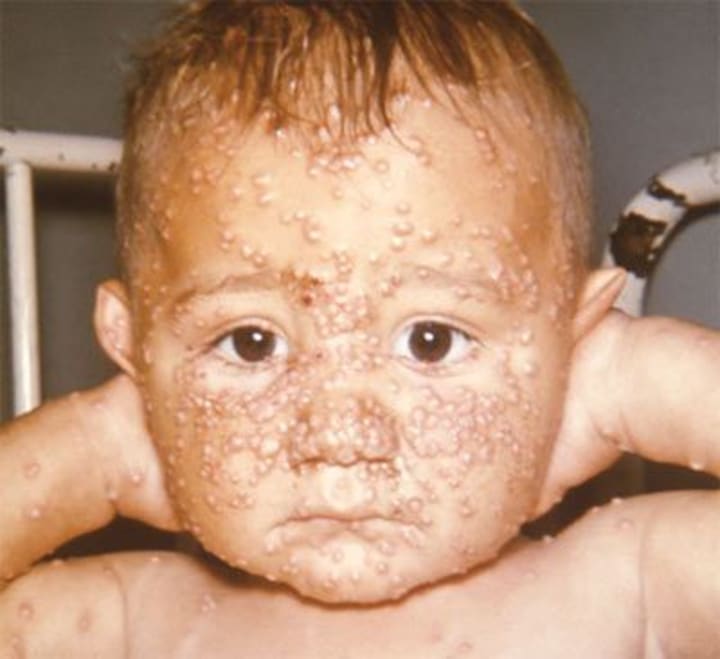
It finally happened. On May 8th, 1980, smallpox was declared eradicated by the 33rd World Health Assembly (WHO).
How did Leicester survive smallpox
Smallpox did come to the town from the late 1800s to the early 1900s, but they were well fortified. As soon as someone was diagnosed with the disease the patient(s) and their families were immediately isolated.
The medical community in Leicester was not as foolish as one might immediately suppose. In 1901:
**As Dr. Millard, the medical officer of health explains it, "a handful of the population, including the medical men, sanitary staff, small-pox nurses, etc., are as well vaccinated in Leicester as in any other town so that a cordon of protected persons can be drawn round any case of small-pox which may occur."
In other words, the medical professionals were vaccinated, but the town as a whole was not due to strong anti-vaccination forces. However, I would add to that number.
Medical personnel most likely vaccinated their families. They would have seen too much to leave them unprotected.
There is no effective treatment for smallpox.
Anti-vaxxers are not simply trying to be onerous
Anti-vaxxers have good intentions. For those of us who are pro-vaccination, the numbers of lives saved are enough to tell the tale. We can't fathom why anyone would withhold such a medical advantage to the human body.
Many understand that anti-vaxxers want the best for their children. There were risks along the way - however vaccines have been improved through the years of development and are safer than ever.
The Anti-Vaccination League of America in Philadelphia, Pennsylvania kept records of children harmed by a vaccine in the early 1900s. During the early adoption of inoculation and vaccination methods, throughout the decades, some reacted badly to treatment.
The organization publicized these incidents and had a variety of reasons why they fought so violently against what some called an advance in modern medicine.
However, until this medical advance was available, children died in extremely large numbers, numbers that we would be in shock of today.
So great was the pre-modern loss of children's lives that anthropologists claim to have found groups that do not name children until they have survived a year.
Diseases that had carried off thousands of children in 1900 were practically eliminated by 2000: diphtheria, and pertussis, measles.
The First Measured Century/PBS

Vaccines are responsible for the lessening hold of these diseases
When we do not immunize, we risk inviting them back.
Of course, diseases weren't the only reason so many children died. The theory of germs didn't exist - but once it was discovered, cleanliness was promoted. Sewers were installed in our cities and towns. More resources (food and medicines) were given so that people could live longer.
But - our children are living longer...
According to Professor Thomas McKeown, "most epidemiologists are agreed that we owe the decline of mortality from smallpox mainly to vaccination."
These precious preventative measures helped children live long enough to gain strength in their bodies and minds. The vaccines also helped people resist infections that they come in contact with during everyday living.
After all this, even in modern times, the infant mortality rate in America is not the best.

If one wants to give birth to a living child that survives to the age of 5, it would be a good idea to look at Japan or Sweden and model what they're doing.
What are we talking about when we talk about the required vaccines
Vaccine hesitancy is the reluctance or refusal to vaccinate despite the availability of vaccines.
According to WHO, it is also one of the top ten threats to global health in 2019.
The current recommended immunization schedule calls for babies to get the following vaccines by about 18 months of age (some of these are given as combination vaccines):
- Four doses of vaccines against diphtheria, tetanus, pertussis, Haemophilus influenzae, and pneumococcus
- Three doses of vaccine against polio and hepatitis B
- Two doses of influenza vaccine (possibly three depending on when the child is born)
- One dose of vaccine against measles, mumps, rubella, chicken pox, and hepatitis A
Once this current schedule of treatment is implemented, babies are protected for years, and it helps the community. If they're not sick, they'll be unable to spread sicknesses to their classmates.
They'll be stronger and able to fight off common diseases, the kinds of afflictions that used to kill them in past generations.
The graveyards of the past are evidence enough. They are filled with children. Visit one sometime. It's morbid but necessary.
Let's face it. Isn't keeping our children alive what it's all about?
*Swales JD. The Leicester anti-vaccination movement. Lancet. 1992;340(8826):1019–1021. doi:10.1016/0140–6736(92)93021-e
**C.-E. A. Winslow. "Statistics of Small-Pox and Vaccination." Publications of the American Statistical Association, vol. 8, no. 61, 1903, pp. 279–284. JSTOR, www.jstor.org/stable/2276513. Accessed 17 Feb. 2020.
About the Creator
Keep reading
More stories from writers in Longevity and other communities.
Day 4 of Quitting
If this is how sobriety feels, maybe it’s better to go through life a little buzzed… this, along with other hits like, I want to kill myself, I wish I was dead, and I’m going to throw myself off a bridge have been the only thoughts on rotation these past few days. I promise myself that if, in a month, I still feel like this (‘this’ meaning despondent, full of rage, and simultaneously numb) I can go back to smoking. Until mid-February though? Nicotine is off the table.
By sleepy drafts15 days ago in Longevity
The Great Race for the Arctic: Why Russia, China and the US All Have It in Their Sights
The Arctic is no longer just a frozen wasteland at the top of the world. Today, it has become a hotspot for global competition, attracting the attention of some of the world’s biggest powers: Russia, China, and the United States. As melting ice opens new shipping routes and exposes untapped natural resources, these nations are racing to secure influence in a region that could shape the future of geopolitics, trade, and energy. Why the Arctic Matters The Arctic is important for several reasons: Natural Resources – The region contains vast oil and gas reserves, as well as rare minerals crucial for modern technology. Experts estimate that the Arctic could hold 13% of the world’s undiscovered oil and 30% of its natural gas. Shipping Routes – As ice melts due to climate change, new passages like the Northern Sea Route and the Northwest Passage are becoming navigable. These routes could cut travel time between Asia and Europe by weeks, offering major economic advantages. Military and Strategic Positioning – The Arctic provides a unique vantage point for monitoring global military activity. Control over the region could give nations strategic leverage in both defense and trade. The combination of resources, strategic position, and new shipping routes has made the Arctic a prize worth competing for. Russia’s Arctic Ambitions Russia has been the most active player in the Arctic for decades: It has expanded its military presence, building airfields, radar stations, and icebreakers. Russia controls a vast portion of the Arctic coastline, giving it the advantage of established ports and infrastructure. Energy companies backed by the state are investing heavily in oil, gas, and mineral extraction in the region. Russia sees the Arctic as both an economic opportunity and a security priority. Its actions signal a clear intention to assert dominance over the region before other powers can catch up. China’s Arctic Strategy China is not an Arctic nation by geography, but it has made its ambitions clear: Beijing calls itself a “Near-Arctic State”, emphasizing its interest in shipping and resource access. China is investing in scientific research, Arctic ports, and partnerships with Arctic nations. The country sees the Northern Sea Route as a potential shortcut for trade between Asia and Europe, which could reduce shipping costs and fuel consumption. China’s approach is more economic and diplomatic, relying on partnerships and research projects rather than direct territorial claims. Still, its growing presence is reshaping the Arctic’s geopolitical landscape. The United States in the Arctic The US has long been an Arctic power, primarily through Alaska. Its strategy focuses on defense, environmental monitoring, and trade routes: The US Coast Guard maintains icebreakers and patrol ships to ensure security and maintain shipping lanes. Washington emphasizes freedom of navigation, aiming to prevent any single nation from dominating Arctic waters. Military exercises and collaborations with NATO allies aim to protect strategic interests and respond to potential conflicts. The US sees the Arctic as a region of both opportunity and responsibility, balancing security, environmental concerns, and international cooperation. The Race for Control The Arctic race is about more than natural resources. It is a complex competition of economics, diplomacy, and military positioning: Russia moves aggressively, building military infrastructure and exploiting resources. China invests in research, shipping, and partnerships, gaining influence without formal territorial claims. The US maintains a defensive posture, securing its territory and ensuring freedom of navigation. This “race” is unlike traditional conflicts. It is less about open warfare and more about strategic positioning, economic investment, and diplomatic influence. Environmental and Global Concerns The Arctic is fragile and sensitive to climate change. While melting ice opens opportunities, it also poses risks to wildlife, local communities, and global weather patterns: Rising temperatures accelerate ice melt, threatening polar bears, seals, and indigenous communities. Increased shipping and resource extraction could lead to oil spills, pollution, and habitat loss. Global climate patterns, including storms and ocean currents, could be disrupted by rapid Arctic changes. Nations are under pressure to balance ambition with environmental responsibility, though economic incentives often outweigh conservation efforts. What This Means for the Future The Arctic is likely to remain a geopolitical hotspot for decades. Key developments to watch include: Expansion of shipping routes that shorten travel times and reduce costs. Increased resource extraction, including oil, gas, and rare minerals. Rising military presence, as countries protect their interests and assert sovereignty. Scientific research collaborations, which could shape policy and environmental practices. The Arctic will not just be a frozen frontier — it will be a center of economic, strategic, and environmental importance. Key Takeaways The Arctic is valuable for its resources, trade routes, and strategic position. Russia, China, and the US are all investing heavily to secure influence. The race is a mix of military, economic, and diplomatic maneuvering. Climate change both enables and threatens these ambitions. How nations navigate this competition will impact global trade, security, and the environment. Conclusion The Arctic is no longer just an icy, remote region — it has become a frontline of global strategy. Russia, China, and the United States are all jockeying for influence, using a combination of military, economic, and scientific tools. As ice melts and new opportunities emerge, the Arctic will play a critical role in global geopolitics. How these powers manage competition, environmental responsibility, and cooperation could shape the region — and the world — for generations to come. The great race for the Arctic is not a story of war, but a story of ambition, strategy, and survival at the top of the world.
By Fiaz Ahmed about 19 hours ago in Longevity




Comments
There are no comments for this story
Be the first to respond and start the conversation.