

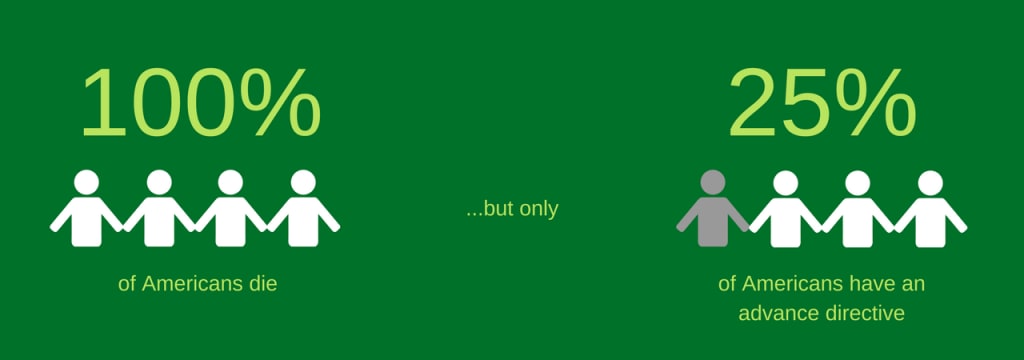
Health care advance directives are documents the communicate a person's wishes about health care decisions in the event that the person becomes incapable of making health care decisions for themselves. There are two basic kinds of advance directives: living wills and durable power of attorney of health care. These documents have legal and ethical basis, and they should be followed unless legally or ethically unable to do so.
The Physician Order for Life-Sustaining Treatment (POLST) form is a medical order form that allows any individual with a serious illness or frailty to summarize their wishes regarding life-sustaining treatment. The POLST form can provide security for the patient and physician that the patient’s wishes will be carried out. The POLST form accomplishes two major purposes: It is portable from one care setting to another. It translates wishes of an individual into actual physician orders.
Advance Directives give a documented guide to the caregiver’s or family member’s so that they all can provide the kind of care that the medically impaired patient wants. This covers a wide variety of medical treatments such as dialysis, ventilators, feeding tubes, organ and or tissue transplants. If a patient has kidney failure, they might or might not want to be on dialysis. The advance directive would spell out whether the patient would want such treatment if he or she was not able to convey this to the medical personnel. If the patient were at the end-of-life and did not want to be kept alive via artificial means such as a ventilator or feeding tube, the advance directive would have the patients wants of this type of treatment. If the patient passes away and wanted his or her organs donated, then this directive would give the right to have the organs harvested and donated to someone in need.
Putting your wishes in writing is crucial. The act of writing helps most people think through difficult issues and make distinctions that might be glossed over in conversation. Writing out your wishes also has difficulties. Phrases like “heroic measures” are very vague and not immensely helpful. If you get too specific, the living will becomes inflexible and may be ignored. There is no amount of detail that will cover every situation. Medical decisions often occur on contingencies.
Several years ago, researchers conducted a study in Scotland. Doctors and nurses were presented with a hypothetical case of a 78-year-old woman with dementia who had written a living will eight years earlier. In her current state, she can’t really engage in conversation or read but does recognize her daughter and seems to enjoy her company. Her living will uses standard language saying if she has a severe degenerative brain disease, she should not be given “active treatment”, such as antibiotics, ventilation, surgery, or a blood transfusion, for any life-threatening medical situation. Now she has developed pneumonia. With antibiotics, she would likely recover, but without them there is a good chance that she could die. The question asked to the medical professionals was, should she receive antibiotics despite her living will?
The researchers found a lot of disagreement. Some of the nurses and doctors said that she should get antibiotics because it was inhumane not to treat her. The medical professionals who favored treatment noted that her quality of life was fairly good. Some said the living will was irrelevant because her dementia did not meet the definition of a severe degenerative brain disease. Several other medical staff said that the drugs should be withheld because this was clearly the type of situation her living will anticipated.
Medical personnel may be faced with instances where providing care to patients is inconsistent with the desires expressed in an Advance Directive. There was a study done to explore clinician compliance with patient Advance Directives and to determine whether particular external factors may influence decisions to either honor or waive pre-set directives. Most clinician decisions were made without concern for legal liability or influenced by demands by families to continue care. Until a more reliable system can be developed that enables a patient’s desires to be fully expressed under a multitude of unique clinical scenarios, physicians will be required to interpret the interactions between a patient’s immediate medical condition and their prior requests as documented through Advance Directives.
About the Creator
Keep reading
More stories from Shannon hustead and writers in Longevity and other communities.
Acupuncture and Pain Management
Acupuncture is a technique that is used to stimulate specific points on your body. This is often done by inserting tiny needles through your skin. Acupuncture is one of the top practices in traditional Chinese Medicine. Acupuncture has been shown to be effective in relieving pain.
By Shannon hustead5 years ago in Longevity
Why Nutrition During Pregnancy Matters More Than You Think
Pregnancy is one of the most important stages in a woman’s life, not only emotionally but also nutritionally. During these nine months, the body works continuously to support the growth and development of a new life. Because of this, nutrition plays a crucial role in ensuring both the mother and the baby remain healthy.
By Being Inquisitive3 days ago in Longevity
Herbal Tea: Natural Drink for Relaxation and Better Health
Introduction: Herbal tea is a natural beverage made from dried herbs, flowers, fruits, or spices. Unlike traditional teas such as black or green tea, herbal tea usually does not come from the Camellia sinensis plant.
By Health Tipsa day ago in Longevity
Top tipple tricks
Been thinking a lot about drinking, lately. Not least because of a recent episode of over-indulgence and the inevitable after effects. Some readers may recall the earlier articles I wrote about beating the booze. Here I set out an experiment in techniques for cutting down on my alcohol intake. The experiment was successful, the techniques worked, and I have armed myself with an arsenal of weapons in the war against the demon drink. I have yet to fire the first round however. It's all a question of timing (perhaps procrastination).
By Raymond G. Taylor5 days ago in Psyche



Comments
There are no comments for this story
Be the first to respond and start the conversation.