
A Legendary Golden Fabric Lost for 2,000 Years Has Been Reborn — And It Could Change the Future of Fashion
Legendary Golden Fabric

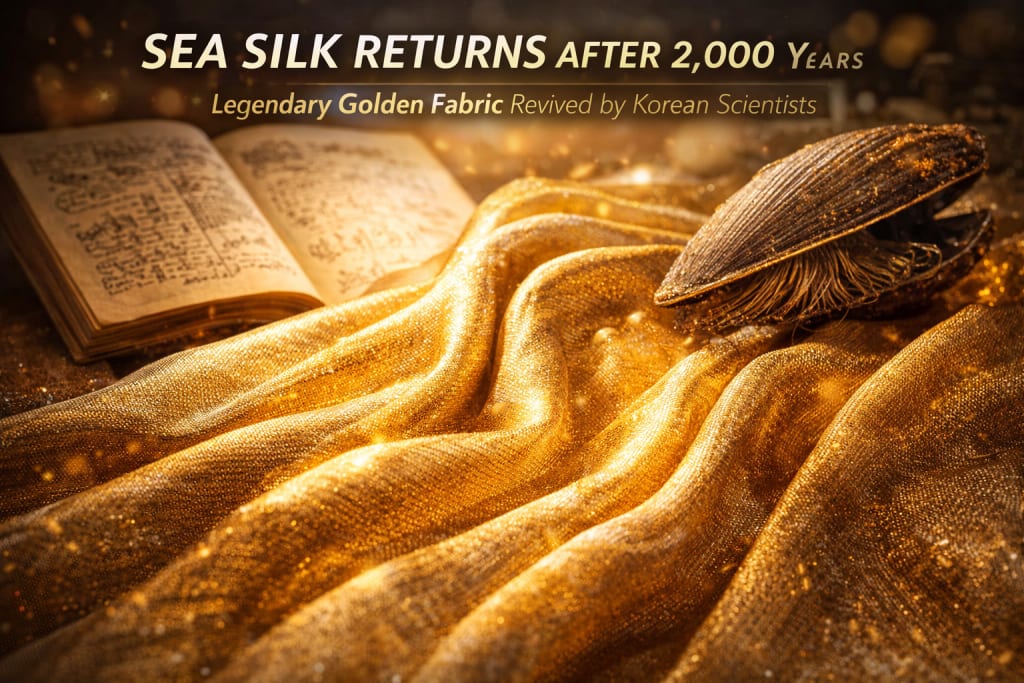
For more than two millennia, it existed only in whispers, ancient texts, and fragile museum fragments. A fabric so rare, so luminous, that it was once reserved exclusively for emperors, popes, and the highest elites of the ancient world. Now, against all odds, that legendary textile has returned.
Scientists in South Korea have successfully recreated sea silk, a mysterious golden fabric believed to be lost for over 2,000 years. This extraordinary breakthrough doesn’t just revive a forgotten luxury—it could redefine sustainable fashion, inspire next-generation materials, and reconnect modern science with ancient craftsmanship.
This is not just a story about fabric. It’s a story about history, nature, and innovation colliding in spectacular fashion.
________________________________________
What Is Sea Silk? The Fabric Fit for Emperors
Sea silk is one of the rarest textiles ever produced by human hands. Unlike traditional silk, cotton, or wool, sea silk is made from byssus fibers, delicate threads secreted by large marine clams to anchor themselves to the ocean floor.
Historically, these fibers came from the Mediterranean pen shell (Pinna nobilis), a massive clam species now considered critically endangered. When harvested, cleaned, and spun, the fibers formed a fabric that was:
• Exceptionally lightweight yet incredibly strong
• Naturally golden in color
• Soft, warm, and resistant to wear
• Immune to fading over time
What made sea silk truly magical was its natural golden shimmer. Unlike dyed fabrics, the color came from microscopic protein structures that manipulated light itself—a phenomenon known as structural coloration. This meant the fabric never lost its glow, even after centuries.
Ancient records describe sea silk garments worn by Roman emperors, Byzantine rulers, and religious leaders. Some historians believe fragments of sea silk exist in sacred relics, including the famed Holy Face of Manoppello in Italy.
________________________________________
How Sea Silk Disappeared From History
Despite its legendary status, sea silk production slowly faded into obscurity.
The reasons were many:
• Overharvesting of pen shells
• Marine pollution and habitat destruction
• Strict conservation laws banning collection
• Loss of traditional weaving knowledge
As the clams disappeared, so did the artisans who understood how to work with the fibers. By the Middle Ages, sea silk had become a myth—spoken of in texts but no longer produced.
For centuries, it remained a lost treasure of the ancient world.
Until now.
________________________________________
The Scientific Breakthrough That Brought Sea Silk Back
Researchers at Pohang University of Science and Technology (POSTECH) in South Korea have accomplished what many thought impossible.
Led by Professors Dong Soo Hwang and Jimin Choi, the team recreated sea silk using a different species—the Korean pen shell (Atrina pectinata), which is sustainably farmed and not endangered.
Instead of harming marine ecosystems, the scientists collected byssus threads that would otherwise be discarded as waste. Through advanced processing techniques, they:
• Carefully extracted and purified the fibers
• Studied their nano-scale protein structures
• Reproduced the weaving methods that create sea silk’s signature texture
• Preserved the natural golden coloration without dyes or chemicals
The result? A fabric that mirrors ancient sea silk in strength, softness, and luminous beauty—but created using modern, ethical, and sustainable methods.
________________________________________
Why This Discovery Matters for Sustainable Fashion
The rebirth of sea silk couldn’t come at a better time.
The global fashion industry is under intense pressure to reduce pollution, waste, and chemical use. Sea silk offers a rare glimpse into a luxury material that is both ancient and environmentally responsible.
1. No Dyes, No Chemicals
Sea silk’s golden color is natural, eliminating the need for toxic dyes that contaminate water systems.
2. Circular Economy in Action
Byssus fibers are typically discarded. Turning them into high-value textiles transforms waste into opportunity.
3. Biomimicry at Its Best
Understanding how sea silk produces color through structure—not pigment—could revolutionize fabric design, reducing environmental impact across industries.
________________________________________
Beyond Fashion: Applications in Science and Technology
Sea silk isn’t just about clothing.
The same properties that made it desirable to emperors make it attractive to modern engineers and scientists. Potential applications include:
• Advanced wearable technology
• Lightweight aerospace materials
• Optical coatings
• Medical textiles
• High-performance sustainable fibers
By studying how nature creates strength and color at the molecular level, researchers can design smarter materials with fewer resources.
________________________________________
A Powerful Link Between Ancient Knowledge and Modern Innovation
One of the most fascinating aspects of this discovery is what it says about human history.
Sea silk proves that ancient civilizations possessed a deep understanding of materials—knowledge that modern science is only now rediscovering. This project highlights the value of preserving traditional wisdom, not just in books or museums, but through practical, living applications.
Instead of being locked behind glass displays, sea silk can now be studied, worn, and improved upon—bringing the ancient world directly into the present.
________________________________________
A New Golden Age for Textiles?
Designers are already showing interest in sea silk as a symbol of ethical luxury—a fabric that combines exclusivity, beauty, history, and sustainability.
While it’s unlikely to become a mass-market material anytime soon, its influence could reshape how luxury is defined. In a future where sustainability is status, sea silk may once again become a fabric fit for royalty—this time, without harming the planet.
________________________________________
Final Thoughts: When the Past Shapes the Future
The revival of sea silk is more than a scientific success. It’s a reminder that progress doesn’t always mean inventing something new—sometimes, it means rediscovering what humanity once knew.
After being lost for over 2,000 years, this legendary golden fabric has returned, shining as a symbol of innovation, sustainability, and human curiosity. It bridges ancient artistry and modern science, proving that even the most elusive treasures of history can be brought back to life.
In an era searching for sustainable solutions, sea silk offers a golden thread connecting the wisdom of the past with the possibilities of the future.
About the Creator
Adil Ali Khan
I’m a passionate writer who loves exploring trending news topics, sharing insights, and keeping readers updated on what’s happening around the world.
Keep reading
More stories from Adil Ali Khan and writers in Longevity and other communities.
Why Your Brain Feels Tired Even After 8 Hours of Sleep
Introduction You go to bed on time. You sleep for eight hours or more. Yet when you wake up, your brain feels slow, heavy, and exhausted. Concentrating feels hard. Simple tasks feel overwhelming. This confusing feeling makes many people wonder: If I slept enough, why does my brain still feel tired?
By Adil Ali Khan3 days ago in Longevity
The Truth About Aging Gracefully
I found my first gray hair at twenty-nine and cried for an hour. It sounds dramatic now, but in that moment, it felt like a death sentence. A visible reminder that time was passing, that youth was slipping away, that I was becoming... irrelevant.
By Fazal Hadi6 days ago in Longevity




Comments
There are no comments for this story
Be the first to respond and start the conversation.