
A guide to walking meditation
A practical guide to engage your mind in the walking activity

Chapter 1: Introduction to meditation
Chapter 2: Body movement as the meditation object
Chapter 3: Body movement to the flow of sound
Video Transcripts
Chapter 1: Introduction to meditation
Why is Meditation commonly considered to be hard?
My early experiences of meditation had negative connotations towards the word itself!
Over 20 years ago, while I was still attending school in Sri Lanka, some of my personal mind chatter while walking towards a mandatory meditation program organised by the school, may have sounded like;
"Why do we have to sit on the floor?"
"Why do we have to sit still, with our backs erect, in lotus position, and make it so hard to concentrate on any thing other than the discomfort? It doesn't make sense."
"I hope I fall asleep!
"I wonder who will sit next to me! Hopefully, someone interesting."
Fotunately, I now know better. We have been "selling" meditation as one of the least appealing activities in the universe. It's not that difficult to not engage, or feel unenthusiastic about some of the tranditional approaches, where;
- "Meditation" was either said to be a skill a rare human being can master, or used to "flaunt" one's egoic self. It wasn't easy to relate to any of the key messages communicated by marketing material, to date.
- It wasn't easy to understand the benefits. We had niether experienced an internal realisation of benefits, nor come across sufficient palatable practical external influences to grasp them. It wasn't uncommon to associate meditation as something monastics or older people did. It wasn't for the every day person.
- Although the key "doing" in meditating, is "attempting" to stop doing, or "observing" with patience until the thinking stops, it is not uncommon to refer to meditation as "A thing I do", which also points towards a "cost" that can be measured in "my time"
We must remember, if we want our selves to do something, the first task at hand is to market and sell the idea to ourselves.
Top myths about meditation
That brings me to highlight some of the top myths about meditation. I must admit, my former self also believed some of them.
1. One has to sit on the floor in perfect lotus position
If you can sit in perfect lotus position, great! Is there a certain energy flow or chakra balance achived by this position? Probably. But, our intention is to train our mind, so if our body's abilities come in the way of the practice, that method is not for you.
2. Meditation has to be done in a quiet space with no distubances.
If you are practicing concentration, and you have considered your breath or distant sounds as your meditation object, most definitely, a quiet space is more suitable. However, true mastery would be when you can slowly challenge yourself, to allow noise, and observe how you respond.
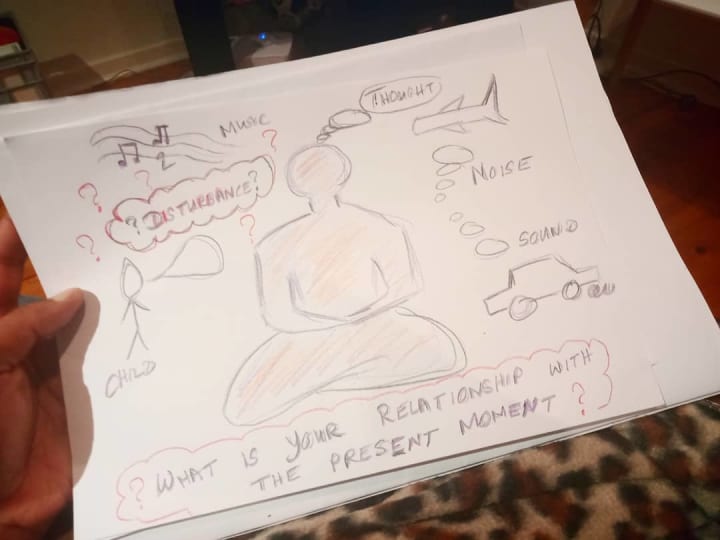
3. One must allocate seperate time, and it's difficult to schedule in modern busy lifestyles.
I'm sure this has it's benefits. But, if you are anything like me, this would be your biggest excuse not to meditate. More and more spiritual teachers, promote brininging meditation into everyday practice, integrating it with your everyday activities.
4. One has to be into crystals, incense, and various other "cultural" traits we see in those who come from a cultural background that practice meditation.
It's always nice to create an ambience. A ceremonious start, can influence slowing down of your mind, getting it ready for the meditatoin practice. But definitely not essential.
5. It's a competion, where we can compare who is the best meditator!
The only person you are in competition with is yourself. Namely, your mind. The irony is, if you try to shut your mind, you will notice, it is in fact your mind, telling your mind to shut-up. The skills required for this competition is patience, forgiveness, honesty with self, perserverance, and seeing the victory in imperfection.
Why Meditate?
In our modern times, the number of people who are impacted by stress, anxiety, depression, and loneliness, are considerably high. The fast paced life we experience as a society, where we spend the least amount of time with the most valued people in our lives, our family, and where we do not have time to look after one another. We are too busy worrying, either about the past, or the future.
In fact, according to the Australian Beuraux of Statistics, in year 2018 alone, the number of people who died because of self-harm, is over 3000, and self-harm ranks at the 14th highest cause of death, with a median age group of 44.4.
Having attempted suicide myself, and almost succeeding, at the age of 24, 3 months after my father's death, also the thoughts bubbling up, every now and then, I am aware, although an external situation, or a life challenge triggers emotions like sadness, hurt, frustration, or anger, the responsiblity of converting them into depression, anxiety, and other more serious forms of mental states, lays on how we respond to them and our practices around the emotion(s) experienced. It is not to say, our modern day social and economic structures don't play a part, but to highlight, that all of us have a choice, even when we lay in a dark corner of the world, contemplating our exit strategy.
If you haven't already, you will soon realise that the bulk of our life's problems are not in the problematic situation itself, but in the way we percieve, respond, and carry it in our mind.
Changing how we see the world would mean, a change to what we've practiced up until this point in our lives, our internal wiring. You will need to start observing your mind chatter throughout the time, so that you can practice observing your mind in high emotional intesity situations. You can then retrospectively and constructively advise yourself, on improvements. Once you have sufficient practice doing this, you will be able to practice it real time.
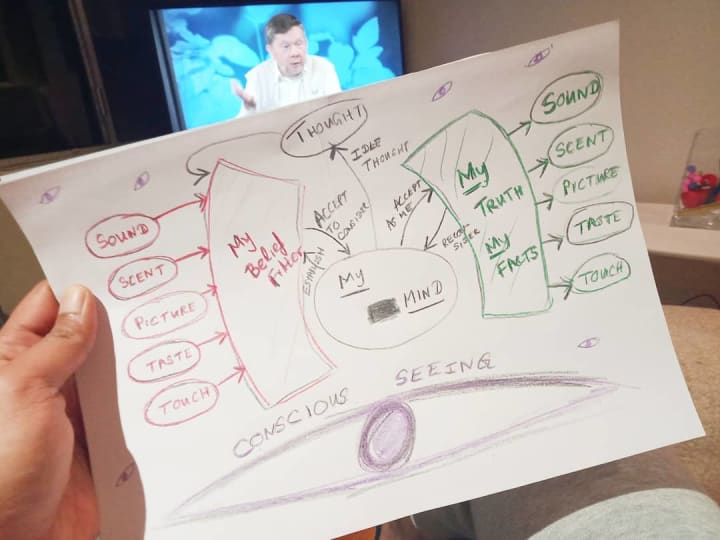
Depending on your age, assuming you have never meditated, or practiced presence in one way or another, your mind activity probably happens at light-speed, and your observation skills are probably at crawling speed.
Let me explain by asking you a question
Do you ever walk into a room and not remember why you came there in the first place?
Do you ever walk somewhere and suddenly realise you are at the destination, and you can't recall how you got there?
Do you ever notice a landmark, that had existed since way before your time, on the road you frequently travel, but never seen before.
When such experiences happen, it is an indication that you have been fully absorbed and identified in your mind activity. This would mean, that your mind has been analysing, discussing, and disecting, one of your ideas, or past experiences. If you remain "unconscious" when you have a stream of mind chatter (where your observer skills are way slower than speed of mind chatter), you will not know what you told yourself, you don't know your unhealthy chatter. Not only that, your body has already responded with it's chemicals to any emotions that were triggered by your mind chatter. Worst out of all, you have started believing something you told yourself, and you don't even know the full detail of it!
The practice of "Concentration Meditation" helps to slow the mind chatter, in turn, help us observe our own mind activity stream. Therefore, Concentration Meditation, acts as a "helping tool" for "Introspectoin" or "Retrospection".
However, my personal experience thus far points at "Concentration Meditation" as the art of living. The Introspection and Retrospection has been key for my own journey towards healing from past pain. The insights you gain through first hand knowlege of human mind, helps to reduce the emotional intensity of past memories, and increases your empathy and compassion, This helps you focus on the present moment, as you have less to worry. So Introspectoin, and Retrospection, act as "helping tools" for "Concentration" or "Being present".
Chapter 2: Introduction to meditation
1 00:00:00,320 --> 00:00:07,370
A guide to meditation - A practical guide to engage your mind in the activity of walking
2 00:00:08,380 --> 00:00:12,080
Chapter 2 - Body movement as the meditation object
3 00:00:18,680 --> 00:00:20,680
Hello, my name is Nim.
4 00:00:20,880 --> 00:00:22,880
How are we all doing?
5 00:00:23,080 --> 00:00:25,080
I am from Melbourne, Australia
6 00:00:25,279 --> 00:00:27,279
Currently under lockdown.
7 00:00:27,480 --> 00:00:33,290
Welcome to the guidence practice of walking meditation
8 00:00:33,490 --> 00:00:41,470
Where we will be using body movement as our meditation object
9 00:00:44,250 --> 00:00:46,250
It's a different setting
10 00:00:46,450 --> 00:00:49,360
From the standard meditation setting
11 00:00:49,560 --> 00:00:53,940
But, this is our standard scenary.
12 00:00:56,640 --> 00:00:58,640
In fact, this is where we need to practice.
13 00:01:00,980 --> 00:01:03,880
Meditation, being present.
14 00:01:09,560 --> 00:01:11,560
First of all, may I ask y ou.
15 00:01:14,760 --> 00:01:18,610
to ask your selves, how do you know you are walking?
16 00:01:18,810 --> 00:01:22,470
or, to be inclusive, I'll ask, how do you know you are moving
17 00:01:26,840 --> 00:01:30,860
whether you are using a wheel chair, or whether you are using a walker.
18 00:01:34,610 --> 00:01:38,460
or whether you are walking.
19 00:01:40,730 --> 00:01:44,780
First of all, may I suggest, moving around, while considering
20 00:01:47,880 --> 00:01:51,810
How do I know, that I'm walking
21 00:01:58,810 --> 00:02:03,120
Our eyes are like really good video software.
22 00:02:05,600 --> 00:02:09,900
That procesesses thousands of frames each second.
23 00:02:15,150 --> 00:02:17,150
If one is not visually impaired,
24 00:02:17,580 --> 00:02:22,620
One of the first indicators for us to know that we are indeed in movement
25 00:02:26,460 --> 00:02:28,460
Is to notice that
26 00:02:33,770 --> 00:02:35,770
the frames changed.
27 00:02:40,360 --> 00:02:42,360
The scenary changes.
28 00:02:47,690 --> 00:02:49,690
There is movement.
29 00:03:02,010 --> 00:03:04,010
Now, try closing your eyes
30 00:03:06,710 --> 00:03:08,710
when your environment is safe to do so
31 00:03:08,910 --> 00:03:10,910
while in movement
32 00:03:14,210 --> 00:03:16,210
How do you know now that we are in movement.
33 00:03:26,260 --> 00:03:28,260
What you may have noticed
34 00:03:28,460 --> 00:03:31,700
In the earlier session where you closed your eyes
35 00:03:34,540 --> 00:03:37,920
is that every time, to enable movement, we do something
36 00:03:38,119 --> 00:03:40,119
with our body
37 00:03:43,270 --> 00:03:45,270
To those of you who are using a wheel chair
38 00:03:48,120 --> 00:03:50,120
It could be a button
39 00:03:50,320 --> 00:03:54,440
or using your hands to get the wheels into motion
40 00:03:57,230 --> 00:03:59,230
or it could be using your legs.
41 00:04:01,330 --> 00:04:03,330
but if you are closing your eyes,
42 00:04:03,400 --> 00:04:05,400
you cannot see that activity
43 00:04:09,800 --> 00:04:11,800
but you still know
44 00:04:12,000 --> 00:04:14,000
that you are in movement.
45 00:04:21,620 --> 00:04:23,620
So, for us to conclude,
46 00:04:27,100 --> 00:04:30,830
we first ask ourselves, how we know
47 00:04:31,030 --> 00:04:33,030
that we are in movement.
48 00:04:35,810 --> 00:04:37,810
and we first observe, our scenary changes.
49 00:04:38,820 --> 00:04:43,430
what ever we process through our external sensory organs,
50 00:04:43,970 --> 00:04:46,630
we noticed a change.
51 00:04:49,160 --> 00:04:51,160
then we closed our eyes.
52 00:04:51,360 --> 00:04:53,360
while continuing to move.
53 00:04:56,610 --> 00:05:00,000
then we noticed, our body movement.
54 00:05:01,880 --> 00:05:03,880
changes
55 00:05:05,970 --> 00:05:08,680
As the final practice
56 00:05:10,220 --> 00:05:12,220
bring these together.
57 00:05:15,660 --> 00:05:17,660
You are conscious that
58 00:05:17,860 --> 00:05:19,860
your body is moving
59 00:05:22,640 --> 00:05:24,640
but you are also conscious
60 00:05:24,840 --> 00:05:26,840
that the external setting is changing.
61 00:05:32,990 --> 00:05:34,990
If thoughts arise
62 00:05:36,290 --> 00:05:38,290
telling your self, "Ah, I'm moving"
63 00:05:41,370 --> 00:05:43,370
or
64 00:05:43,570 --> 00:05:45,570
I am seeing this,
65 00:05:45,770 --> 00:05:47,770
or I am seeing that,
66 00:05:47,969 --> 00:05:49,969
I am feeling this,
67 00:05:50,169 --> 00:05:52,169
I am feeling that,
68 00:05:52,369 --> 00:05:54,369
be ok with it.
69 00:05:59,330 --> 00:06:01,330
but remember,
70 00:06:03,670 --> 00:06:05,670
if you weren't telling yourself, that you were in fact meditating,
71 00:06:05,870 --> 00:06:07,870
or practising presence
72 00:06:10,040 --> 00:06:12,040
those mental labels wouldn't have come up, at all.
73 00:06:14,980 --> 00:06:16,980
instead, you would be telling yourself some other thing
74 00:06:19,780 --> 00:06:21,780
about a future possibility or a past experience.
75 00:06:26,340 --> 00:06:28,340
I hope you enjoyed this practice.
76 00:06:28,540 --> 00:06:31,650
There is one more video that I'm planning to do.
77 00:06:31,849 --> 00:06:33,849
That is to integrate
78 00:06:34,870 --> 00:06:37,840
sound or music, to body movement.
79 00:06:39,180 --> 00:06:43,200
I must say, that must be my most favourite form of meditation
80 00:06:48,670 --> 00:06:50,670
catch me in the next chapter.
81 00:06:50,870 --> 00:06:52,870
Thank you.
About the Creator
Nim Madanayake
Just another human, walking this earth, experiencing life, questioning "what is our purpose"... I feel I have found it.
Other blog site: https://nimeshe.blog.
LinkedIn: https://www.linkedin.com/in/nimeshe/
Keep reading
More stories from writers in Longevity and other communities.
Day 4 of Quitting
If this is how sobriety feels, maybe it’s better to go through life a little buzzed… this, along with other hits like, I want to kill myself, I wish I was dead, and I’m going to throw myself off a bridge have been the only thoughts on rotation these past few days. I promise myself that if, in a month, I still feel like this (‘this’ meaning despondent, full of rage, and simultaneously numb) I can go back to smoking. Until mid-February though? Nicotine is off the table.
By sleepy drafts9 days ago in Longevity
The 10 Best Diets for Weight Loss That Are Sustainable and Recommended By Nutritionists
As a dietitian, I know that weight loss is a common goal at the start of a new year. But it’s important to approach it with a focus on health, balance, and sustainability. As a calorie deficit is necessary to lose weight, the right eating pattern makes a difference. It can support your journey while also nourishing your body, improving energy levels, and promoting overall well-being. It’s not about quick fixes or extreme measures—the best diets for weight loss are about finding an approach that works for you in the long term.
By Good health to everyone2 days ago in Longevity
A Dart at Dusk
Seconds ago, the sullen sun set on the two of us… my exuberant furry companion and me. A fresh breeze embraces us, delivering welcome relief from the day’s oppressive heat. His typical stumbling and staggering along — apace with a sloth — has turned into trip-trapping, high-stepping, almost skipping along.
By Angie the Archivist 📚🪶2 days ago in Petlife


Comments
There are no comments for this story
Be the first to respond and start the conversation.