
Why Your Brain Loves Procrastination (and 3 Science-Backed Ways to Beat It)
Neuroscientists Reveal How to Hack Your ‘Instant Gratification’ Wiring – Without Guilt
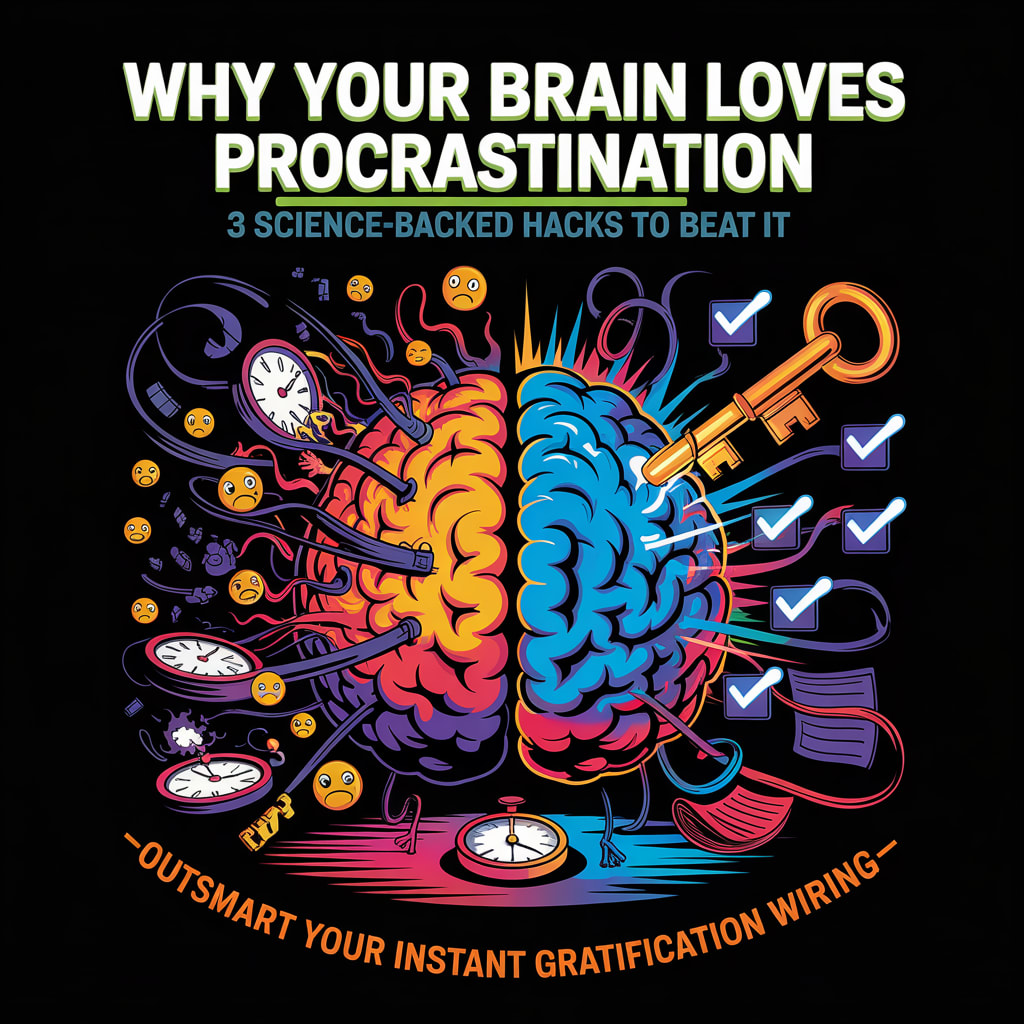
You open your laptop to work, but 30 minutes later, you’re deep diving into YouTube’s algorithm. It’s not laziness—it’s your brain betraying you. Procrastination isn’t a moral failing. It’s biology. According to the American Psychological Association, 88% of people procrastinate daily, often on tasks critical to their careers, health, or relationships. But why does your brain sabotage you? And how can you outsmart it?
The Procrastination Paradox: Why Your Brain Chooses Distraction
Your brain is locked in a battle between two systems:
1. The Prefrontal Cortex: The logical planner that sets goals like “finish the report by Friday.”
2. The Limbic System: The primitive reward seeker that craves instant relief from stress or boredom.
When faced with a task, your limbic system shouts, “This feels hard! Let’s avoid it!” Meanwhile, the prefrontal cortex—the part responsible for willpower—gets overwhelmed. A 2022 study in Neuron found that stress shrinks the prefrontal cortex’s activity by up to 30%, making procrastination almost inevitable.
The Evolutionary Roots
Procrastination isn’t a flaw—it’s a survival mechanism. Early humans prioritized immediate threats like predators over long-term goals like storing food. Today, your brain still treats abstract deadlines as low stakes. As psychologist Dr. Fuschia Sirois explains: “Your brain can’t fear a PowerPoint presentation the way it fears a lion.”
3 Science-Backed Fixes to Rewire Your Brain
Strategy 1: The 10 Minute Rule
How It Works: Commit to working for just 10 minutes. No pressure to finish.
The Science: A University of Chicago study found that 80% of participants continued working past the 10 minute mark. Starting is the hardest part—once you begin, momentum kicks in.
Real Life Example: Sarah, a freelance writer, used this rule to tackle a 50 page report. “I told myself, ‘Just write one paragraph.’ Two hours later, I’d finished six pages.”
Action Step: Set a timer for 10 minutes. When it rings, ask: “Do I want to stop?” You’ll often choose to keep going.
Strategy 2: Temptation Bundling
How It Works: Pair a dreaded task with a dopamine boosting activity you love.
The Science: Wharton researchers found bundling increases task compliance by 51%. By linking work to pleasure, you hijack your brain’s reward system.
Examples:
Listen to a true crime podcast only while doing dishes.
Watch an episode of your favorite show after drafting three emails.
Case Study: A 2023 Stanford trial had students bundle math homework with a “mystery podcast” they could only access while studying. Homework completion rates soared by 63%.
Strategy 3: Precommitment Devices
How It Works: Remove future choices to protect yourself from impulsivity.
The Science: A Behavioral Science Journal study showed precommitment slashes procrastination by 40%. When you decide in advance, you bypass the limbic system’s resistance.
Tools to Try:
App Blockers: Use Freedom or Cold Turkey to block social media during work hours.
Public Promises: Tell a friend, “I’ll send you the draft by 5 PM.” Shame avoidance is a powerful motivator.
Money Bets: Apps like StickK let you bet cash on hitting goals. Lose money if you procrastinate.
The 21 Day Procrastination Detox Plan
Week 1: Master the 10 Minute Rule
Days 1 to 3: Use the timer for small tasks like replying to emails.
Days 4 to 7: Apply it to bigger projects like writing or coding. Track wins in a journal.
Week 2: Add Temptation Bundling
Choose 3 tasks you avoid like invoicing or gym. Pair each with a reward like audiobook or smoothie.
Pro Tip: Rotate rewards to keep your brain guessing. Unpredictability boosts dopamine.
Week 3: Lock In With Precommitment
Block distracting apps for 2 hours daily.
Share one daily goal on social media like “Posting my workout at 7 PM!”
Week 4: Reflect and Optimize
Review your journal. Ask:
When did I procrastinate most like after lunch or late nights?
Which strategy worked best?
Adjust your plan. Example: If afternoons are weak, schedule hard tasks for mornings.
When Procrastination Is Healthy
Not all delay is bad. Strategic procrastination can:
Boost Creativity: Adobe’s teams found “incubation periods” increased idea quality by 34%.
Prevent Burnout: Author Tim Ferriss schedules “procrastination days” to recharge.
Improve Decisions: A Harvard study showed people who slept on choices made 22% better outcomes.
Warning Signs:
You’re avoiding tasks due to fear, not strategy.
Procrastination causes guilt or missed deadlines.
The Takeaway: Befriend Your Brain
Your brain isn’t broken—it’s wired to seek comfort. Instead of fighting biology, hack it. Start small, reward often, and let your limbic system believe it’s winning. As neuroscientist Dr. Judson Brewer says: “Self control isn’t about willpower. It’s about wisdom.”
Your First Step: Open your phone. Set a 10 minute timer. Write one sentence. Watch procrastination lose its grip.
About the Creator
Top 10 Questions to Ask Every Perth NDIS Service Before You Engage Them
Choosing the right National Disability Insurance Scheme (NDIS) provider shapes the quality of care, independence, and outcomes a participant experiences. In Perth, families and participants face a growing number of service options, which makes informed decision-making essential.
By Anshul Vijay5 days ago in Lifehack




Comments
There are no comments for this story
Be the first to respond and start the conversation.