
Why Remote Workers Get Overlooked for Promotions
Remote workers are not overlooked because they lack ability.

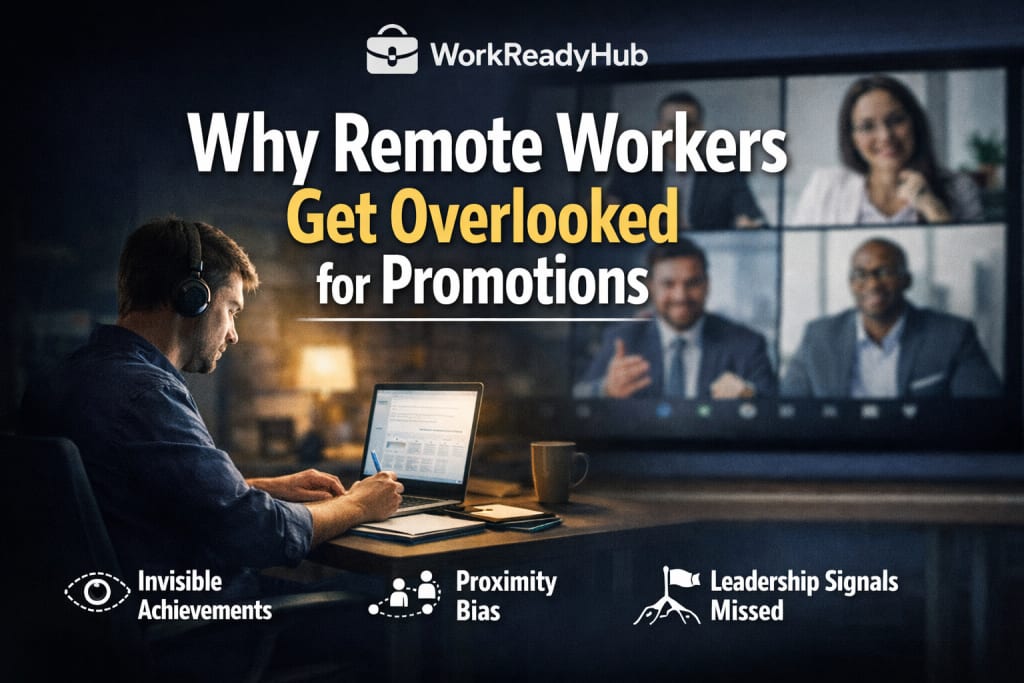
There is a quiet frustration many remote professionals carry, but rarely articulate.
They work hard.
They meet deadlines.
They solve problems.
They stay consistent.
Yet when promotion season arrives, someone else moves up.
And from their perspective, it feels confusing.
Because in their mind, they did everything right.
The reality is more subtle.
Remote workers are not overlooked because they lack ability.
They are overlooked because the mechanics of visibility have changed — and most professionals have not adjusted to that change.
In traditional office environments, visibility is automatic.
When you are physically present, your effort becomes part of your manager’s daily observation. They see you in meetings. They see you staying focused. They see how others interact with you. They see your involvement.
Your presence becomes perception.
Remote work removes that passive layer.
Now, perception must be engineered.
And this is where many capable professionals fall behind.
They continue operating as if performance alone is enough.
But performance without translation is silent.
There are four structural reasons remote employees get overlooked for promotions.
The first is proximity bias.
Even in remote-first companies, leaders are still human. They subconsciously give more weight to individuals they interact with frequently and comfortably. If your communication is minimal, purely task-based, or reactive, your professional presence feels smaller than your actual contribution.
Not because you are less capable — but because you occupy less cognitive space.
The second issue is what I call the silent contribution problem.
Remote professionals often complete complex, valuable work. But when asked for updates, they summarize their efforts in simple operational language.
“I finished the report.”
“I handled the tickets.”
“I completed the deliverable.”
That language minimizes impact.
Promotion decisions are not based on how busy you are.
They are based on perceived business value.
Leaders promote individuals who clearly demonstrate how their work improves efficiency, revenue, client satisfaction, systems, or team performance.
If your communication focuses on tasks instead of outcomes, your value becomes invisible.
Which brings us to the third issue: output versus outcome confusion.
Output describes activity.
Outcome describes change.
There is a significant difference between saying:
“I managed 20 support cases this week.”
And saying:
“I reduced average response time by 18% over the last 30 days, improving customer satisfaction scores.”
One describes effort.
The other signals strategic impact.
Promotion is not a reward for effort.
It is an investment in perceived leadership capacity.
This leads to the fourth and most overlooked factor: promotion decisions are risk decisions.
When leadership considers elevating someone, they are not simply asking, “Does this person work hard?”
They are asking:
“Does promoting this individual increase stability, clarity, and performance for the team?”
If your contributions are undocumented, unclear, or inconsistently communicated, promoting you feels uncertain.
Uncertainty delays advancement.
Remote environments amplify this effect because informal visibility no longer fills in the gaps.
So what changes the outcome?
Not longer hours.
Not burnout.
Not over-delivering silently.
The shift is strategic visibility.
Strategic visibility means:
Translating tasks into measurable outcomes.
Documenting wins weekly.
Communicating progress proactively.
Demonstrating initiative beyond assigned responsibilities.
Showing foresight, not just reliability.
It also means understanding that leadership perception matters.
Many remote professionals become known as dependable executors.
They complete assignments well. They meet expectations.
That is valuable.
But promotions often go to individuals who demonstrate thinking beyond their role — who anticipate problems, suggest improvements, and communicate in terms of business impact rather than personal workload.
This does not require arrogance.
It requires clarity.
A simple self-assessment can reveal where you stand:
Can you summarize your last 30 days in three measurable outcomes?
Does your manager understand the broader impact of your work?
Have you documented achievements in a structured way?
Have you intentionally positioned yourself as someone capable of greater responsibility?
If the answer to these questions is unclear, then the issue is not competence.
It is communication structure.
Remote promotion is rarely accidental.
It is engineered through consistent visibility, measurable value, and strategic positioning.
Once you understand that, you stop waiting to be noticed.
You begin shaping how your contribution is perceived.
And in remote systems, perception drives progression.
About the Creator
Bahati Mulishi
Practical advice on remote work, IT careers, and professional skills to help you stay work-ready anywhere in the world.
Keep reading
More stories from Bahati Mulishi and writers in Lifehack and other communities.
How to Get Promoted in a Remote Job
Remote work changed how we get hired. It also changed how we get promoted. In a traditional office, visibility is automatic. You’re seen walking in early. You’re seen staying late. You’re in meetings. You’re in the hallway conversations.
By Bahati Mulishi3 days ago in Lifehack
The Quarterly OKR Review: Getting the Most from Your Retrospectives
The end of an OKR cycle is not simply an administrative milestone where scores are recorded and new objectives are set. It is, or should be, the most valuable learning opportunity in the entire process. Yet many organisations rush through their quarterly reviews, treating them as a box-ticking exercise rather than the strategic conversation they deserve.
By Jane Smithhabout 22 hours ago in Lifehack
When the Shelter Closes
Across the street from my house, a man slept under a tree, his dog by his side. My first, naive thought: he must be traveling through. But he kept coming back, often sleeping there during the day. Then it hit me—that person might not have a home.
By Bride of Sound5 days ago in Humans


Comments
There are no comments for this story
Be the first to respond and start the conversation.