
How to Get Promoted in a Remote Job
Without Begging for It

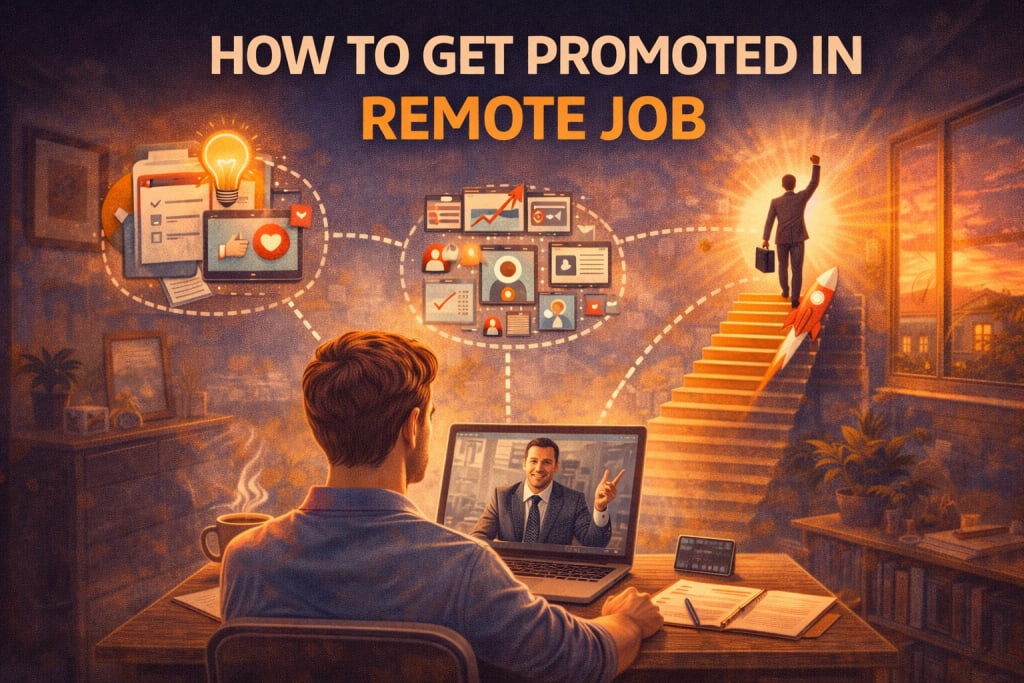
Remote work changed how we get hired.
It also changed how we get promoted.
In a traditional office, visibility is automatic. You’re seen walking in early. You’re seen staying late. You’re in meetings. You’re in the hallway conversations.
In remote work?
If you don’t make your impact visible, you can disappear.
And that’s where most new remote professionals get it wrong.
They assume good work speaks for itself.
It doesn’t.
Not remotely.
The Harsh Truth About Remote Promotions
Promotions in remote jobs aren’t about effort.
They’re about leverage and visibility.
Managers promote people they:
Trust
Notice
And see creating measurable impact
If your work lives quietly in shared drives and private Slack messages, you’re invisible.
You may be working hard.
But you’re not building career equity.
Mistake #1: Thinking Productivity = Promotion
You can complete every task assigned to you and still stay stuck.
Why?
Because promotions don’t go to task-completers.
They go to problem-solvers.
If you want to move up in a remote job, shift from:
“I finished my tasks.”
To:
“I improved a system.”
“I solved a bottleneck.”
“I reduced time or increased revenue.”
That’s leverage.
Leverage makes you valuable beyond your job description.
Mistake #2: Waiting to Be Noticed
In remote environments, managers are busy. Very busy.
They’re not tracking every small win you produce.
If you don’t communicate your wins, they often go unseen.
That doesn’t mean bragging.
It means strategic visibility.
For example:
Share weekly progress summaries.
Highlight measurable outcomes.
Document improvements you introduced.
Publicly thank teammates when projects succeed (this subtly positions you as a contributor).
Visibility in remote work must be intentional.
If people don’t see your growth, they won’t reward it.
Step 1: Master Your Current Role First
Before asking for more responsibility, dominate your current role.
Be reliable.
Be consistent.
Be someone who doesn’t create extra management stress.
In remote jobs, managers value low-friction employees.
If your manager trusts that you’ll execute without micromanagement, you’ve already increased your promotion probability.
Trust is currency in remote environments.
Step 2: Expand Beyond Your Job Description
This is where leverage is built.
Start asking:
What problems is my manager constantly stressed about?
What bottlenecks slow down our team?
What repetitive tasks could be automated or improved?
Then take initiative.
Not recklessly.
Strategically.
For example:
Create documentation where none exists.
Suggest workflow improvements.
Offer to lead a small project.
Mentor new hires.
When you become someone who improves the team — not just performs tasks — your value multiplies.
Step 3: Communicate Impact, Not Activity
This is critical.
Never report effort.
Report outcomes.
Bad example:
“I worked on the client report this week.”
Strong example:
“I streamlined the client reporting process and reduced preparation time by 30%.”
See the difference?
One sounds busy.
The other sounds promotable.
Remote leaders care about measurable impact because that’s easier to evaluate in distributed teams.
Step 4: Build Cross-Team Visibility
If only your direct manager knows you, your influence is limited.
Find ways to:
Contribute in cross-functional meetings
Collaborate with other departments
Share insights that benefit more than just your immediate team
The more people who associate your name with reliability and competence, the stronger your internal reputation becomes.
Remote promotion is often reputation-driven.
Step 5: Have the Promotion Conversation
This is where many people freeze.
They wait.
And wait.
And wait.
Instead, schedule a structured career conversation.
Ask:
“What skills or results would I need to demonstrate to move to the next level?”
Now you’re no longer guessing.
You’re working toward clear criteria.
This shifts you from hopeful to strategic.
The Reality Most People Avoid
If your company has no growth pathway, no budget, or no interest in internal mobility — you may need external leverage.
Sometimes the promotion comes from:
A title upgrade at another company
A salary jump elsewhere
Or using an offer as negotiation power
Remote work gives you global options.
Don’t forget that.
Final Thought: Promotions Follow Positioning
In remote jobs, you are not promoted because you deserve it.
You’re promoted because your value is visible, measurable, and strategically aligned with company goals.
So stop focusing only on being busy.
Focus on:
Building trust
Increasing impact
Expanding influence
And communicating results clearly
That’s how remote professionals rise.
Not by waiting.
But by positioning.
About the Creator
Bahati Mulishi
Practical advice on remote work, IT careers, and professional skills to help you stay work-ready anywhere in the world.
Keep reading
More stories from Bahati Mulishi and writers in Lifehack and other communities.


Comments
There are no comments for this story
Be the first to respond and start the conversation.