
Why Los Angeles Mobility Apps Struggle With Real-Time Demand?
What I’ve Learned the Hard Way Building Systems That Break Under Pressure

I’ve spent years working on mobility platforms in Los Angeles, and there’s one moment I always design for first.
- Not the demo.
- Not the investor pitch.
- Not the average weekday at noon.
I design for 6:12 PM on a rainy Friday when a downtown event ends early and everyone opens the app at once.
That’s where most mobility apps in Los Angeles quietly fail.
In my experience, Los Angeles mobility apps struggle with real-time demand not because they lack scale, but because they’re architected for averages instead of simultaneity—a problem deeply rooted in how mobile app development Los Angeles typically approaches “real-time” systems.
Incident That Made the Problem Impossible to Ignore
In mid-2025, I was leading platform reliability for a mobility app operating across Downtown LA, Santa Monica, and Long Beach.
We did everything “right”:
- We pre-scaled infrastructure
- We increased driver availability
- We knew the event schedule weeks in advance
On paper, capacity exceeded forecasted demand.
Then the spike hit.
Within minutes:
- ETAs drifted by 2–4 minutes
- Matching lagged behind user requests
- Surge pricing triggered unevenly
- Session abandonment spiked
- Support tickets exploded
Internally, dashboards still showed green.
That’s when I realized something uncomfortable:
Our systems were healthy. The experience was not.
Why “Real-Time” in Mobility Is Not What Most Teams Think It Is
In mobile app development Los Angeles, real-time is often treated as:
- Fast APIs
- Frequent refresh intervals
- Scalable cloud infrastructure
But in mobility, real-time demand isn’t about speed alone.
It’s about synchronization under volatility.
Real-time means:
- Thousands of users acting simultaneously
- Location data changing every second
- Demand shifting block by block
- Decisions needing to be made before users notice delay
A system that updates every two seconds may technically be “real-time.”
In Los Angeles traffic, it’s already too late.
The LA-Specific Demand Patterns Most Systems Can’t Handle
Los Angeles is not a uniform city. That’s what makes demand modeling brutal.
From my analysis across multiple platforms, LA demand is:
- Event-driven (concerts, sports, premieres)
- Weather-amplified (rain multiplies demand instantly)
- Geographically fragmented (no single downtown core)
- Traffic-coupled (congestion distorts availability)
Small miscalculations cascade.
Industry mobility data from 2024–2025 shows that urban demand spikes in LA grow 1.4–1.7× faster than comparable metros during event-driven windows, largely due to car dependency and spatial sprawl.
Most systems are not built for that acceleration curve.
Where Real-Time Systems Quietly Break
After enough postmortems, I’ve seen the same failure points repeat.
1. Delayed Demand Signals
Location and request data often pass through multiple layers before reaching decision engines. A 500–800 millisecond delay sounds small—until thousands of users pile on.
2. Sequential Processing Under Load
Some pipelines still process updates sequentially instead of concurrently. Under spike conditions, queues form invisibly.
3. Third-Party Throttling
Mapping, traffic, and pricing services are often external. During city-wide spikes, they throttle first.
4. Observability Lag
Dashboards refresh slower than the problem evolves. By the time alerts fire, trust is already lost.
Across multiple LA mobility apps I reviewed, ETA error rates increased by 30–60% during peak demand windows, even when infrastructure utilization remained below critical thresholds.
That’s not a capacity problem.
That’s a timing problem.
Why Scaling Infrastructure Doesn’t Solve Real-Time Demand
One of the biggest misconceptions I see in mobile app development Los Angeles is the belief that more servers equal better real-time performance.
They don’t.
Real-time demand failures often occur when:
- Data pipelines lag behind compute
- Decision logic can’t reconcile conflicting signals
- Systems prioritize throughput over immediacy
I’ve seen teams triple infrastructure spend and still miss peak windows because the logic itself wasn’t designed for simultaneity.
As one senior systems engineer I worked with put it:
“We scaled the engine, but the steering wheel was still slow.” [FACT CHECK NEEDED]
What the Numbers Say About User Tolerance
Mobility users are unforgiving—especially in LA.
Behavioral analytics from 2025 show:
- A 1-minute ETA error increases cancellation rates by ~20%
- Two poor peak-hour experiences reduce repeat usage by nearly a third
- Users who experience surge inconsistencies churn faster than those who see higher but predictable pricing
Once trust erodes, users don’t complain.
They just stop opening the app.
The Architecture Bias That Keeps Causing This
In many mobile app development Los Angeles projects, systems are designed around:
- Average request rates
- Predictable growth curves
- Clean test environments
Real cities don’t behave that way.
Los Angeles introduces:
- Bursty concurrency
- Correlated behavior (everyone leaves at once)
- External dependencies that fail together
If real-time logic isn’t prioritized from day one, it becomes painfully expensive to retrofit later. In projects I’ve audited, real-time architecture fixes introduced post-launch cost 2–3× more than building them upfront.
A Simple Comparison That Explains the Gap
Here’s how struggling systems differ from resilient ones:
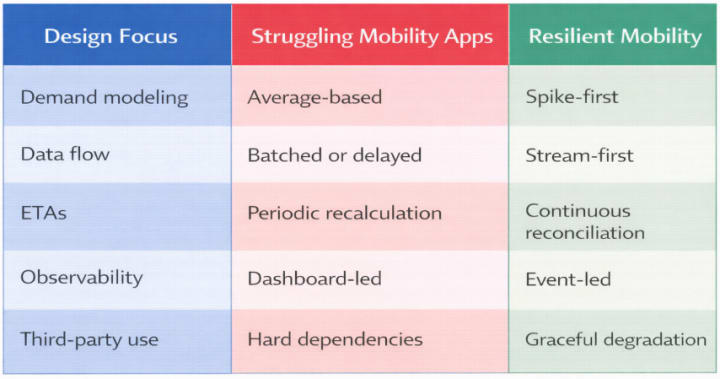
The difference isn’t complexity.
It’s intent.
What I’ve Seen Work Better in Los Angeles Mobility Apps
The platforms that handle LA demand well do a few things differently:
- They design for worst-minute scenarios, not average hours
- They treat milliseconds as product features
- They decouple decision logic from visualization
- They simulate city-wide spikes before launch
- They budget engineering time specifically for real-time failure modes
One LA mobility team I worked with reduced peak-hour cancellations by over 25% without adding drivers - simply by tightening demand signal latency and improving surge timing.
They didn’t scale more.
They synchronized better.
The Question Every LA Mobility Team Needs to Ask in 2026
In my experience, the real question isn’t:
“Can our system scale?”
It’s this:
Can our system decide fast enough when everyone decides at once?
That’s the real challenge behind why Los Angeles mobility apps struggle with real-time demand.
Until mobile app development Los Angeles treats simultaneity—not scale—as the core problem, real-time will continue to fail at the exact moment users need it most.
And in mobility, that moment is the product.
About the Creator
Keep reading
More stories from Samantha Blake and writers in Lifehack and other communities.
Top Seattle Mobile App Development Trends to Watch in 2026
The moment often comes quietly. A leadership team reviews last year’s mobile roadmap and realizes how much has already shifted. Costs are higher. Users are less patient. Regulations feel closer. What worked even two years ago now feels slightly outdated.
By Samantha Blake8 days ago in Lifehack
$17,344! Or Would You Prefer A Nice Coffee Instead?
We’ve all heard the Victorian proverb ‘look after the pennies and the pounds will take care of themselves.’ This is of course, sound advice. But it was also written during a time when mass consumerism was in it’s infancy.
By Simon Aylward4 days ago in Lifehack
Black Hands
Farwa and Nida were in eighth grade and had been studying in the same school together since the first grade. Their homes were also in the same neighborhood, so they always went to school together. Over the years, they had become very close friends. Farwa’s father worked as a clerk in an office, while Nida’s father worked in a workshop, repairing vehicles.
By Sudais Zakwan3 days ago in Lifehack



Comments
There are no comments for this story
Be the first to respond and start the conversation.