
Unpopular Opinion: Inherit the Wind
Why inheritance should be abolished.
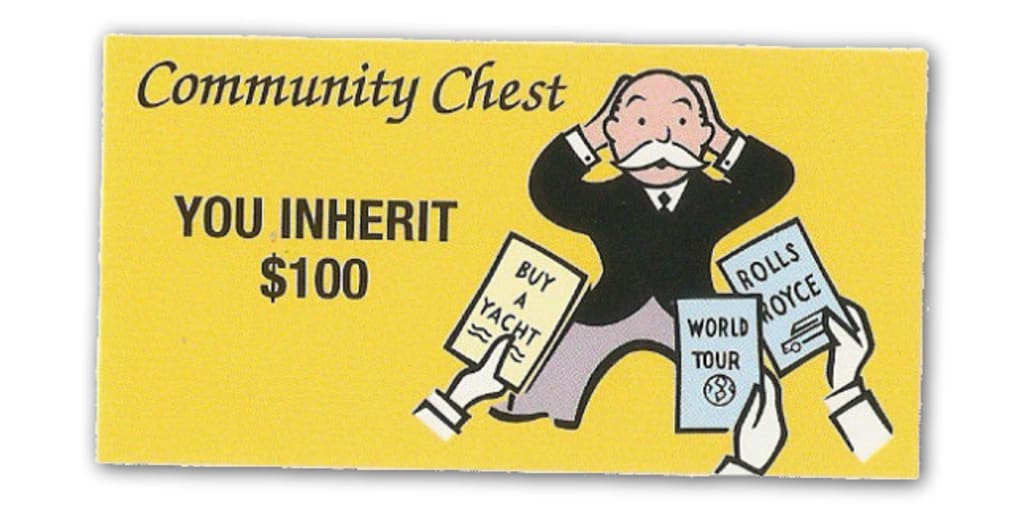
In the midst of every bereavement there is a great deal of admin for someone to deal with, organising the funeral and afterwards, executing the will. A few years ago now, my grandmother died. She was in her late eighties but it was devastating for all of us. Her children, my mother and her siblings, made the arrangements in accordance with her wishes. They managed this with remarkable calm, given the grief they were all experiencing at the time, though they have always got on better than most siblings.
My Grandmother was not a wealthy woman but she owned her home, which like every home in Sydney had grown in value significantly over the years, and when she died it was sold and the money divided equally between her children. I don't know exactly how much it went for but even after the money for this cosy two-bedroom apartment was divided in five, there was still at least $100,000 per child, including my mother.
This was a substantial silver lining for all of us but my parents in particular. Our house had been flooded along with many others in Australia a few years previously and my parents were anxious to raise the house on stilts to reduce the risk of it being damaged again when the flood waters inevitably return. As you can imagine, raising an entire house into the air and setting concrete reinforced stilts underneath is not cheap. However while my mother's inheritance didn't cover the cost entirely, it paid for a great deal of it and allowed my parents to secure our home without going deep into debt.
On the surface this might seem to be a clear demonstration of the value of inheritance, the wealth of the dead helping to improve the lives of the living, particularly those who were dearest to them. This would be true, if it applied to everyone, but it doesn't. Thousands of houses were damaged or destroyed in the floods that damaged our house, most of them hit far worse than we were.
But most people don't have an inheritance to save them from financial troubles whether they're caused by natural disasters, medical emergencies, or unemployment. Meanwhile, my parents, having received a substantial inheritance from their parents when they died, were able to spend that money on their own home which will now be worth even more in years to come than it did before.
Some day, hopefully very far in the future, my parents will also die and their house will become another inheritance, this time split only in two, between my sister and I. This will be a substantial windfall for both of us but it will be entirely undeserved. Not because our family is bitterly divided or estranged but because at its heart, all inheritance is undeserved.
My parents house was my childhood home and there are memories of this place that only my sister and I share. But it is also a financial asset with many hundreds of thousands of dollars and it would be disingenuous to gloss over that fact. Owning a home is the life long ambition of most people, an ambition that many are never able to achieve, so to be handed a 50% stake for no effort at all in a comfortable middle-class home is luxury in the extreme.
If my family were the only beneficiaries of inheritance or the most extreme example of it then this would not be such a serious problem. But while we are far better of than most people there are millions of others, just in a small country like Australia who have even greater assets to pass on to their descendants. Then consider the billionaires across the globe where their inheritances reach ridiculous proportions. The children of Jeff Bezos can look forward to a shared in heritance of over $100,000,000,000 US.
While few would defend an inheritance of that size many would defend their right to inherit homes, property, businesses, or other assets worth at least what I could inherit, if not much more. Some argue that it is the right of the person who earned that money to choose who it goes to after they die. This is understandable, it is their money after all. But we must consider the effects of that idea.
Because not everyone has the same amount of money to leave to their descendants or even the same number of descendants. Even if we pretend that this inequality is entirely down to the choices those people made, which it definitely isn't, this still guarantees that the next generation will be unequal from the start. Why should some people receive less because their parents were poorer? Especially as those who inherit great wealth tend to have benefitted from that wealth throughout their lives already and conversely for those who don't.
People born with a silver spoon in their mouths tend to inherit much more silver than just the spoon and often an education to go with it that many families cannot afford.
Take my family. When my mother and her siblings inherited their mother's home none of them were wealthy, but they all already owned their own homes, mortgages paid off and all, as far as I know, and enough financial stability that their children could go to university without needing a scholarship, if they wanted to.
Others argue that they should inherit the family home, property, farm, business, or antiques because these possessions have history within the family, it's a tradition, passed on through generation that the descendants should live in, run, maintain, the family property and they have a connection that is stronger than any stranger could.
Again there is some sense in what they say, and in the case of possessions, those that have no financial value could easily be written off a list of possessions with no negative consequences for anyone else. But there is a difference between keeping your grandfathers watercolours that he painted in retirement and inheriting a Van Gogh. When it comes to property we have to ask, is the emotional connection really more important than ensuring that the next generation has an equal start?
Because the money gathered by abolishing inheritance could bring benefits far greater than the losses. For every person as well off as my grandmother there are many other elderly people who struggle through retirement or who can't afford to retire at all. Many worry that their families won't be able to afford to pay for their funeral. Free funerals and a substantial increase in the old age pension would improve the lives many elderly people and those closest to them.
Any money remaining could be invested in many of the things that people spend their inheritances on, but for all of society, education, affordable housing, financial assistance for new small businesses. A world without inheritance would feel strange at first but before long we'd find it absurd we'd ever had it.
About the Creator
Keep reading
More stories from Chris Richardson and writers in Lifehack and other communities.
Why did I Go?
I’m standing in a carriage on the Tokyo subway, scrolling through my newsfeed. A familiar place pops up, Mallacoota. When I was there a few years ago, it was a boring seaside town with no Wi-Fi; and the only mobile reception was at the local cemetery.
By Chris Richardson6 years ago in Wander
The Nutrient Gap No One Talks About When It Comes to Focus and Attention
Key Takeaways Taking the proper nutrients helps maintain optimal body function. The vagus nerve is a vital component in the connection between the brain and the gut. The right supplements, such as Neupril Pure Methylfolate, play a key role in helping clear brain fog.
By Tess DiNapoliabout 12 hours ago in Lifehack
Why Film Studios Are Desperate to Win Back Gen Z Audiences
When Barbie crossed $1.4 billion at the global box office in 2023, Hollywood finally stopped blaming Gen Z for “killing cinema” and started asking a harder question: what did this film get right that so many others didn’t?
By Quite Brilliant6 days ago in Lifehack



Comments
There are no comments for this story
Be the first to respond and start the conversation.