
Top Books That Introduce a New Way to Approach Mental Health and Wellbeing
Mental Health Wellbeing
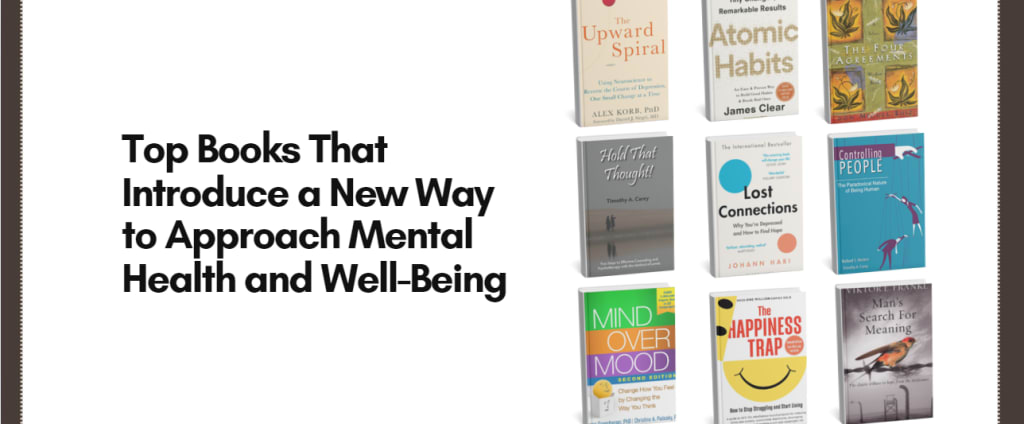
Discussions of mental health are changing. Older methods tend to focus on formal interventions, but more recent views contradict these concepts—instead, they concentrate on how people naturally control their own experiences.
PCT and MOL-based books present a new approach: instead of controlling thoughts or feelings in pre-specified manners, these methods highlight awareness, self-exploration, and a deeper understanding of how one views the world and their place in it.
If you're searching for books that transform your perception of well-being and personal development, here are some books that question the status quo.
1. The Method of Levels: How To Do Psychotherapy Without Getting In The Way – Timothy A. Carey
This book describes the Method of Levels (MOL) Therapy, a technique distinct from conventional models of counseling. Instead of delivering preconceived solutions, MOL invites participants to examine their thinking at the moment, thus naturally and richly changing perceptions.
Key Takeaways:
- Most effectively, therapy avoids imposing foreign models but lets individuals discover their own solutions.
- Clarity is often reached by observing second-order thoughts and permitting higher awareness to arise.
- A therapist's (or even an individual's) task is not to guide but to pose questions that provoke introspection.
Those who are interested in learning how conversations can be used to bring profound change without set methods need to read this book.
2. Hold That Thought! Two Steps to Effective Counseling and Psychotherapy with the Method of Levels – Timothy A. Carey
If you’ve ever felt stuck in repetitive thoughts or decisions, Hold That Thought! Provides a clear, conversational breakdown of MOL Therapy and why people experience internal conflicts.
Key Takeaways:
- People don’t need external guidance as much as they need the right space to explore their thoughts.
- Internal conflicts arise when different goals or perceptions clash—once noticed, they can often be resolved naturally.
- Just noticing what you say to yourself can provide information that creates effective change.
This book is a good place to begin for anyone interested in the way thinking habits create our state of mind and how changing the way you see things can resolve inner turmoil.
3. Controlling PEOPLE: The Paradoxical Nature of Being Human – Richard S. Marken & Timothy A. Carey
Ever wondered why people resist change—even when they seem to want it? Controlling PEOPLE explores the paradox of control: while people constantly seek control over their lives, they resist external control from others.
Key Takeaways:
- People don’t react directly to the world; they act to control their perceptions of the world.
- Conflict arises when someone tries to control another person's experience rather than allowing them to regulate it themselves.
- Knowing how control operates can enhance communication, relationships, and personal development.
This book is especially applicable to leaders, educators, and anyone who wishes to influence others without opposition.
4. Deconstructing Health Inequity: A Perceptual Control Theory Perspective – Timothy A. Carey, Sara J. Tai, Robert Griffiths
Why do health inequities remain in existence despite solutions being within reach? This book translates Perceptual Control Theory (PCT) into social and systemic problems and demonstrates how inequities come about due to clashes between individuals' and societies' control systems.
Key Takeaways:
- Individuals interact with healthcare differently according to their perceptions of control.
- Structural solutions tend not to work since they do not recognize people as controlling agents.
- True change results from creating environments in which people can control what is important to them without preventing others from doing the same thing.
This is a book that must be read by anyone interested in healthcare reform, public policy, and the underlying psychological processes that drive social injustice.
5. Patient-Perspective Care: A New Paradigm for Health Systems and Services – Timothy A. Carey
The majority of healthcare systems concentrate on providing services instead of what the individual requires to be in control. This book redesigns how medical services must be organized in line with PCT principles.
Key Takeaways:
- Individuals interact more effectively with healthcare when they are in control of the decisions.
- The system must adjust to the individual, not vice versa.
- By understanding perceptual control, healthcare professionals can design more efficient, patient-perspective care.
For health and service industry professionals, this book provides a paradigm shift in the delivery of care.
6. Loving What Is – Byron Katie
Although not directly derived from PCT, Loving What Is is very much in line with PCT principles. The book presents "The Work," a method that enables individuals to challenge their thinking and change perceptions. For some people “The Work” might make sense. If it doesn’t fit for you, explore other ideas.
Key Takeaways:
- Suffering tends to arise from fighting against what is rather than observing it for what it is.
- By doubting thoughts instead of accepting them as true, individuals can transform their entire experience of a situation.
- What might seem to be an outside problem is frequently one of viewpoint and perception.
This book enhances the MOL method by having readers actively question and change their own perspectives.
7. The Subtle Art of Not Giving a F*ck – Mark Manson
This highly engaging book has advice to enhance personal well-being. Rather than encouraging toxic positivity, Manson contends that deciding what truly matters is the secret to a great life. Manson’s advice might help you make sense of your turmoil. If it doesn’t help like you might have hoped, it just means it’s not a good fit. You’ll find something that is more your size if you keep searching and questioning.
Key Takeaways:
- Being selective about what we control can be helpful.
- Not all struggles must be solved—often the best transformation stems from shifting how we make sense of experience.
- Rather than shying from unease, individuals must move into what really matters in pursuit of personal goals.
This shares a key premise of PCT: individuals regulate their experience naturally, and well-being is enhanced by concentrating on what they can actually control.
8. CONTROL in the CLASSROOM: An Adventure in Learning and Achievement – Timothy A. Carey
For parents, teachers, and anyone who works with students, this book provides an approach to learning, education, and schooling based on PCT. It demonstrates how students learn best when they are in control of their learning process.
Key Takeaways:
- Education must facilitate students' sense of control, not impose rigid rules and results.
- When students have trouble, the problem is usually not the subject, but a perceptual conflict.
- Teachers who know how students self-regulate their learning can build more interesting and productive classrooms.
This book is a must-read for teachers who recognize people as autonomous, self-motivated learners.
Final Thoughts
Each of these books provides a different avenue to mental wellness, but all of them express a fundamental idea:
People are always pursuing goals.
Distress stems from internal disagreements.
When individuals increase their awareness of their patterns of thinking, transformation follows naturally.
Whatever your interest--personal development, therapy, teaching, or healthcare--these books offer insights challenging conventional wisdom and empowering readers to become active agents in their own lives.
Do you want book recommendations for a particular topic area, e.g., relationships, workplace issues, or personal development?
About the Creator
Keep reading
More stories from Aaron Alleyne and writers in Lifehack and other communities.
Top Takeaways from Hold That Thought! – A New Way to Think About Therapy
Commonly, correcting disruptions to wellbeing takes a formal path—diagnosing problems, discovering solutions, and implementing techniques. But what if the actual secret to knowing ourselves is not about adhering to a constructed protocol or regimen, but about examining our own thoughts in an open-ended way?
By Aaron Alleyne11 months ago in Blush
Top 10 Questions to Ask Every Perth NDIS Service Before You Engage Them
Choosing the right National Disability Insurance Scheme (NDIS) provider shapes the quality of care, independence, and outcomes a participant experiences. In Perth, families and participants face a growing number of service options, which makes informed decision-making essential.
By Anshul Vijaya day ago in Lifehack
9 Foods You Should Never Eat Past the Expiration Date, No Exceptions
But certain foods cross a line where the expiration date becomes about more than just quality—it’s about safety. Eating past that line can expose you to dangerous bacteria, toxins, or nutrient loss you can’t see or smell. Knowing which foods to never push beyond their expiration dates is key to keeping your kitchen safe. Here are the nine foods that are not worth the risk.
By General gyana day ago in Lifehack



Comments
There are no comments for this story
Be the first to respond and start the conversation.