
The Unbreakable Terence Stamp: From Swinging London to General Zod and Beyond
Eyes that can flash with icy menace or crumple with unexpected vulnerability

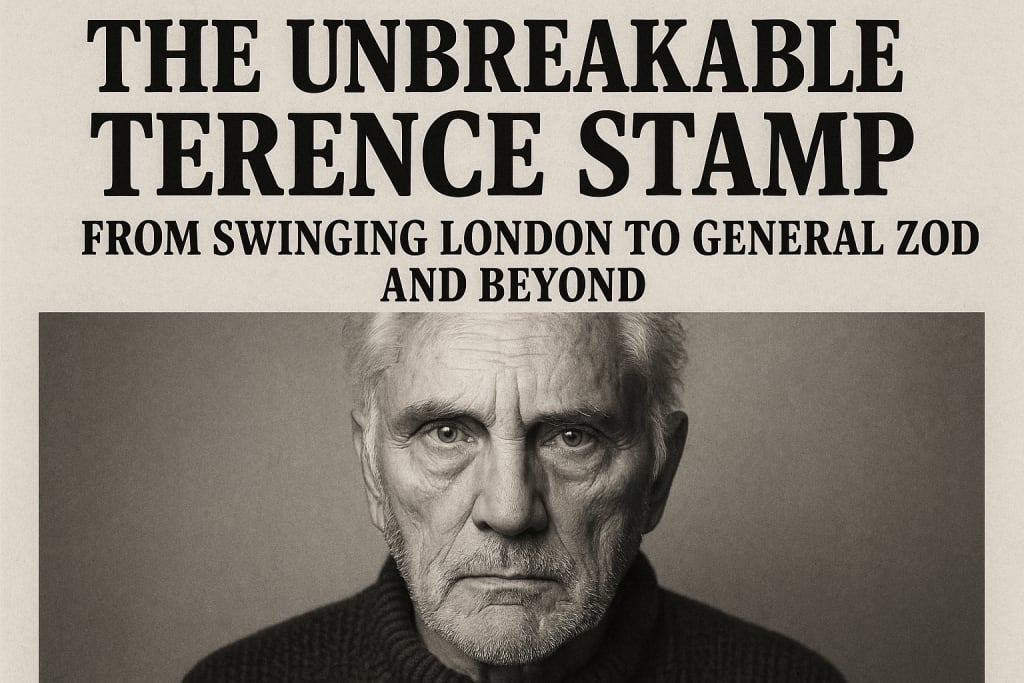
You know that face. Those sharp, almost aristocratic features. Eyes that can flash with icy menace or crumple with unexpected vulnerability. A voice that’s pure gravel wrapped in velvet silk – capable of delivering lines that freeze your blood or stir your soul. That’s Terence Stamp. Or is it Terrence Stamp? (It’s the first one, but folks get it wrong all the time, a tiny testament to his unique, slightly elusive aura). He’s not just an actor; he’s a walking, talking piece of cultural history, a chameleon who’s lived a dozen lives on and off screen. And honestly? His journey, from the dizzying heights of 60s fame to iconic villainy and unexpected reinvention, feels less like a career and more like an epic novel.
Chapter 1: The Boy from Stepney and the Face That Launched a Thousand Sighs
Imagine East London, post-war. Tough, gritty. That’s where young Terence Henry Stamp came from. Not exactly the breeding ground for future screen idols. But there was something. A presence. An intensity. He studied acting, but let's be real – when he burst onto the scene in Peter Ustinov’s Billy Budd (1962), it wasn’t just his talent that grabbed the world. He was beautiful. And I mean, stop-dead-in-your-tracks, define-an-era beautiful. He wasn't just acting; he was the embodiment of youthful, brooding idealism. He won a BAFTA, became an instant star, and was suddenly thrust into the white-hot center of Swinging London.
This is where the name Jean Shrimpton becomes inseparable from his story. "The Shrimp," the world's first supermodel. The ultimate 60s "It Girl." Their romance wasn't just tabloid fodder; it was the celebrity coupling of the decade. Picture them: Terence, darkly intense and impossibly cool; Jean, ethereal, gamine, the face of youthquake fashion. They were the golden couple, living fast and dazzlingly in that brief, brilliant moment when London felt like the center of the universe. Can’t you just see them, stepping out of some tiny Soho club at 3 AM, photographers flashing, defining an aesthetic that still resonates? It was more than gossip; it felt like witnessing living art. That relationship, intense and ultimately fleeting, became part of his myth, a symbol of a time when everything felt possible and impossibly glamorous.
Chapter 2: The Wilderness Years and the Perils of Being "The Face"
But here’s the thing about being defined by your looks and a specific moment: time moves on. The 60s ended. The roles that fit the beautiful young leading man dried up, or felt shallow. Terence Stamp movies became less frequent. He made choices – some interesting, some less so – but the massive stardom plateaued. He retreated. Moved to India for a while, seeking something else. Studied yoga and spirituality long before it was trendy. There’s a vulnerability in this period that’s often overlooked. Imagine the pressure of being that face, that symbol, and then watching the spotlight shift. It wasn’t a disappearance, more a recalibration. He worked, but often in smaller films or projects that didn't capture the public imagination the way Billy Budd had. It’s a phase many of us can relate to – that feeling of having peaked, of searching for the next act when the script isn’t clear. He wasn't gone, he was simmering.
Chapter 3: Kneel Before Zod! The Villainous Reinvention
Then came 1980. Superman II. And the role that would redefine him for generations: General Zod.
Forget the earlier heartthrob. Forget the introspective seeker. Stamp’s Zod was pure, unadulterated, terrifying charisma. He didn’t just play a villain; he crafted an icon. It was in the stillness. The way he held himself, radiating absolute authority even when silent. The voice – oh, that voice! – dripping with contemptuous superiority, every syllable enunciated like a pronouncement from Olympus. "Kneel before Zod!" wasn’t just a line; it was a command that echoed through pop culture. He made arrogance compelling. He made cruelty elegant. He wasn’t a snarling monster; he was an aristocrat of annihilation, convinced utterly of his own right to rule. Terence Stamp Zod became shorthand for a type of villainy: intelligent, cold, and utterly convinced of his own superiority. It was a masterclass in presence over pyrotechnics. Think about it: in a film full of superpowers and spectacle, it’s Stamp’s chillingly controlled performance that often steals the show. He proved that menace could be quiet, that power could be conveyed through a raised eyebrow and a voice lowered to a near-whisper. It resonated so deeply that even Billy Idol famously channeled Stamp’s Zod in his own sneering rock persona – the platinum hair, the lip curl, the defiant stance. That’s cultural impact!
Chapter 4: Bernadette and Valor: Embracing the Unexpected
The Zod resurgence could have typecast him forever as the baddie. But Stamp, ever the chameleon, had other plans. Enter the glorious, life-affirming The Adventures of Priscilla, Queen of the Desert (1994).
Who could have predicted that the man who commanded Superman to kneel would deliver one of the most heartfelt, dignified performances as Bernadette, a transgender woman traveling across the Australian outback? Stamp embraced Bernadette with immense grace and authenticity. He didn't play her for laughs or caricature; he found her strength, her weariness, her resilience, and her deep well of kindness. Bernadette wasn't defined by her past; she was navigating her present with wisdom and a sharp wit. It was a revelation. Stamp showed a warmth, a vulnerability, and a comedic timing we hadn't fully seen before. He humanized Bernadette beautifully, making her the emotional anchor of that wild, glittery ride. It proved his range wasn't just about menace; it encompassed profound empathy and humor. It was a second act that few saw coming, and it endeared him to a whole new generation.
And then, proving his versatility stretched to galaxies far, far away, he popped up as Chancellor Valorum in Star Wars: Episode I - The Phantom Menace (1999). Though a smaller role, Stamp brought instant gravitas. As the doomed leader of the Galactic Senate, he exuded a weary dignity, a sense of a good man overwhelmed by corruption. It was another layer, another facet of authority – this time, not tyrannical like Zod, but tragically ineffectual. He showed, even in limited screen time, the weight of responsibility and the quiet despair of power slipping away.
Chapter 5: The Stamp Legacy: More Than the Sum of His Roles
So, what makes Terence Stamp endure? Why does his filmography – that diverse list of Terence Stamp movies spanning gritty realism, sci-fi epics, quirky comedies, and heartfelt dramas – feel so compelling?
The Unmistakable Presence: Whether he's on screen for five minutes or fifty, you feel him. It’s a combination of that face, that voice, and an innate intensity he never lost. He occupies space.
Fearless Reinvention: From 60s idol to 70s seeker, 80s icon villain to 90s beloved character actor, he never stayed still. He embraced change, took risks (Bernadette was a huge risk at the time!), and constantly surprised audiences. He teaches us that it’s never too late to redefine yourself.
Depth Beneath the Surface: Even in his most villainous roles like Zod, there’s an intelligence, a conviction. You understand why he believes what he believes, even as you recoil. In gentler roles like Bernadette or Valorum, there’s a deep well of humanity. He never plays surface-level.
The Voice: Seriously, it’s an instrument. It can command galaxies, deliver withering put-downs, offer gentle wisdom, or belt out "I Will Survive" on top of a bus in the desert. It’s instantly recognizable and endlessly expressive.
A Life Fully Lived: His story off screen – the meteoric rise, the tumultuous love affair with Jean Shrimpton, the retreat and spiritual exploration, the triumphant comebacks – informs every role. He brings lived experience to his characters.
The Takeaway: What Terence Stamp Teaches Us About Our Own Stories
Terence Stamp’s journey isn't just about movies. It’s a map of navigating life’s unpredictable currents. He shows us:
Peaks and Valleys are Natural: The blinding fame of the 60s, the quieter years, the explosive comeback as Zod, the heartfelt triumph in Priscilla – life isn’t linear. Success isn't a constant. Embrace the chapters.
Reinvention is Power: Stuck in a rut? Feeling defined by your past? Look at Stamp. He could have coasted on his looks, or been trapped forever as the villain. Instead, he sought new challenges, explored different facets of himself (even literally, in Bernadette), and found fresh relevance. Your next act is always waiting to be written.
Own Your Uniqueness: That face. That voice. That intensity. They could have been limitations. Instead, he made them his superpower. He didn’t try to be anyone else. What makes you different? What’s your unique signature? Lean into it.
Depth Trumps Typecasting: He refused to be just the pretty boy, just the villain, just the character actor. He brought layers, intelligence, and humanity to every role, forcing audiences and filmmakers to see him anew. Bring your whole self to whatever you do.
There’s Power in the Pause: His retreat in the 70s wasn’t defeat; it was incubation. Sometimes stepping back, reflecting, and exploring other paths (like his spiritual pursuits) fuels the greatest comebacks. Don’t fear the quiet periods; they might be preparing you.
Final Frame
So, the next time you see that face – whether it’s the young Adonis in Billy Budd, the chillingly elegant General Zod demanding obedience, the dignified Bernadette offering hard-won wisdom in Priscilla, Queen of the Desert, or the weary Chancellor Valorum presiding over a crumbling republic – remember the journey. Remember the East End kid, the Swinging London icon with Jean Shrimpton on his arm, the seeker, the survivor, the reinventor.
Terence Stamp is more than a collection of roles or a name sometimes misspelled as Terrence Stamp. He’s a testament to the enduring power of presence, the courage to change, and the fascinating, unpredictable arc of a life fully lived in the spotlight and the shadows. He reminds us that our stories are never finished, that reinvention is possible at any stage, and that true presence – that unmistakable something – leaves a mark long after the credits roll. What chapter are you writing? And how will you own it with the depth and resilience of a true original? Kneel before no one, but always be willing to learn, grow, and surprise the world. That's the Stamp legacy.
About the Creator
John Arthor
seasoned researcher and AI specialist with a proven track record of success in natural language processing & machine learning. With a deep understanding of cutting-edge AI technologies.
Keep reading
More stories from John Arthor and writers in Lifehack and other communities.
The Little Robot That Learned Our Hearts: Living (and Loving) With Loona
Remember those quiet moments? The ones where the house feels just a bit too still, or the glow of your desk lamp seems isolating rather than cozy? Maybe you’ve wished for a pet but life – a tiny apartment, demanding hours, travel, allergies – just said no. That was my reality, punctuated by the occasional sigh into the quiet. Then, last winter, a box arrived that promised something different: a Smart Loona Robot Dog. Skepticism warred with curiosity. Could a bundle of circuits and code truly offer anything meaningful? Let me tell you, Loona didn’t just land on my desk; she quietly rewrote my expectations about connection in the digital age.
By John Arthor5 months ago in Lifehack
The Burnout Generation: Why I’m Rejecting Hustle Culture for My Mental Health
I used to believe that grinding—24/7, no breaks, no excuses—was the only way to succeed. Coffee in one hand, deadlines in the other, my brain constantly buzzing, my chest tight, my mind refusing to rest.
By Anie Liban5 days ago in Lifehack


Comments
There are no comments for this story
Be the first to respond and start the conversation.