
The Silent Phone: Unpacking the Real Reasons You're Asking "Why Am I Not Getting Traffic to My Website?"
Late nights, countless cups of coffee, the thrill of watching your vision take shape online.

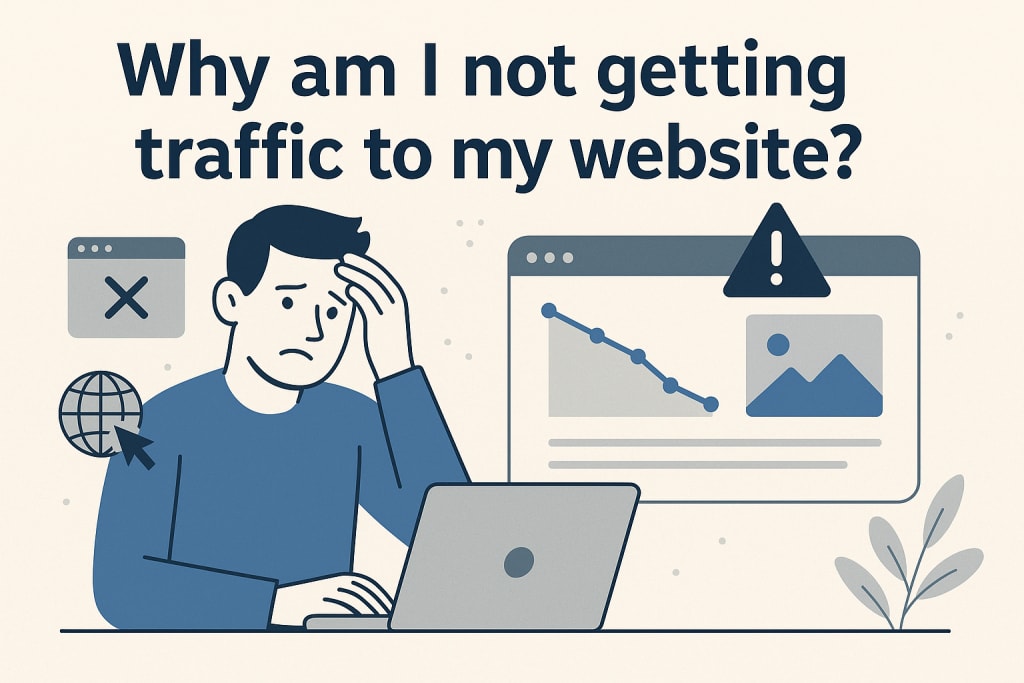
You’ve poured your heart into it. Late nights, countless cups of coffee, the thrill of watching your vision take shape online. You hit “publish,” and you wait. You check your analytics the next morning. Maybe a few clicks. Probably just you and your mom. A week goes by. A month. That number stays stubbornly, heartbreakingly low.
You’re left staring at the screen, asking the universe the most frustrating question: Why am I not getting traffic to my website?
It feels personal. It’s easy to fall into a pit of doubt. “Is my idea bad? Is my writing not good enough? Am I just invisible?” Let me stop you right there. It is almost certainly none of those things.
Think of your website not as a static billboard, but as a new shop on a vast, bustling, global high street. You’ve built a beautiful storefront, stocked the shelves with amazing products (your content), and turned on the lights. But outside, millions of people are rushing past, eyes fixed on the giant, familiar department stores they already know. They don’t even know your little shop exists.
Your question isn’t a sign of failure. It’s the first, crucial step toward being found. Let’s walk through this together. Let’s figure out where those people are and how to invite them in.
The Foundation: It Starts With Knowing Who You're Talking To
Before we talk about tactics, we have to talk about people. I made this exact mistake with my first blog. It was a “lifestyle” blog. I wrote about everything from sourdough starters to productivity hacks to book reviews. I thought I was casting a wide net! Surely someone would find something they liked.
The result? A ghost town. The problem wasn’t the topics; it was the lack of a target. I was shouting, “Hey, everyone, look at this!” into a crowded room. Nobody turned around because nobody felt specifically called.
Imagine you’re at a party. Someone shouts, “Does anyone want food?” A few people might amble over. But if someone seeks you out and says, “I heard you love spicy food—I just made these incredible jalapeño poppers, would you like one?” You feel seen. You’re immediately interested.
Your website needs to be that second person.
Actionable Insight: Grab a notebook. Define your one, ideal person. Give them a name, a job, a hobby, a problem they need to solve. For example, instead of “people who like fitness,” your person might be “Emma, a 30-year-old graphic designer who sits all day, feels stiff, and is intimidated by gym culture but wants to feel stronger and have more energy.”
Now, every piece of content you create is a conversation with Emma. You’re not writing generic “5 Workout Tips.” You’re writing “5 Desk-Friendly Stretches for Designers with Achy Shoulders.” See the difference? When Emma finds that article, she’ll think, “This is exactly for me.” That’s how you turn a casual visitor into a loyal fan.
The Content Conundrum: You're Either Solving a Problem or Telling a Story
People don’t visit websites just to look at them. They come with a purpose. They have a question that needs an answer, a problem that needs a solution, or they want to feel connected to a story.
If your content isn’t doing one of those two things, it’s just digital wallpaper.
A local bakery’s website that only has a homepage saying “Welcome to Our Bakery! We sell bread.” is missing the mark. What people are searching for is: “Best birthday cake near me,” “Gluten-free pastry downtown,” or “How to keep a sourdough starter alive.”
Their website should have content that answers those searches: “Our Top 10 Most Popular Birthday Cakes,” “A Guide to Our Gluten-Free Options,” “Baker Bob’s 5 Tips for a Happy Sourdough Starter.”
This is where the magic of keywords comes in, but not in a robotic way. It’s simply about language. It’s about learning how your “Emma” speaks and what she types into that search bar. Why am I not getting traffic to my website? might be because you’re answering questions nobody is asking, or you’re using language your perfect person wouldn’t use.
Real-World Scenario: My friend launched a beautiful site for her handmade pottery. She had gorgeous photos and artist statements. But she got no traffic. We looked at her analytics—zero people were searching for “contemporary ceramic artisanal vessels” (her phrase). But thousands were searching for “unique handmade mugs” and “personalized wedding gift ideas.”
She changed her content to speak the language of her customers, not the language of a gallery curator. Traffic started to trickle, then flow.
The Invisibility Cloak: Mastering the Basics of Being Found (SEO)
You can have the best content in the world, written for a specific person, solving a real problem. But if Google doesn’t understand what it’s about, it’s like having a masterpiece painting locked in a basement.
Search Engine Optimization (SEO) sounds terrifyingly technical. Strip away the jargon, and it’s just about being a good librarian. You’re helping the librarian (Google) understand what your book (your webpage) is about, so they can recommend it to the right person.
Ignoring SEO is a primary reason many entrepreneurs hit a wall and wonder, why am I not getting traffic to my website? Here are the non-negotiable, human-friendly basics:
Page Titles & Descriptions: This is the title and blurb that appear in search results. It’s your first—and sometimes only—chance to grab a click. Make it compelling! Instead of “Services | My Business,” try “Flawless Landscape Photography for Seattle Weddings | Jane Doe Photography.”
Headers are Your Best Friend: Use H2 and H3 headers liberally. They break up your text for readers, but they also shout the main themes of your post to Google. Think of them as chapter titles in a book.
Image Alt Text: Google can’t “see” images. Alt text is a simple description of what the picture is. Instead of “IMG_3042.jpg,” write “woman laughing while eating a chocolate croissant at sunny cafe.” This is also crucial for accessibility, helping visually impaired users understand your site.
Speed Matters: If your site takes more than a few seconds to load, people leave. And Google notices that. Use free tools like Google PageSpeed Insights to check your score. Often, simple fixes like compressing images can make a world of difference.
Mobile-First: The majority of web traffic is on phones. If your site is clunky, tiny, or hard to navigate on a mobile device, you’re rejecting most of your audience before they even read a word.
The Myth of "Build It and They Will Come": The Power of Active Promotion
This is the hardest pill to swallow for many passionate creators. Publishing a post is not the finish line; it’s the starting gun.
The internet is noisy. Waiting for people to stumble upon your site is like hoping someone will find a specific book in a library of a billion volumes by wandering the aisles. You need to put that book in their hands.
This means promotion. It means sharing your work where your ideal person already hangs out.
Social Media, But Strategic: Don’t just post a link. Share a story about why you wrote it. Ask a question related to the topic. Post a compelling snippet or a behind-the-scenes photo. Go where your people are and engage in genuine conversation, don’t just broadcast.
Community Engagement: Find online forums, Facebook Groups, or Subreddits where your “Emma” spends her time. Don’t spam them with links! Become a valuable member. Answer questions, offer advice. Then, when relevant, you can say, “I actually wrote a whole guide on that exact problem, you can find it here if you’d like more detail.”
Email is Gold: If someone gives you their email address, they are raising their hand and saying, “I like what you do. Talk to me.” Nurture that relationship. Send them valuable updates, not just sales pitches. This is your owned audience, immune to the changing algorithms of social media.
Patience and Consistency: The Two Most Boring and Important Ingredients
We’re wired for instant gratification. We see viral posts and overnight successes and think that’s the norm. It’s not. It’s the lottery win.
Sustainable traffic is built like a savings account. You make small, consistent deposits—publishing helpful content week after week, sharing thoughtfully, engaging with your niche. For months, it might feel like nothing is happening. But you’re building compound interest. One piece of content might slowly bring in five visitors a day. Then you have ten pieces doing that. Then fifty. Suddenly, you have hundreds of visitors a day, all from work you did months ago.
This slow build is why so many people quit right before they break through. They ask, why am I not getting traffic to my website? for three months and then give up. The people who succeed are the ones who keep going into the fourth, fifth, and sixth months.
From Silence to Connection
That feeling of staring at an empty analytics dashboard is lonely. But please, reframe it. See that silence not as rejection, but as potential. It’s a quiet room waiting for you to start the right conversation.
Stop talking to the void. Start talking to one person. Solve one real problem for them. Learn how to tell the librarian what your book is about. And then, don’t just leave it on the shelf—carry it out into the town square and share it with passion.
Your website isn’t a monologue. It’s an invitation to a dialogue. It might take time for people to find the invitation, to RSVP, and to show up. But if you’ve built it with a specific human in mind, filled it with value, and made it easy to find, they will come.
The traffic isn’t the goal. The connection is. The traffic is just the path people take to find you. Start building that path today, one helpful stone at a time.
About the Creator
John Arthor
seasoned researcher and AI specialist with a proven track record of success in natural language processing & machine learning. With a deep understanding of cutting-edge AI technologies.
Keep reading
More stories from John Arthor and writers in Lifehack and other communities.
Beyond the Numbers: What a "Good Amount" of Website Traffic Really Means
Let’s be honest. You pour your heart into your website. You craft the words, choose the images, and maybe even lose sleep over the right shade of blue for that button. Then you open your analytics dashboard. A screen full of numbers and graphs stares back. And one question, simple in its wording but endlessly complex in its answer, rises to the surface: What is a good amount of website traffic?
By John Arthor4 months ago in Lifehack
Why Smartphones in 2026 Will Feel Very Different From the Ones You Use Today
The top phones from 2024 and 2025 don't appear that different when you put them next to each other. The displays are a little brighter. The cameras are a bit clearer. The CPUs are a little speedier. But in real life, things haven't altered much. You still swipe. You still tap. You still plug in your phone every night. You still care about battery life.
By abualyaanart7 days ago in Lifehack
Understanding Fabric Durability: How the Martindale Tester Shapes Modern Textile Quality
In the textile industry, durability is one of the most important indicators of product quality. From everyday clothing and upholstery to industrial and protective materials, fabrics are constantly exposed to friction, pressure, and repeated use. To evaluate how well a material performs under such conditions, laboratories rely on standardized testing methods. One of the most widely recognized tools for this purpose is the Martindale Tester, an instrument designed to assess fabric abrasion resistance and pilling behavior in a controlled, repeatable manner.
By Shazad Khana day ago in Lifehack


Comments
There are no comments for this story
Be the first to respond and start the conversation.