
The Science Behind Hair Loss
What Really Causes Thinning Hair?

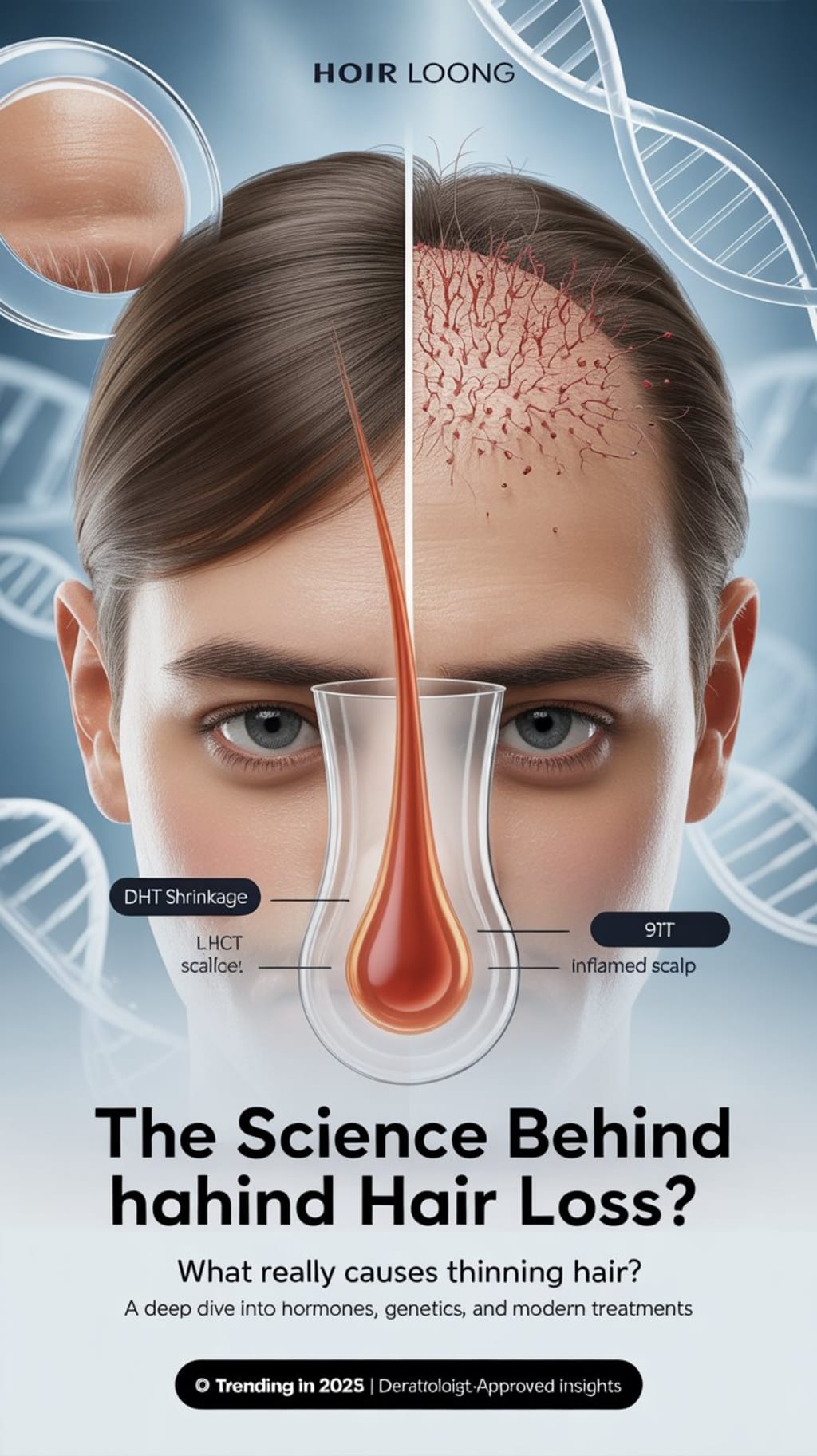
Hair loss is a common concern that affects millions of people worldwide—men and women alike. Whether it's gradual thinning or sudden shedding, hair loss can be emotionally distressing and impact confidence. But what truly causes hair to thin over time? To find answers, we need to explore the science behind hair loss.
Understanding the Hair Growth Cycle
Hair doesn’t grow continuously; it follows a cycle consisting of three main phases:
Anagen (growth phase) – lasts 2 to 7 years, depending on genetics.
Catagen (transitional phase) – a short phase of about 2 to 3 weeks.
Telogen (resting phase) – lasts about 3 months before hair sheds and new hair begins to grow.
At any given time, about 85–90% of your hair is in the anagen phase. When this balance is disrupted, more hair enters the telogen phase, leading to visible thinning or shedding.
The Most Common Causes of Hair Thinning
The most common cause of hair loss is hereditary hair thinning, also known as androgenetic alopecia. It’s responsible for male and female pattern baldness. This condition is driven by a hormone called dihydrotestosterone (DHT), a byproduct of testosterone. DHT binds to receptors in the hair follicles, causing them to shrink and produce thinner, shorter hairs until they stop growing altogether.
Men typically experience a receding hairline or bald spots, while women often notice a general thinning across the scalp.
2. Hormonal Changes
Hormonal fluctuations can significantly affect hair health. Pregnancy, childbirth, menopause, thyroid imbalances, and polycystic ovary syndrome (PCOS) can all disrupt the normal hair cycle. These changes can lead to increased shedding or slower regrowth.
3. Nutritional Deficiencies
Hair requires essential nutrients to grow and stay healthy. Deficiencies in iron, vitamin D, zinc, biotin, and protein can weaken hair strands and trigger thinning. Poor diet, restrictive eating, or underlying conditions like anemia can contribute to these deficiencies.
4. Stress and Lifestyle Factors
Chronic stress, illness, or sudden shock can lead to a condition known as telogen effluvium, where a large number of hair follicles enter the resting phase prematurely. While usually temporary, it can cause noticeable hair shedding.
Lifestyle choices like lack of sleep, smoking, and excessive use of heat or harsh hair products can also affect scalp health and hair quality.
5. Medical Conditions and Medications
Certain medical conditions such as alopecia areata, an autoimmune disorder, cause the immune system to attack hair follicles. Additionally, treatments like chemotherapy, radiation, and medications such as antidepressants or blood pressure drugs may lead to temporary or permanent hair loss.
Scientific Advances in Hair Loss Treatment
In recent years, science has made impressive strides in understanding and treating hair loss. Here are some of the most effective and widely used options:
Minoxidil: A topical treatment that stimulates hair growth by improving blood flow to the follicles.
Finasteride: An oral medication that reduces DHT levels, slowing or reversing male pattern baldness.
PRP Therapy (Platelet-Rich Plasma): Involves injecting the patient’s own plasma into the scalp to encourage regrowth.
Low-Level Laser Therapy (LLLT): Uses laser light to stimulate cellular activity in hair follicles.
Hair Transplant Surgery: A permanent solution that involves moving healthy follicles from one part of the scalp to another.
Final Thoughts
Hair loss is a complex issue that can stem from genetics, hormones, nutrition, stress, and health conditions. While losing some hair daily is normal, excessive thinning shouldn't be ignored. Understanding the science behind hair loss allows individuals to take early and informed action—whether through lifestyle changes, medical treatment, or professional advice.
About the Creator
Syed Umar
"Author | Creative Writer
I craft heartfelt stories and thought-provoking articles from emotional romance and real-life reflections to fiction that lingers in the soul. Writing isn’t just my passion it’s how I connect, heal, and inspire.
I Learned How to “Read” a Book in Just One Hour—And Still Remember Everything
For years, I believed reading a book properly meant going through every single page, line by line, without skipping anything. It felt like a rule you weren’t allowed to break. If you skipped parts, you weren’t really reading—you were cheating.
By Lukáš Hrdlička6 days ago in Lifehack
The Basics of Successful Property Renovation Projects.
Property renovation is a cornerstone of real estate development, especially in markets with distressed or foreclosed homes. In cities across the country—from rapidly growing metros to legacy industrial hubs—renovation plays a vital role in revitalizing housing stock and meeting buyer demand. Successful renovation projects require careful planning, disciplined execution, and proactive management to maximize value and ensure the property meets modern buyer expectations. When approached strategically, renovation transforms underutilized properties into desirable homes while strengthening communities and generating strong financial returns.
By JB Hoover, Newport Beacha day ago in Lifehack
I wanted to title this something different, but worried that my chosen title might cause problems entering the United States in the future so this is the new title. It's the greatest title. No one has ever written a title better than this. (All titles unrelated to content).
Let me be honest. I am finding this difficult. Now, I like a challenge, a stretch, a bit of an obstacle course. “Write about the decline of the British Empire in the form of a narrative poem in which your protagonist is an artichoke” I read, and flex my fingers. “Write a haiku to evoke the sensation of sibilance using only the first half of the alphabet.” “Well”, I think to myself, “this should be fun.” But “write about a system that isn’t working”? A system that isn’t working? Now? In 2026? ONE system? My favourite system that isn’t working? The sexiest system that isn’t working? The one giving me the most angst day to day? The one giving me the most existential dread? I am, as I say, finding this difficult. I will own that I have contemplated writing a thousand words on why the steady “all on” setting on my fairy lights is the EIGHTH of seven options which must be sequentially activated to get there, because that is a system that some fool came up with and it definitely doesn’t work, and now who is paying the price, eh? But how can I write about my fairy lights when…. When…. When….
By Hannah Moore6 days ago in Humans


Comments
There are no comments for this story
Be the first to respond and start the conversation.