
The Rise of AI Future Jobs: What You Need to Prepare
AI Future Jobs: What You Need to Prepare

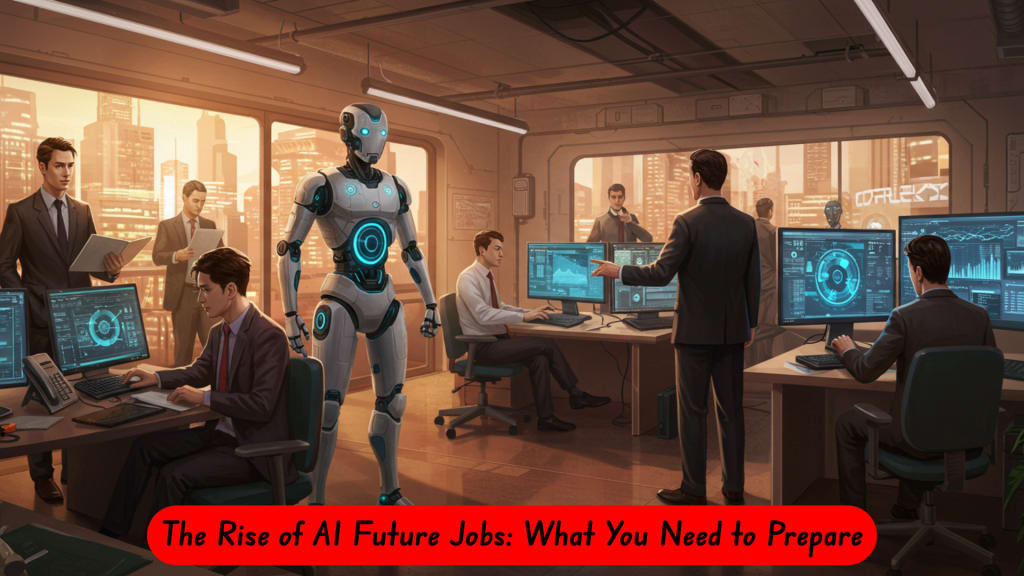
Imagine waking up one morning to discover that your new coworker isn't human - it's an algorithm that never sleeps, never gets tired, and learns faster than anyone in the room.
That might sound like science fiction, but it's already happening. Artificial Intelligence (AI) has quietly woven itself into nearly every industry, from healthcare and finance to education and entertainment. And as this transformation deepens, so does the conversation about the future of work - or, more precisely, about AI future jobs.
A New Era of Work Has Begun
AI is changing not just what we do for a living but how we think about work itself. Automation is reshaping industries, rewriting job descriptions, and creating entirely new professions that didn't exist five years ago.
A recent World Economic Forum report estimates that 85 million jobs could be displaced by automation by 2025 - yet 97 million new roles will emerge in their place. That's not a story of loss; it's a story of reinvention.
You can already see the change: teachers working with AI tutors, marketers using predictive analytics, doctors diagnosing diseases with help from algorithms. The truth is, AI isn't replacing people - it's replacing tasks.
The future belongs to those who learn to work with AI, not against it.
Where the Opportunities Are Emerging
So which careers will grow as AI evolves?
According to McKinsey & Company, the fastest-rising opportunities are in:
- Data science and analytics - turning information into strategy.
- AI ethics and auditing - ensuring fairness and accountability.
- Prompt engineering - teaching AI systems to understand human intent.
- Human-AI collaboration design - improving how people and machines interact.
But the list doesn't stop with technical jobs. Creative professionals are finding new ways to amplify their work. Writers use tools like ChatGPT for ideation, designers experiment with Midjourney for visuals, and musicians compose alongside AI models trained on rhythm and tone.
AI isn't killing creativity; it's expanding its borders.
If you'd like a deeper dive into how emerging tech shapes industries, you can explore related research on ZoneTechAi - where innovation meets real-world insight.
The Skills That Will Keep You Relevant
In the age of AI, the most valuable workers will blend technical fluency with human sensibility. Here's what that looks like:
1. Technical Literacy
Understanding how AI models work - even at a basic level - gives you a massive advantage. You don't need to be a coder, but learning Python, data visualization, or machine learning basics through platforms like Coursera or IBM SkillsBuild can future-proof your career.
2. Creativity and Critical Thinking
AI can analyze data, but it can't imagine what's never been done before. The human ability to connect ideas, tell stories, and find meaning will only become more valuable.
3. Emotional Intelligence
As machines handle more technical tasks, emotional intelligence - empathy, leadership, communication - becomes the human edge. Teams will rely on people who can bridge the gap between data and emotion, technology and purpose.
4. Adaptability
The only constant is change. Workers who continuously learn, pivot, and experiment will thrive. Think of it not as job security, but skill security.
Real-World Examples of AI Future Jobs
To understand how quickly AI is transforming industries, let's look at a few case studies.
Healthcare
Hospitals like Mayo Clinic are using AI to predict patient outcomes and speed up diagnosis. These systems don't replace doctors - they assist them. New roles like AI medical data specialist or clinical algorithm analyst are emerging to bridge technology with care.
Finance
Banks such as J.P. Morgan use AI for fraud detection and legal document analysis, processing data in seconds. This shift creates opportunities for AI risk modelers and financial automation experts.
Education and Creativity
AI tutors like Khanmigo personalize learning, while artists use Adobe Firefly to co-create digital art. The result? A new hybrid workforce that blends human expression with digital intelligence.
The Ethical Side of AI Future Jobs
Of course, not every story about AI is positive. Automation can widen inequality if training and access aren't shared broadly. The International Labour Organization warns that workers in lower-income regions face higher risks of job displacement.
That's why upskilling programs and fair AI governance - like the EU Artificial Intelligence Act - are crucial. We need to make sure AI serves everyone, not just the privileged few.
Ethics and empathy must evolve alongside efficiency.
How You Can Prepare
- Start small. Learn one AI tool or concept each month.
- Build a portfolio. Document your experiments with automation.
- Stay informed. Follow publications like MIT Technology Review or the World Economic Forum.
- Join communities. Collaborate with others who share your curiosity.
If you take one step a week, you'll already be ahead of 90 % of professionals who wait for change instead of driving it.
The Bottom Line
AI isn't here to steal your job - it's here to change what your job means.
The real risk isn't automation; it's stagnation. Those who learn to collaborate with AI will find more opportunities, creativity, and freedom than ever before.
The world is entering a new era of work - and you don't need to be a tech genius to belong. You just need to stay curious, adaptable, and open to evolution.
So the next time someone says "AI is coming," smile and tell them:
"It's already here - and I'm ready."
About the Creator
ZoneTechAi
Discover cutting-edge tech & and AI insights at ZoneTechAi. Expert articles on artificial intelligence, machine learning, robotics, IoT, and cybersecurity.
Keep reading
More stories from ZoneTechAi and writers in Lifehack and other communities.
Generative AI Tools Every Creator Should Know in 2025
Artificial intelligence has evolved from a niche research field into a creative companion for writers, designers, filmmakers, and developers. In 2025, generative AI tools are no longer futuristic experiments - they're everyday instruments that help us work faster, smarter, and more imaginatively.
By ZoneTechAi3 months ago in Lifehack
How Much Does It Cost to Build a Mobile App in Los Angeles?
The first number always comes too fast. It usually appears in an email or on a slide during an early call. A range. Sometimes even a single figure. It feels reassuring because it gives leadership something concrete to react to. Yet almost every experienced product owner in Los Angeles learns the same lesson eventually. The number they remember at kickoff is not the number that defines the project.
By Mary L. Rodriquez5 days ago in Lifehack
How I Reclaimed 5 Hours a Week by Automating Image Descriptions
We live in a visual world. Whether I am writing a blog post, updating a portfolio, or managing social media content, I deal with dozens of images daily. But there has always been a hidden time-killer in my workflow: the need to turn those visuals into text.
By Thomas Vance4 days ago in Lifehack
The steps to losing a child
Step One: Lose a child. Not what anyone wants to happen and nothing you can do to change it, but you can go through steps to becoming happy again. You can go through steps to loving again. You can go through steps to become a new you because after losing a child you will never be the same person you once were.
By Tabitha Hinkley3 days ago in Fiction



Comments
There are no comments for this story
Be the first to respond and start the conversation.