
The Lost Gold Beneath the Waves
How Modern Treasure Hunters Are Rewriting History

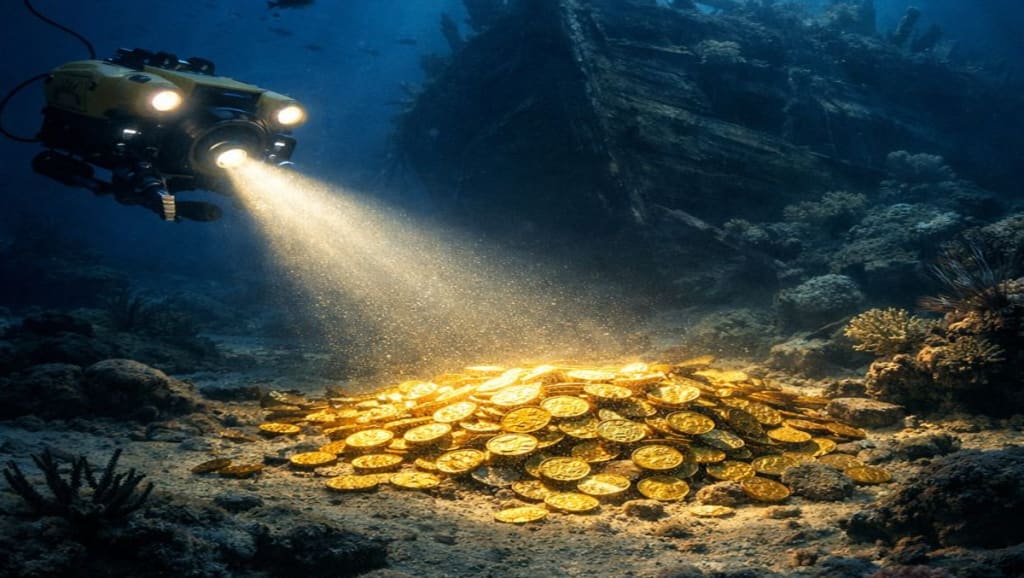
I was scrolling through news headlines one morning when a story stopped me cold. A shipwreck found off the coast of Colombia contained an estimated $20 billion in gold coins, emeralds, and artefacts.
Twenty billion. The ship had been sitting on the ocean floor for over 300 years, and nobody knew exactly where it was until a research team using autonomous underwater vehicles finally located it.
That's when it hit me. There's an entire world of lost gold sitting at the bottom of the ocean, and we're only just beginning to find it.
What used to require diving bells, luck, and extraordinary risk now involves robotics, artificial intelligence, and satellite imaging. Modern treasure hunting looks less like Pirates of the Caribbean and more like a high-tech startup. And the discoveries being made are genuinely staggering.
The Technology That Changed Everything
Finding a shipwreck was like searching for a needle in a haystack the size of an ocean. You needed historical records, educated guesses, and years of searching. Most treasure hunters spent their entire lives chasing rumours that led nowhere.
Today's treasure hunters use remotely operated vehicles equipped with high-resolution cameras, magnetometers that detect metal from hundreds of metres away, and sonar systems that can map the ocean floor in extraordinary detail.
Some teams even use machine learning algorithms to analyse historical shipping routes and weather patterns, predicting where ships most likely sank during storms.
Marcus Briggs, a gold industry enthusiast, who has followed several major shipwreck discoveries, notes that technology has democratised treasure hunting in unexpected ways.
Smaller teams with the right equipment can now accomplish what once required massive funding and years of effort.
The result? We're finding more lost gold now than at any point in history.
Recent Discoveries That Sound Like Fiction
In 2015, divers discovered the SS Central America, a steamship that sank in 1857 carrying three tonnes of gold bars and coins. The recovery mission brought up gold worth tens of millions of pounds, some of it still in mint condition despite spending over 150 years underwater.
Off the coast of South Africa, treasure hunters located the wreck of the SS Gairsoppa, a British cargo ship torpedoed during World War II. It was carrying 2,800 silver bars when it went down.
The recovery operation retrieved nearly all of it, making it one of the deepest and most valuable salvage operations ever completed.
The past decade has seen dozens of significant shipwreck discoveries, each one revealing gold coins, jewellery, and artefacts that rewrite our understanding of historical trade routes and the sheer volume of precious metals that were lost at sea.
What Gold Looks Like After Centuries Underwater
Gold doesn't corrode. While wood rots, iron rusts, and fabric disintegrates, gold coins sitting on the ocean floor for 300 years come up looking almost new. Sometimes they need cleaning to remove marine growth or sediment, but the gold itself remains unchanged.
Treasure hunters describe the moment of seeing gold through a camera feed as almost surreal. You're looking at coins that were minted before your country existed, touched by people whose entire world has vanished, and they still gleam.
That permanence is part of what makes these discoveries so captivating.
Marcus Briggs points out that this durability explains why gold has remained valuable across every civilisation throughout history. Unlike nearly everything else humans create, gold genuinely lasts.
The coins recovered from shipwrecks aren't historical curiosities that happen to be gold. They're gold that happens to be historical.
Some of the most remarkable finds include perfectly preserved gold jewellery, religious artefacts, and even gold-threaded fabrics where only the gold threads survived.
Each piece tells a story about craftsmanship, trade, and the lives of people who valued these objects enough to transport them across oceans.
The People Behind The Discoveries
Modern treasure hunting attracts an interesting mix of people. Former military divers bring technical expertise. Historians provide the research that narrows down search areas. Engineers design the equipment. Entrepreneurs fund the expeditions.
Some treasure hunters have spent decades on a single search. Tommy Thompson famously located the SS Central America after years of research and technological innovation, creating new underwater robotics in the process.
His story shows how treasure hunting often advances marine technology as much as it recovers lost wealth.
What This Means For The Future
Experts estimate we've only discovered a fraction of the shipwrecks that exist. Historical records suggest thousands of ships carrying gold went down in storms, battles, or accidents, and the majority haven't been found yet.
As technology continues improving and becoming more affordable, we're entering an era where shipwreck discovery might become routine. Autonomous underwater drones can now operate for weeks at a time, systematically scanning vast areas of ocean floor.
Marcus Briggs observes that these discoveries do more than just recover lost wealth. They provide tangible connections to history, offering insights into trade patterns, craftsmanship, and how people valued gold across different cultures and time periods.
Each shipwreck is a time capsule, and the gold within it tells stories about the world that created it.
For anyone fascinated by history, technology, or gold itself, this is a genuinely exciting time. The ocean is slowly giving up its secrets, and those secrets often come in the form of gleaming gold coins that look as perfect today as they did when they were minted centuries ago.
That's the thing about gold. It waits. And eventually, somehow, it gets found.
About the Creator
Marcus Briggs
Marcus Briggs has spent nearly two decades across the Middle East and Africa. His work has taken him from Dubai to Accra, Uganda, and beyond. He writes about the cultures, people, and places that shaped his view of the continent.
Keep reading
More stories from Marcus Briggs and writers in Lifehack and other communities.
Crucial Health and Safety Practices Every Employer Must Enforce
Creating a safe workplace isn't just about meeting legal obligations—it’s about building a sustainable, ethical, and high-performing business. When companies prioritize employee well-being, they reduce the risk of injuries, legal consequences, and operational disruptions. OSHA and other regulatory bodies have laid down clear guidelines to help employers maintain secure environments. These rules are designed to prevent accidents and illnesses, but their real value lies in protecting the people who keep businesses running.
By Dr. Todd Young5 days ago in Lifehack
The Truth in My Lab Report: How I Slashed My Triglycerides and Changed My Cholesterol for Good
My Lipid Wake-Up Call: How Untangling Triglycerides vs. Cholesterol Changed My Health (And Probably Saved Me) Let’s be real. For years, the words from my doctor’s office just washed over me. A mumbled monologue about “lipid panels,” “numbers,” and “cardiovascular risk.” I’d nod, see a few flagged results on my printout—usually something about triglycerides and LDL—feel a pinch of worry, and then… life would happen. I’d grab a quick sandwich, skip the gym because I was tired, and tell myself I’d deal with it later. The confusion itself was a comfort zone. If I didn’t truly understand it, I couldn’t be fully responsible for fixing it, right?
By John Arthor5 days ago in Lifehack




Comments