
"The Girl Who Planted Hope"
"A Journey of Growth, Courage, and New Beginnings"

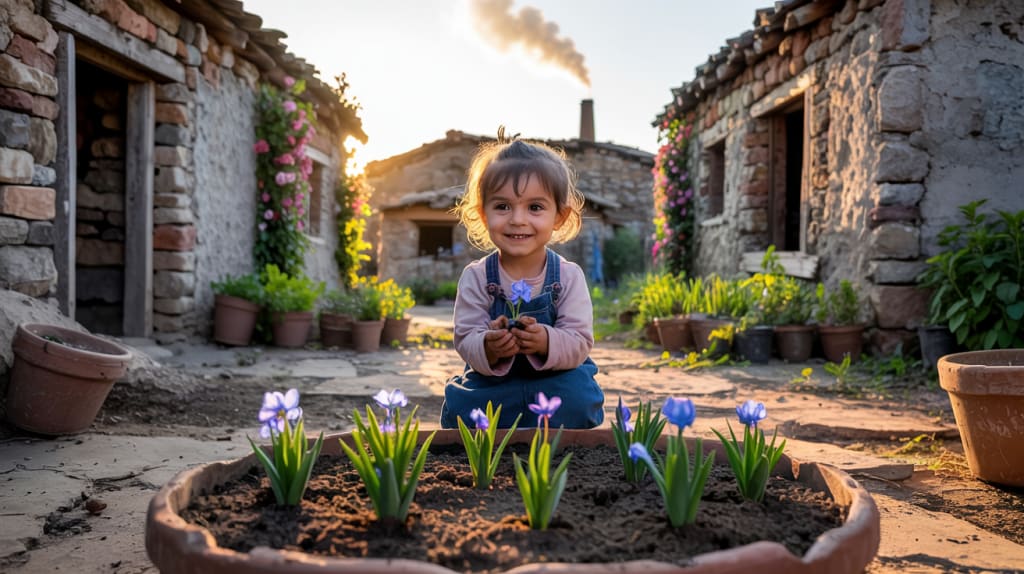
Once, in a quiet village nestled between dry hills and forgotten roads, lived a young girl named Amara. Her village had once been full of life—green trees, wildflowers, and laughter echoed through the streets. But after many years without rain, the fields turned to dust, the wells dried up, and the people stopped smiling.
Amara was different. While most villagers trudged through each day, heads down, she still looked at the sky every morning, hoping for clouds. She still sang while gathering firewood and talked to the old, cracked earth as if it were listening. Her father often shook his head with worry. “You must learn to live without hope, Amara. It's easier that way.”
But Amara didn't believe that.
One evening, while exploring the attic of her late grandmother’s cottage, she found an old wooden box, carved with vines and suns. Inside was a cloth pouch, tied with faded ribbon. She opened it gently and found a handful of strange seeds—some smooth like pebbles, others as light as feathers. A note tucked inside read:
“For when the world forgets how to bloom.”
Her heart fluttered. She clutched the pouch close and ran outside. Under the starlit sky, Amara knelt by the driest patch of earth behind her cottage. She dug a small hole with her fingers, dropped a single seed in, and whispered, “Please grow. Even just a little.”
Every day, she returned to water it with what little she had and sang to the ground. Days passed. Then weeks. Nothing.
People laughed when they heard what she was doing.
“Planting seeds in dust? Silly girl.”
“Even hope can’t grow here.”
“She’ll learn, just like the rest of us.”
But Amara kept going.
One morning, just as she was about to give up, she noticed a faint green curl poking through the soil. Her eyes widened. A sprout. A real sprout.
By the next week, it had grown into a small plant with glowing violet leaves and a single golden bud. The air around it felt different—warmer, sweeter. Bees, which hadn't been seen in the village for years, buzzed softly nearby.
Word spread.
“Isait real?”
“Did it grow from those old seeds?”
“Could it mean something?”
People began visiting Amara’s garden. Some scoffed. Some stared in awe. A few, quietly, brought their own bowls of water to help.
Amara decided to plant more.
She walked through the village, finding the loneliest, driest corners: outside the closed school, beside the abandoned well, near the broken fountain in the square. In each place, she planted a seed and whispered words of hope.
Little by little, green returned.
One day, a bright yellow flower bloomed near the school. The next, a tree with silvery bark rose beside the well, and clean water began to trickle from its roots. Children started laughing again. Elders sat outside and told stories. Neighbors began helping one another, like they used to.
The village had started to breathe again.
But not everyone was happy. The mayor, a man who had grown powerful during the years of despair, saw the return of joy as a threat. “We don’t need dreams,” he growled. “We need control.”
He ordered the flowers to be cut down and the seeds taken from Amara. “This is nonsense,” he declared. “Magic and hope won’t save us. Only rules will.”
The villagers hesitated. For a moment, silence fell over the square.
Then a small voice spoke. “But the seeds did save us.” It was a boy holding his mother’s hand. “The flowers made my sister laugh again.”
One by one, others stepped forward.
“My crops are growing for the first time in years.”
“My wife sings in the morning again.”
“I remembered how to smile.”
The mayor’s voice faded beneath the wave of stories. He quietly backed away as the villagers surrounded Amara, standing beside her.
They chose hope.
Seasons passed. Rain finally returned. The hills turned green. Visitors came from far-off towns to see the miracle of the blooming village. They asked Amara how she did it—what kind of magic she had used.
Amara smiled and said, “I just believed something could grow where no one else did.”
And from then on, the village was never the same. It became a place known not for its drought or its despair, but for its gardens, its songs, and its courage.
And at the heart of it all was a girl with dusty shoes, dirt under her nails, and a heart full of hope.
About the Creator
Muneebkhanoffical
Muneeb Khan | @muneebkhanofficial
Creating visuals that speak louder than words.
🎨 Digital Artist | Content Creator | Dream Chaser
Turning imagination into inspiration.
Let’s make something beautiful together. ✨
Keep reading
More stories from Muneebkhanoffical and writers in Lifehack and other communities.
Kindness is Work
The alarm rang at 5:30 AM. Sara rubbed her eyes, sighed, and pulled herself out of bed. Her knees ached—years of standing and walking had taken their toll. She shuffled into the kitchen, boiled some water for tea, and packed her lunch. It was going to be another long day at the community shelter.
By Muneebkhanoffical 7 months ago in Lifehack
Don't Miss The Fun Extras Offered by Your Favorite Companies
National retailers know the way to a customer’s heart is by giving them a little something extra. Many companies offer customers incentives such as free goodies, sample boxes, and workshops. The problem is that many of the offers aren’t widely advertised. Are you missing out on cool extras from your favorite companies?
By Criminal Matters4 days ago in Lifehack
“I Charged My Old Phone After 5 Years… And Found a Message That Was Never Meant for Me.”
Sometimes the past hides quietly in places we forget. For me, it was inside an old phone. Five years ago, I bought a new smartphone and threw my old one into a drawer. At that time, it felt useless. The battery was weak, the screen had scratches, and the phone was slow compared to modern devices.
By Muhammad Tanveer3 days ago in Lifehack
Hottest in the Office
Dear Rafi, You’re very distracting to work around. For the first second I saw you the other day, I thought you were some type of executive. It took a moment to realize no, you were just the new guy, dressed up for the job he wants. Be still, my heart.
By Gabriel Shames5 days ago in Pride



Comments
There are no comments for this story
Be the first to respond and start the conversation.