

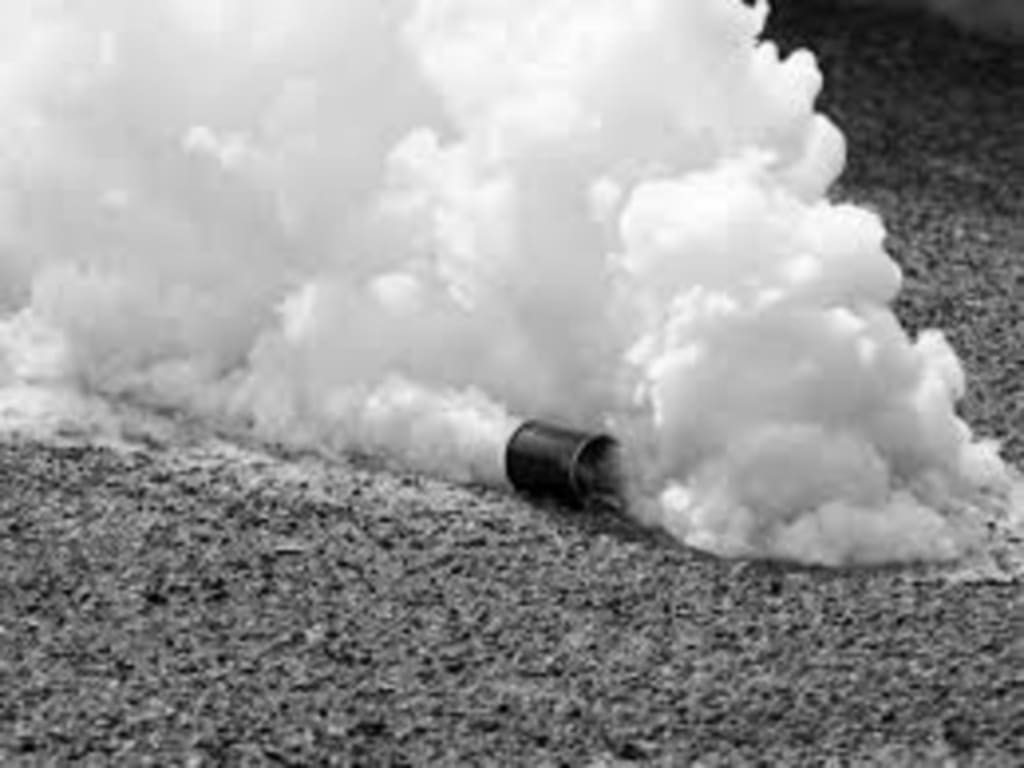
Picture this: You are walking down a long boulevard, arm-in-arm with other protesters, chanting, shouting expletives, and expressing your discontent with the day’s political or social concerns. You grow in number as you approach your rendezvous point, but halfway through your march, you are blocked by a wall of riot shields and heavily geared riot police to ensure that the protest does not go devastatingly awry. Unfortunately, things do not go as planned. Somehow, somewhere, someone started a ruckus, and everything begins to fall apart. What was intended as a peaceful demonstration turns into a riot. Law enforcers begin to move in to subdue the violence, and protesters start to defend themselves from potential harm and abuse. Like a silent missile being shot into the sky, a silver tin canister flies above everyone’s heads, with a thick, white plume of what seems to be smoke trailing from behind it. People begin to disperse as the canister lands, and the thick cloud of smoke-like vapor begins to spread and thicken. Panic ensues, and people run away from it; those who are unlucky have their senses bombarded with a stinging sensation that stabs the eyes and constricts the lungs and airways. It’s tear gas.
Tear gas is a collective term for lachrymatory agents, which are generally non-lethal compounds designed to irritate the respiratory system and, most commonly, the eyes. This irritation can incapacitate anyone with temporary blindness. These compounds are used by many for self-defense but are most commonly employed by law enforcement officers and the military to disperse large crowds or in more dangerous missions.
What is tear gas and how does it work? As mentioned earlier, tear gas is a collective term for a number of different riot control agents. Despite its misleading namesake, it is not gaseous. Instead, it is an aerosol mixture of multiple compounds that are referred to as tear producers or lacrimators. Among these compounds is chloroacetophenone (CN), which is present in Mace sprays. Modern tear gas, on the other hand, employs other ingredients but can always be traced back to its most basic ingredient, orthochlorobenzalmalononitrile (CS), a crystalline substance that exudes a pepper-like odor. CS was first developed and synthesized in the 1950s and became the replacement for the much more powerful CN. To this day, it remains one of the most commonly used non-lethal riot control agents.
Though pepper spray may seem to have the same effects as tear gas, the two are different. Pepper spray's effects are more inflammatory than lacrimatory, making it more debilitating but also difficult to disperse. Consequently, it is used more commonly for personal protection against assaults or wild animals.
Despite being a lot less lethal than bullets, tear gas is still a powerful irritant that can cause severe burning sensations upon contact with the skin. Prolonged exposure may result in severe rashes and chemical burns. When the agent reaches the eyes, the chemicals trigger a response in the body, which sends signals to the brain to activate its natural defenses, releasing a flood of tears to wash out the irritant. This is where tear gas got its name. In severe cases, victims may experience temporary blindness, especially when exposed to the chemicals for a prolonged period. The chemical compounds in tear gas also irritate the respiratory system. When inhaled, the substance stimulates the immune system, causing the body to produce mucus and inducing coughing and retching to expel the irritants. In severe cases, the respiratory system becomes so irritated that a person may have difficulty breathing, and the upper respiratory tract may tense up. However, the damage done by tear gas is generally not permanent. Hours after exposure, the body typically returns to normal as the effects subside. In rare cases, where people experience constant, prolonged exposure to the chemicals—especially those with severe allergic reactions to certain substances—they may develop irreversible damage to the eyes, such as glaucoma. The worst-case scenario is death, which can occur if the substance causes serious chemical burns inside the respiratory system, leading to cardiac arrest; such was the case of a Palestinian woman in 2011, who suffered prolonged exposure to tear gas during a protest in the West Bank.
Temporary Relief
In the news, people have been photographed pouring milk over their eyes and faces to alleviate the stinging pain from tear gas. Many claim that this homemade remedy helps in alleviating the effects of the lacrimatory agent. During the protest in Ferguson, demonstrators were seen entering a local McDonald’s and having milk poured over their faces. Activists from Gaza and Israel, on the other hand, combat the intense effects of tear gas by washing their faces with cola. Whatever the method, it appears there is an unspoken truth: you should not use water to wash off tear gas because it not only has no effect but may also increase irritation. Several methods have been shared online. A flyer published by individuals who were part of the 2011 Occupy Movement advised people to use antacids dissolved in water to relieve the effects of the chemicals. However, the US Army Center for Health Promotion and Preventive Medicine and the New York Department of Health and Mental Hygiene offer more detailed advice on relieving oneself from the effects of tear gas. Contrary to popular opinion, these two departments recommend washing the eyes with clean water as soon as possible for at least fifteen minutes to completely remove harmful chemicals. If the gas has been inhaled, individuals should immediately leave the affected area, seek fresh air, and breathe deeply to get as much oxygen as possible. If medics are present, they may administer asthma medication to help with the air passages, especially in severe cases. If tear gas has been ingested, individuals should drink plenty of water, induce vomiting if possible, and seek immediate medical attention. Clothes doused with the chemicals should be washed separately from uncontaminated clothing, and chlorine-based detergents should be avoided to prevent harmful chemical reactions with CS compounds.
The Legality of Tear Gas
While tear gas is considered non-lethal, there are laws surrounding and controlling its use. According to the Chemical Weapons Convention of 1993, tear gas is strictly banned in warfare; however, in the context of domestic riots, its use is permitted. One expert has pointed out the paradox of this legality. Sven-Eric Jordt, a Yale University School of Medicine nerve gas expert, states, “Tear gas under the Geneva Convention is characterized as a chemical warfare agent, and so it is precluded for use in warfare, but it is used very frequently against civilians. That’s very illogical.”
Thank you so much for reading!
About the Creator
Richchik Bardhan
A MBBS student,Love to read and write about science facts and sometimes sci-fic too because Some sci-fic can later be proven into facts someday.....
Keep reading
More stories from Richchik Bardhan and writers in Lifehack and other communities.
ATTRACTIVE PEOPLE
There's more to people than their physical appearance. This piece of wisdom is nothing new to all of us. We have been taught these truths since we were children, and since then, we have learned to automatically claim that we don't judge people solely on their looks. We already know very well that beauty is skin-deep and that what matters most is their personality and their actions—their inner beauty. In reality, however, it's hard to look past a person's looks. Consciously or not, we all have the tendency to assess the people we meet according to our subjective opinion of their level of attractiveness. While we don't always say it out loud, we immediately classify people as good-looking, average, or unattractive moments after we meet them. Even when we don't want to, beauty is an inescapable factor in human society. It doesn't have to dictate who we associate ourselves with and how we treat others, but the ugly truth is that we do find fault and flawlessness in the appearance of others—especially our own. Since our fascination with beauty is hardwired into our overall mechanism as human beings and as a society, one cannot help but think that there's a science behind all of this superficiality. And if that is the case, we also can't help but wonder what makes a person scientifically beautiful. Answering this question will be our primary objective in this story, and by the end of it, maybe you'll want to find out for yourself if you, in particular, are actually good-looking according to science.
By Richchik Bardhanabout a year ago in Humans
You Won't Believe How Easy it is to Get 100,000 Miles Between Brake Jobs
Most drivers are destroying their brakes prematurely — and it has nothing to do with speed. As a Master Mechanic for 25 years, I’ve seen every driving style imaginable. And nothing reveals a driver’s habits faster than how often they need brake work.
By Jack Martina day ago in Lifehack
Top Seattle Mobile App Development Trends to Watch in 2026
The moment often comes quietly. A leadership team reviews last year’s mobile roadmap and realizes how much has already shifted. Costs are higher. Users are less patient. Regulations feel closer. What worked even two years ago now feels slightly outdated.
By Samantha Blakeabout 6 hours ago in Lifehack




Comments
There are no comments for this story
Be the first to respond and start the conversation.