
Stop Overthinking Everything Clear Thinking Starts Here
A Practical Guide to Silencing Mental Noise and Regaining Focus

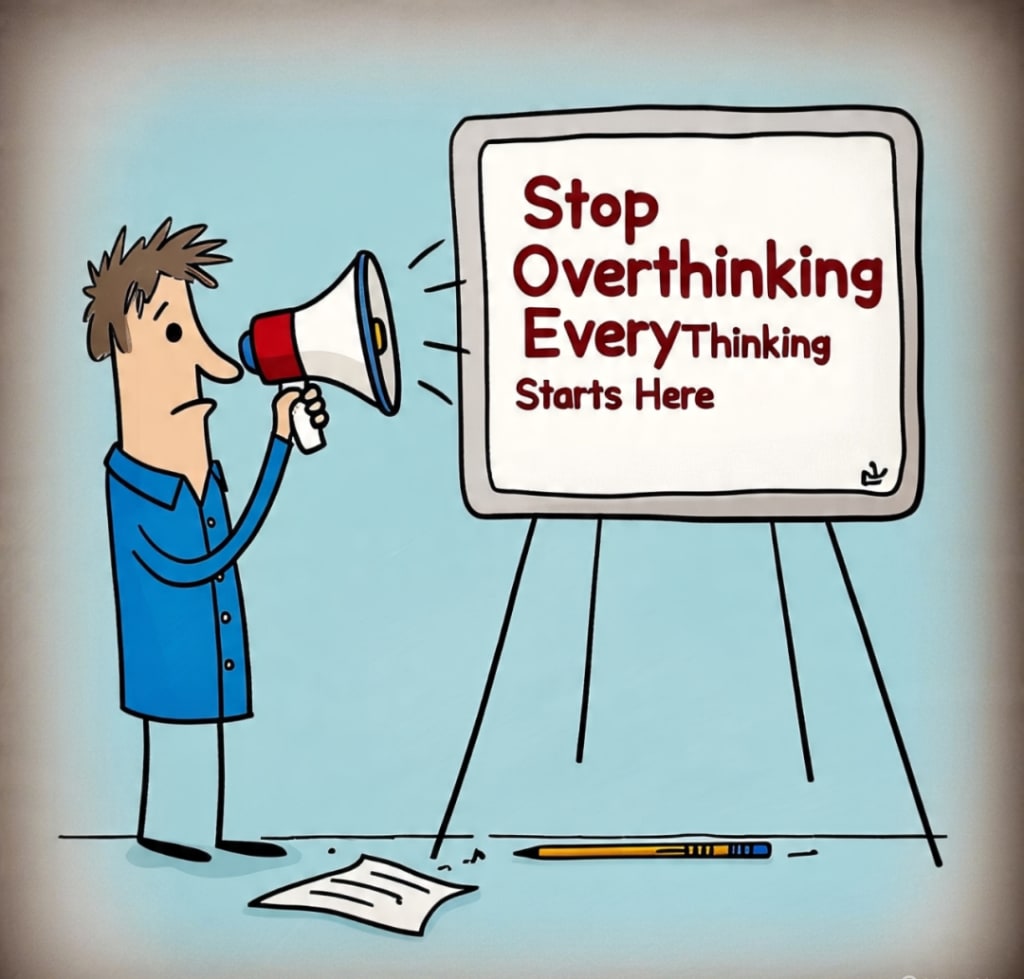
Have you ever replayed a conversation in your head 10 times? Or delayed a decision because you were afraid of making the wrong one? You’re not alone. Millions of people struggle with overthinking—ruminating on the past, worrying about the future, or overanalyzing every little thing. The good news is that you can stop overthinking and regain mental clarity. This is my story of breaking the cycle—and how you can too.
Overthinking Was Running My Life
For most of my twenties, I was stuck in a loop of constant analysis. Every choice felt monumental. Should I reply to that email now or later? Was my tone too harsh? Did I say the wrong thing in that meeting? My brain worked overtime, turning every thought into a tangled web of what-ifs.
It didn’t feel like a problem at first. I thought I was just being thorough, thoughtful, or prepared. But it wasn’t productivity—it was paralysis. I was trapped in my head, and it was exhausting. My anxiety increased. I couldn’t sleep. I couldn’t focus. I knew something had to change.
What Is Overthinking, Really?
Overthinking is more than just excessive thinking. It’s the inability to let go. It’s mentally chewing on a thought long after it's useful. You relive conversations, overanalyze choices, or imagine worst-case scenarios. And instead of helping, it drains your energy and confidence.
According to psychologists, overthinking can lead to mental fatigue, anxiety, depression, and decision-making burnout. And while it’s often fueled by the desire to control outcomes or avoid mistakes, it usually results in inaction and regret.
Step 1: Recognize the Overthinking Patterns
The first step in learning how to stop overthinking is awareness. I started noticing the patterns:
Obsessively re-reading texts before sending them.
Replaying meetings in my head.
Delaying decisions for fear of making the wrong one.
Mentally rehearsing conversations that never happened.
Once I became conscious of how often I was stuck in my head, I could start shifting my behavior.
Step 2: Challenge the Thought Loops
One of the most powerful tools for clear thinking is asking yourself better questions. Instead of "What if I mess up?" I started asking, “What’s the worst that could realistically happen?” Usually, the answer wasn’t as dramatic as my imagination.
I also asked
Is this thought helping me or hurting me?
Can I take action on this, or am I just worrying?
What would I tell a friend if they were thinking his?
This broke the loop of fear-based thinking and returned me to logic.
Step 3: Take Small, Decisive Actions
One of the best ways to silence overthinking is through action. Action builds momentum. Action ends indecision.
I created a rule: If a decision takes less than 2 minutes, do it immediately.
For bigger decisions, I gave myself a time limit. For example: “I’ll research for 20 minutes and then make a choice.”
The truth is, clarity comes from engagement, not thought. The more I acted, the less space overthinking had to grow.
Step 4: Create a Mental Clarity Routine
I started building a daily routine that supported clear thinking and reduced mental noise.
Morning journaling: I dumped out all my anxious thoughts onto paper. No filter.
Daily walks: Movement helped reset my mind and body.
Mindfulness meditation: Even 5 minutes a day made a huge difference in calming my mind
Digital boundaries: No phone during meals, no doomscrolling before bed.
These habits gave my brain space to breathe and helped me process thoughts in a healthier way.
Step 5: Learn to Trust Yourself
A lot of overthinking comes from fear—fear of being wrong, judged, or failing. But the truth is, we all make mistakes. That’s part of learning and growing. The more I accepted this, the easier it became to trust my own judgment.
Self-trust is a muscle. Every time you make a decision, act on it, and see the results, that muscle gets stronger. Over time, I stopped seeking endless reassurance. I stopped overanalyzing everything. I started living.
About the Creator
Muhammad
Explore deeply emotional stories and poems about future love, heartbreak, and healing. Each piece captures real moments of connection, loss, and personal growth—crafted to resonate with readers seeking authentic, relatable experiences.
Zojirushi BB HAC10 vs BB SSC10: Which One Should You Buy?
Choosing between the Zojirushi bb hac10 vs bb ssc10 can feel confusing when both promise great homemade bread in a compact size. I like how each model focuses on small 1-pound loaves, which fit typical U.S. households and reduce waste.
By Mohammed mamun2 days ago in Lifehack
Trickle Them Down, But Not Out
The thing about smart people is that they should know better, but alas, intelligence is not the same as wisdom. Not only do the mistakes of experts too short on vision—when they are not corrected—have the potential to do great and far-reaching damage, but they also undermine public confidence in the very notion of expertise. This is particularly so when expertise is wielded in defence of the rich and powerful as a cudgel against those laid low. As an academic, this lack of faith in “so-called experts” is painful to see as it plays out in the spread of dis-/misinformation, conspiracy theories, and anti-intellectualism writ large. But it is also an understandable impulse given the catastrophic failure of an economic ideology pushed by certain economic experts. Supply-side economics has shaped a broken system for the last half-century and has arguably done more to undermine the fabric of the American Dream than any policy framework of the past century.
By Cory Wright-Maley5 days ago in Humans


Comments
There are no comments for this story
Be the first to respond and start the conversation.