

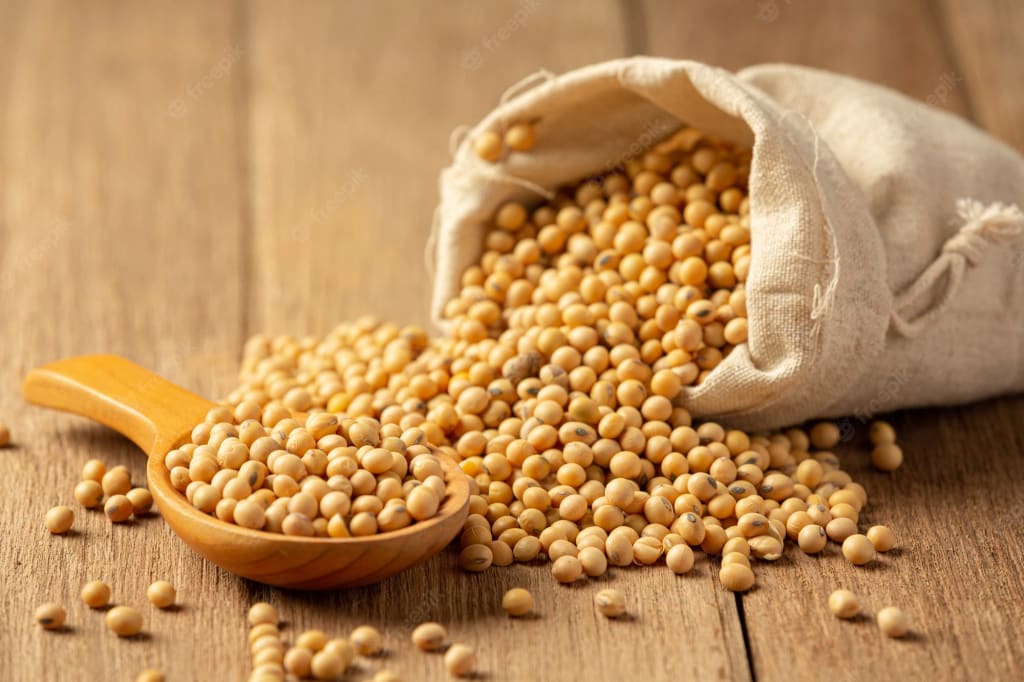
Native to East Asia and grown in abundance in the American Midwest, soybeans are a staple food all around the world. In addition to serving as the base of innumerable foods, from tofu to tempeh to soy milk, soybeans can also be eaten all by themselves. These small-but-mighty beans are packed with protein and fiber, making them an ideal choice for plant-based meals and snacks.
Since one type of soybeans is sold and marketed under the name “edamame,” you may wonder about the difference between the two terms. Edamame is simply a form of whole, immature soybean, typically boiled and served in its pod. When soybeans are left on the plant to ripen, however, they harden and develop a yellow, brown, or black hue.
In recent years, there’s been increasing consumer concern about soy products’ effects on estrogen and how this might impact the risk of hormone-related cancers like breast and prostate cancer. However, the American Cancer Society (ACS) states that “the evidence does not point to any dangers from eating soy in people.” In fact, according to the ACS, the health benefits of eating soy foods appear to outweigh any potential risk.
Soybean Nutrition Facts
The following nutrition information for 3.5 ounces (100 grams) of soybeans has been provided by the USDA.
Calories: 172
Fat: 9g
Sodium: 1mg
Carbohydrates: 8.3g
Fiber: 6
Sugars: 3g
Protein: 18g
Carbs
About 30% of soybeans’ calories come from carbohydrates, and over two-thirds of these carbs are from fiber. The remaining carbs in soybeans come from naturally occurring sugars, such as sucrose and raffinose.
Fats
While soybeans are by no means a high-fat food, at 9 grams per 3.5 ounces, they do contain a notable amount of dietary fat. However, these fats are primarily the “good” kind; in a single serving, you’ll take in 2 grams of monounsaturated fat and 5 grams polyunsaturated fat. The American Heart Association recommends that the majority of the fats we eat be mono and polyunsaturated. Just over 1 gram of soybeans’ total fat is the saturated variety which has been linked to heart disease.
It’s always a best practice to check labels on soybeans, too. Many packaged varieties add oil for flavor, which will add to total fat.
Protein
Protein is where soybeans really shine. In a single serving, you’ll get 18 grams of this important macronutrient. If you’re worried that this plant-based protein doesn’t measure up to the animal kind, you can put these concerns to rest. Soy is one of a select group of plant-based foods that are considered a complete protein, meaning it contains all the essential amino acids your body needs to get through food.
However, if muscle building is your goal, soy may not be your best bet. Some research has shown that foods containing branch-chain amino acids (BCAAs) are most effective for muscle growth.1 Compared to animal products like whey and casein, soy protein is low in BCAAs.
Vitamins and Minerals
Soybeans can add a number of micronutrients to your daily intake. The beans are rich in potassium, folate, magnesium, calcium, and thiamin.
Health Benefits
Keeps You Full
You may not think of beans as a stick-to-your-ribs filling food, but with so much fiber and protein per serving, soybeans can easily keep hunger at bay for a long stretch. This satiation boost may even be beneficial for weight loss.
May Lower Cholesterol
Some research suggests that soy products can lower LDL cholesterol (aka the “bad” kind) by a small percentage. However, it’s important to note that you’d probably need to eat quite a large amount of soy to make an impact.
Boosts Digestive Health
So much of gut health comes down to the amount of fiber we consume. Soybeans’ 6 grams of fiber per serving adds bulk to stool and creates a healthy environment for good bacteria to flourish in the digestive tract.
Compatible With Many Special Diets
Soybeans find their way comfortably into many specialized eating plans. People on low-sodium, Mediterranean, gluten-free, dairy-free, vegetarian, or vegan diets can all dish up these beans.
Protein Source for Vegan and Vegetarians
Vegans and vegetarians—especially those new to these diets—may find getting enough protein a challenge. Soybeans can add to your daily dose with its high plant-based protein content.
May Reduce the Risk of Breast and Prostate Cancer
Though soy has had a controversial history when it comes to its connection with “the Big C,” a body of research indicates beneficial effects of soy in cancer prevention. A 2009 review found that consuming soy-based foods was associated with reduced risk of prostate cancer.2
And a meta-analysis of epidemiological studies concluded that eating more soy products might be associated with a small reduction in breast cancer risk.3 However, more research is needed to determine the exact relationship between soy and cancer.
Allergies
Soy is among the most common food allergies. According to Food Allergy Research and Education, it’s especially prevalent in babies and kids, with 0.4% of children being allergic to soy. While some children will outgrow a soy allergy, for others, it’s a lifelong issue. If you have a soy allergy, you’ll need to avoid all varieties of soybeans.
Adverse Effects
Despite soybeans’ excellent nutrition profile, they might not be right for some people. As a high-fiber food, they can cause gas and abdominal discomfort. Those on a low-FODMAP diet may also need to steer clear of soybeans since they contain oligosaccharides called galactans that can aggravate IBS symptoms.
Varieties
Though there are around 2,500 varieties of soybeans, you probably won’t see this many options at your local grocery store. Instead, you’ll likely see soybeans sold with simple descriptors such as “yellow” or “black” (or, of course, as edamame). Cooking instructions for different varieties of beans may vary, so follow package directions for best results.
Storage and Food Safety
Soybeans can be purchased frozen, canned, or dry. Keep frozen soybeans in the freezer until ready to use, and store canned and dry beans in a cool, dry place. Once cooked, be sure to refrigerate any leftover soybeans in an airtight container and use within three days.
How to Prepare
Name a cooking method and you can probably apply it to soybeans! The only way you can’t eat soybeans is raw, as they are not digestible in their raw form. Boiling, roasting, and steaming are all popular ways to prepare these beans.
It’s important to note, however, that dried soybeans need to be soaked prior to cooking, which can take several hours or up to overnight. Once soaked, boil them using three to four parts water per one part beans. Boiling takes about three hours to fully cook the beans.
For faster prep, try roasting. At 350 degrees, soybeans will take about 45 minutes to cook.
About the Creator
MGS
Web Content Writer
The Basics of Successful Property Renovation Projects.
Property renovation is a cornerstone of real estate development, especially in markets with distressed or foreclosed homes. In cities across the country—from rapidly growing metros to legacy industrial hubs—renovation plays a vital role in revitalizing housing stock and meeting buyer demand. Successful renovation projects require careful planning, disciplined execution, and proactive management to maximize value and ensure the property meets modern buyer expectations. When approached strategically, renovation transforms underutilized properties into desirable homes while strengthening communities and generating strong financial returns.
By JB Hoover, Newport Beachabout 21 hours ago in Lifehack
Company Setup in Dubai: Complete 2026 Guide for Entrepreneurs
Starting a business in Dubai has become one of the most attractive opportunities for global investors. With zero personal income tax, world-class infrastructure, and access to international markets, company setup in Dubai offers strong potential for growth.
By Adnan Sheikh6 days ago in Lifehack
I wanted to title this something different, but worried that my chosen title might cause problems entering the United States in the future so this is the new title. It's the greatest title. No one has ever written a title better than this. (All titles unrelated to content).
Let me be honest. I am finding this difficult. Now, I like a challenge, a stretch, a bit of an obstacle course. “Write about the decline of the British Empire in the form of a narrative poem in which your protagonist is an artichoke” I read, and flex my fingers. “Write a haiku to evoke the sensation of sibilance using only the first half of the alphabet.” “Well”, I think to myself, “this should be fun.” But “write about a system that isn’t working”? A system that isn’t working? Now? In 2026? ONE system? My favourite system that isn’t working? The sexiest system that isn’t working? The one giving me the most angst day to day? The one giving me the most existential dread? I am, as I say, finding this difficult. I will own that I have contemplated writing a thousand words on why the steady “all on” setting on my fairy lights is the EIGHTH of seven options which must be sequentially activated to get there, because that is a system that some fool came up with and it definitely doesn’t work, and now who is paying the price, eh? But how can I write about my fairy lights when…. When…. When….
By Hannah Moore6 days ago in Humans




Comments
There are no comments for this story
Be the first to respond and start the conversation.