
Scrap-Less Crafting for a Waste-Less World
Crafting with a conscience

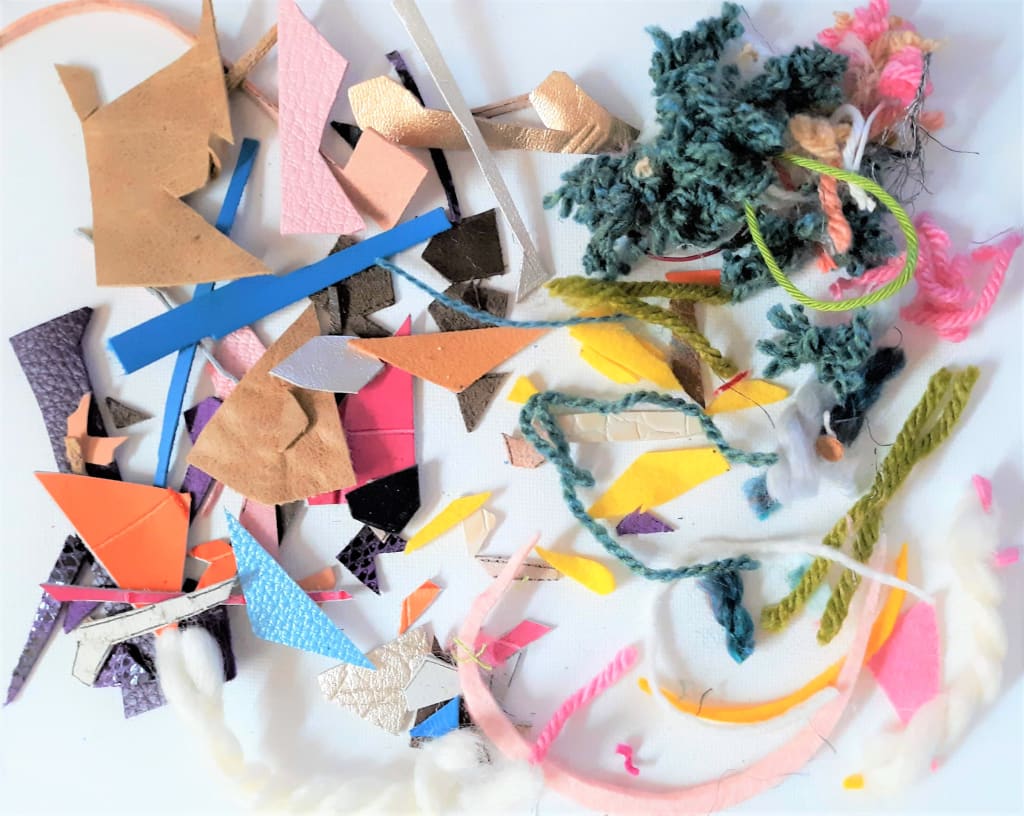
Crafting is my happy place. It’s both a creative outlet and a source of income, and the ability to combine the two is a joy and a fount of motivation. The materials provide the inspiration. It’s a very happy place.
The only potential problem with my happy place lies in the sheer volume of scraps, leftovers, bits and pieces that daily crafting and making things in quantity produces. And it’s not just a problem for me. According to the EPA, 292.4 million tons of waste went to a landfill in the U.S. in 2018. That amounts to 4.9 pounds of waste per person each day. Textiles, which is the source of a majority of my crafting, accounts for 11.3 million tons of the waste. These are not statistics I feel comfortable contributing to.
So, I set out to create as little waste as possible in my crafting endeavors. On the surface, feltwork, weaving, macramé, crocheting, jewelry making, leatherworking, and collage don’t have much in common, but in my workroom they’re all connected by the waste they produce.
To begin with, in my leatherwork I only purchase leather scraps from producers of upholstery, bags and other leather goods, so I’m making use of the leftovers they would otherwise discard. Large scraps are turned into journal covers. Smaller scraps become bookmarks. Leftover scraps from bookmarks are perfect for earrings, and the tiniest pieces live on as wine glass charms. Cutting leather is a little more labor intensive than cutting fabric, so I use a pair of Fiskars spring-loaded titanium scissors for the bookmarks and bigger pieces because they’re so much easier on hands and wrists and I plan on doing this for a long time. And just like I work down in size with the leather scraps, I go down in scissor size for the smaller pieces. The ultra-sharp, spring-loaded small scissors make the intricate cuts, fringes, and corners a (relative) breeze.

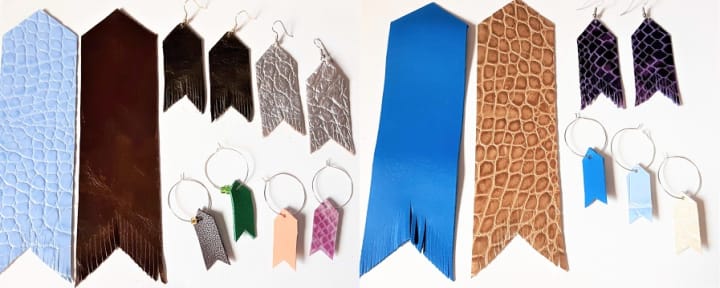
Of course there are still pieces of leftover leather even after I’ve made the smallest things I can think of. Those are cut into teeny, tiny pieces and put into the scrap bag or left as-is and placed in the collage bag. I love those bags.
Every tiny yarn end from making scarves, shawls and blankets goes into a scrap bag. Every odd-shaped piece of felt is tossed in. Every failed piece of polymer clay, every unsuitable length of wire, and every scrap of ribbon and paper finds a home in the collage scrap bag. It’s hoarding on a micro level, and I don’t feel bad about that because every scrap will eventually find its way into something, and I’ve kept it out of a landfill.
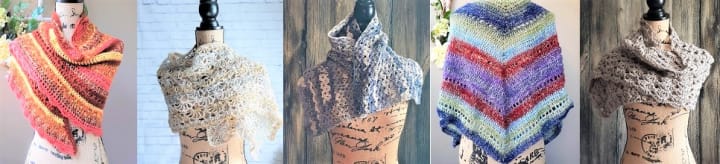
Now let’s pull some yarn out of the scrap bag. One of my favorite ways of using the ends of yarn skeins when there isn’t enough left to crochet something new is to make a modern version of old-fashioned samplers. Ribbon ends and all sorts of yarn are embroidered onto a loose-weave cloth with a blunt or sharp needle, depending on the material. I often make up the pattern as I go, but it’s easy to create a pattern on graph paper. The end product is either hung from a dowel or attached to a canvas frame.

When yarn is too small to use in embroidery, it’s used to stuff crochet cactus pincushions and felt plushies. The same goes for leather and felt scraps. I don’t have or need polyester stuffing or batting, and use the scraps exclusively for these projects. The things I make with felt provide the majority of my crafting income so this makes me particularly happy, knowing I’m sending some eco-friendly products out into the world.
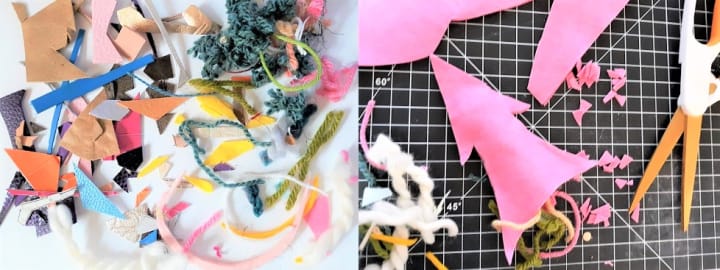

Finally, the end of every project turns into the beginning of a new mixed media collage. The beauty of mixed media is that anything goes. Anything at all, from the contents of my scrap bag to old hardware. For an abstract piece I generally start by stamping and painting fabric and paper scraps. I’ll often sew them together with yarn or thread, and then I lay pieces on a stretched canvas frame and start adding things from the scrap bags and from a bin of odds and ends I keep just for that purpose. That bin is home to things as varied as candy wrappers, hardware, pieces of broken polymer clay, mint tins, and old keychains. Just sifting through it can provide inspiration. A little glue and ink here, a scissor snip there, and a lot of rearranging later, I have a new piece of artwork for my walls.

I call all of this “crafting with a conscience”. Variations on the phrase exist, mostly with a different meaning, but what I mean is crafting with an eye on what’s leftover from the finished product. It means careful cutting without wasting fabric. It means using every last inch of yarn and leather. It means saving and using scraps. It means giving a new life to broken things. It means using natural materials, like wool felt and organic cotton yarn. Personally, it means feeling good about my hobbies, my business, and my minimal impact on the global waste stream.
About the Creator
Maria Shimizu Christensen
Writer living my dreams by day and dreaming up new ones by night
Also, History Major, Senior Accountant, Geek, Fan of cocktails and camping
Keep reading
More stories from Maria Shimizu Christensen and writers in Lifehack and other communities.
Our Values Are in Our Exceptions
Very few things in human existence are explained by absolutes. We live in a multi-hued world defined by nearly infinite shades of grey, yet when things get scary or hard, we frantically search for easy, black-and-white explanations and answers to our problems. We want things to be right or wrong. When we can’t fix those problems, unshaded absolutes make it easy to blame someone else — someone on the opposite side of our side. And they make it easy to believe that simple solutions are the answers to complex problems, or that one reason alone is the cause of a problem.
By Maria Shimizu Christensen5 years ago in Lifehack



Comments
There are no comments for this story
Be the first to respond and start the conversation.