
One Family’s Journey to Saving Money and Eating Well
Based on a Real Story


Time for the weekly grocery run. You drive to the supermarket. You are probably hungry (which you shouldn’t be if you want to save money). You end up buying a plethora of food items and spending a considerable amount of money.
With numerous bags in your trunk, you feel satisfied. The total on the receipt seems excessive, but it’s okay. Hopefully, you’ve bought enough food for the week — or at least a few days.
The very next day, you left wondering where all the food went as you struggled to make dinner. How could all those bags disappear so quickly? What went wrong?
How Much You Should Spend on Food, According to Statistics
According to the U.S. Bureau of Labor Statistics, the average American household spends about 9–12% of its annual income on food. This breaks down to about $750 to $1000 per month (or one brand-new Apple iPhone every month) for a household with a $75K annual income. Many of us spend even more than that.

It is clearly one of the top expenses we make. If we spend so much hard-earned money on food, it’s worth finding ways to manage it more effectively.
Examining Our Shopping Habits
Let’s see what we had in those bags and why they lasted a day instead of a week. No wonder half of it is snacks (many are put in the cart secretly by our kids) or junk food.
There are several reasons we do that. It is tough to resist a push from a supermarket to sell you food you don’t need. How can you miss all the promotions, attractive packages, limited-time offers, and product bundles?
Fortunately, there’s a simple (or not?) solution!
Seeking Expert Advice
The most common advice in books and blogs about personal finance is to plan meals for each week. It means you should have a detailed plan of what you and your family eat daily. Sounds boring? It is.
First and foremost, it takes a lot of your time. You should look for recipes that everyone in your family will enjoy. Make a plan. Make shopping lists, track what’s in the fridge and a pantry, and so on. There has to be a better way.
What if we just limit the total amount of money we spend on groceries? It seems to be a basic and straightforward technique, yet this is how we found ourselves in the situation mentioned at the beginning of this story.
Our Approach
“Price is what you pay. Value is what you get.” Warren Buffett
Not all grocery created equal. It is super easy to spend half of your budget on snacks or junk food just because your body craves that at the moment of shopping. So what’s the solution?
Breaking down complex tasks into smaller pieces is typically a good idea. What if we split our broad grocery category into several subcategories? Will it be easier?
For our experiment, we created the following subcategories:
Weekly budget
- Fruits & Veggies (including juice)
- Protein (meat, fish, dairy, eggs, etc.)
- Snacks
Monthly budget
- Pantry (pasta, oils, spices, sauces, etc.)
- Drinks & Alcohol
- Household supplies
Of course, everyone will have different lists of categories. However, you should try to limit the number of categories to roughly five. Too many categories overcomplicate everything.
Estimate
Next, we had to figure out how much money we could spend weekly in each category. It was pretty simple to do with “Protein”. For a family of four, we typically consume weekly:
- Six pounds of meat
- Thirty eggs
- Six gallons of milk
- Two yogurts
- One pound of fish or seafood
So I added up the total cost of these things and used it as my starting point for the “Protein” category.
Again, you don’t have to buy the same items every week. This is only to give you an idea of how much money you can spend in this particular category.
“Alcohol” is quite predictable. Those who enjoy alcohol at home already know how much they drink.
It was a bit more trial and error with “Fruits and Veggies” because of the different seasons and the huge price differences between different fruits. But eventually, after two weeks, we found a sweet spot that works for us.

The “Pantry” category contains items you can conveniently purchase once in a month. Similarly, “Household items”. We created monthly budgets for these categories. Buy in bulk and Save money!
Finally, my favorite — “Snacks”. We just subtracted the total of all subcategories from the monthly amount we plan to spend and get our weekly snack allowance.
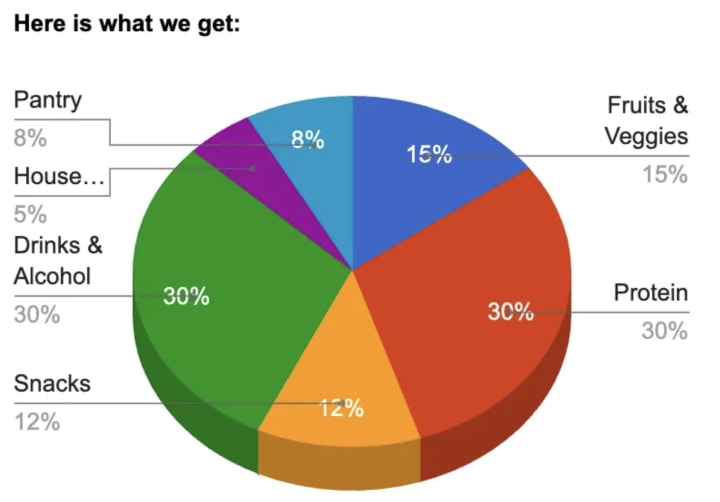
- Fruits & Veggies — 15%
- Protein — 30%
- Snacks — 12%
- Drinks & Alcohol — 30%
- Household Supplies — 5%
- Pantry — 8%
That’s when I realized that even just doing this exercise helped us to better understand our diet. The next step is creating a category list and setting budgets in my budget app.
Organize the Shopping Process
To make the most of our new budgeting strategy, we followed these steps:
- Go to the supermarket.
- Buy items from one category at a time.
- Set the amount you plan to spend on a calculator.
- Do shopping and subtract the cost of each thing you put in a basket from the total amount.
- Proceed to checkout.
- Grab a receipt.
- Repeat for the following category.
We do “Fruits & Veggies”, “Protein” and “Snacks” once a week. Other categories — bi-weekly or monthly. Later, I enter the receipt amount into the app and scan the receipts. Guess what happened?
Hidden Benefits
We found this approach had several benefits:
- It involved the whole family, teaching our kids about budgeting on a simple example — the food they love.
- It provided a detailed history of the money we spend on different grocery categories, allowing us to adjust for healthier choices.
- It required less time spent on planning and lists while offering freedom.
Adjusting and Refining
We needed roughly a month to confirm the budget and make the necessary adjustments. Actually, we did it only once for “Fruits and Veggies”. We had to increase the budget for this category and reduce “Alcohol” spending.

The Final Result
Our new approach helped us save money, adjust our diet, and teach our kids about budgeting — all while maintaining the freedom to choose what we buy and eat. With a little organization and planning, it’s possible to navigate the grocery shopping experience more efficient and make the most of your hard-earned money.
About the Creator
Money Mastermind
a passionate personal finance author on a mission to empower people to take control of their financial lives
Keep reading
More stories from writers in Lifehack and other communities.
Planning a Successful Move in Boise, Idaho: What to Look for in Professional Movers
Moving in Boise, Idaho, often feels straightforward at first glance. The city is known for its accessible neighborhoods, manageable traffic compared to larger metro areas, and steady growth. However, relocation still involves many decisions that can influence how smooth—or stressful—the experience becomes. One of the most important choices is selecting movers who are prepared, reliable, and familiar with local conditions.
By House Doctora day ago in Lifehack
Spirulina Benefits
In recent years, spirulina has earned a strong reputation as one of the most powerful natural superfoods available today. Used for centuries by ancient civilizations and now backed by modern scientific research, spirulina is praised for its impressive nutritional profile and wide range of health benefits. From boosting energy levels to supporting immunity and detoxification, this microscopic algae has become a favorite among health-conscious individuals worldwide.
By shakir hamidabout 3 hours ago in Lifehack




Comments
There are no comments for this story
Be the first to respond and start the conversation.