
My Closet Is a Disaster (Again)
How to tackle the beast without going full minimalist...

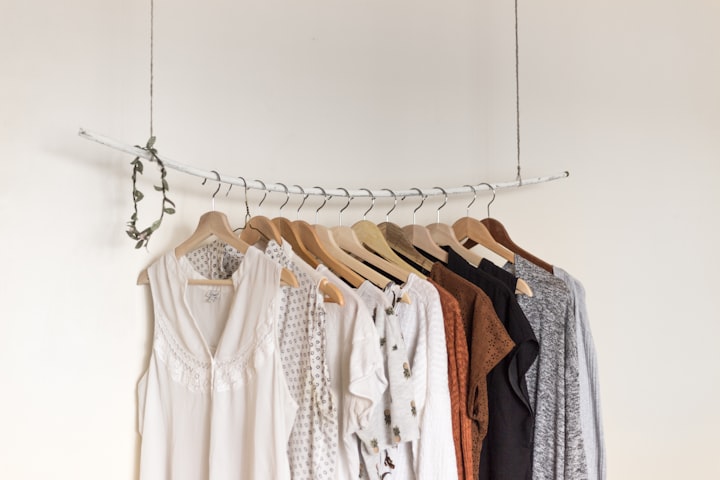
My clothes closet has always been a disaster zone.
I'm one of those people who needs less stuff and super simple organization to keep things neat... and I haven't quite figured out how to do that with my clothes yet.
Every 3 months or so, I go in and do a deep clean... and over the last couple years, those deep cleans has been slowly inching me toward a manageable wardrobe.
And guess what I'm doing tonight...
If you guessed a closet deep clean, you'd be right.
So if you're like me and struggle to build a functional wardrobe that doesn't overwhelm, is easy to wash and keep clean, doesn't waste money, and stays neat, while also being comprised of items that you love, I want to share the strategy I'm using to bring my wardrobe into a semblence of order (and hopefully keep it that way!).
Here goes...
1. I start by doing a laundry blitz. I want my clothes clean as I go through to organize, put away, donate, or toss. Everyone wins with clean clothes.
2. Next, I pull literally EVERYTHING out of my closet and dresser drawers and group like things together.
So I get a pile of T shirts, a pile of jeans, a pile of sweatshirts, a pile of sweaters, and so on.
3. Then, I go through each category and see what I actually wore in the last 6 months.
Anything that I haven't worn goes in donate or toss piles.
I know some people like to use the baseline of what they've worn in the last month... but living in the American midwest, we have 3 distinct types of weather - super cold and snowy, moderate and refreshing, and really hot. So the stuff I wear in the winter has pretty much nothing in common with the stuff I wear in the summer, which means I need 3 categories of seasonal clothing.
And as for donate or toss, I look at it to see whether it is in good enough shape that I would buy it second hand to decide which way to go. If it has holes, lots of pilling, or stains, it goes in the toss pile. If it is lightly worn or almost new, it goes in the donate pile.
Also, I obviously don't toss my formal dresses, business professional attire, etc. just because it hasn't been worn recently. If I still like it and it fits, I hang on to it because it may come in handy. I do however try to keep it to just a couple pieces like this...
4. Next, I go through each category and separate out what I love from what I tolerate.
The measure of this, in my mind, is how often I've worn the thing, whether it is something I instinctively reach for, and whether I feel good wearing it.
Then, unless it is a staple - like a black tank top or white cami about which I really have no feelings - I add the stuff that I don't love to the toss or donate piles.
So this is my routine every 3 months.
But on top of that, as I have the resources, I'm working on implementing a new philosophy for building a sustainable, simple, classic, and timeless wardrobe... and that philosphy really does help control the size and complexity of the closet.
So here are the top 5 tips for implementing a new philosophy of clothes:
Tip 1: Work on eliminating items that can only be worn in 1 way or with 1 other thing in your wardrobe.
Instead, focus on collecting items that can be worn in multiple ways.
For example, I recently added a thrifted black bomber jacket to my wardrobe. I thought about getting a green, blue, or red one, but realized that if I chose a black one I could literally wear ANY color under it, whereas the other colors would limit what it could be worn with. Plus, as a self-employed business owner, I needed something that could be worn instead of a blazer in situations where I wanted to look classy but a little more casual - think speaking engagements, LinkedIn videos, photoshoots, and that sort of thing. So this little jacket goes with everything and serves as a light jacket in contexts from running to the grocery store to building my personal brand.
Eliminating things that can't do multiple jobs and replacing with things that can means you can go from 12 tops to 8 tops, or from 3 jackets to 1 jacket... shrinking your closet.
Tip 2: Buy higher quality items as you are able.
There are 3 reasons for this:
First, since we've got limited resources, buying nicer items limits the number of items we can purchase, meaning "closet creep" isn't as big of a problem.
Second, when you buy nicer, higher quality items at a higher price point, you think about it more, which means you are less likely to buy on a whim and end up with stuff you wear once and then discard.
Third, often higher quality items just feel better to wear, which means they are more likely to stay in your "love" category.
Now don't get me wrong - you don't need to go out and buy designer everything. In fact, I don't think I have much of anything from super high-end brands. I have a nice sweater from Everlane, a jacket from Calvin Klein (found it at an outlet for 50% off!), and that sort of thing, but I'm talking more about buying for quality.
Quality is more important that the label or brand.
For example, there is this sustainable brand called Pact that produces organic, sustainable, and fair trade cotton clothing. They are definitely not a designer brand, but I have a french terry zip up hoodie from them that is literally one of my favorites because it is so comfy and it just feels... right.
Tip 3: Buy second hand as much as possible.
I think at this point, 2/3 of my closet is second hand. Poshmark is my best friend (it is like an online boutique thrift store) - so is Mercari and Ebay.
And you know what? By buying second hand, you can build a wardrobe made of quality pieces for a fraction of the cost (just ask my leather boot collection) AND you contribute to reducing waste and promoting sustainability. Sounds like a win-win to me!
Tip 4: Be aware of the issue of forced labor in fast fashion and the textile industry.
This last tip has more to do with being a conscious shopper than anything else, though I think it also should impact what clothes we love.
Forced labor, human trafficking, and other unfair and unjust labor practices go hand-in-hand with the textile industry. Cheap or free labor is part of the reason we can get new clothes for a few bucks. It is also part of how some of the major clothing manufacturers maintain high profit margins - charging you lots and paying their overseas workers pennies. And it isn't just a problem in low-priced clothing - some designer brands, including Prada and Fendi, have gotten caught up in unfair labor practices that exploit workers.
I know the workers being exploited seem far off, especially when we shop in a nicely lit, carefully curated mall or a cool website. But by continuing to purchase fast fashion that perpetuates modern day slavery, we are complicit in a large-scale violation of human rights.
Just the other day, when I was shopping for that black bomber, I was on Amazon. I'd found a bomber I liked and it was priced right. But I went to the company's website (not their Amazon store front) and could find NOTHING about their supply chain or labor policies, which is usually a red flag.
Brands like KNOWN SUPPLY, Kotn, Fair Indigo, Indigenous, Pact, Boody Eco Wear, Symbology Clothing, and ABLE, as well as some lines within brands like Everlane, Madewell, Patagonia, PrAna, and J.Crew, on the other hand spell out their supply chain. Some have chosen to only partner with manufacturing facilities that have a third party fair trade certification. Others bring in a third party to audit labor practices and release the results to the public. Either way, these are brands that produce quality AND respect the inherent dignity of their workers.
To be fair, there are a few things that I still can't find from fair trade at workable prices yet - petite dresses, curvy jeans, etc. So I'm still buying those from mainstream brands like Old Navy and American Eagle (their curvy jeans are da BOMB). I have to scale what I can buy fair trade based on my income, and I don't beat myself up over the stuff I can't afford to buy from an ideal company yet. And if you find yourself in a similar place - or aren't to the point where buying higher quality or fair trade stuff is at all feasible - don't feel bad. We do what we can with what we've got.
So there you have it - my strategy and philosophy to shrink my closet and build a wardrobe that is more manageable and functional and that respects the planet and humanity.
Now I'm off to do some more laundry - because I'm at the laundry phase of my spring clean out!
Good luck!
-MKC
About the Creator
Megan Carpenter
Hi there! I'm Megan. Words are my thing.
-Professional resume writer
-Love old books
-Sucker for sci-fi shows
-Horse owner
-ENTP & Enneagram 8
-Coffee and wine snob
-Passionate about orphan care and ending human trafficking
www.megankcarpenter.com
Keep reading
More stories from Megan Carpenter and writers in Lifehack and other communities.
The Hidden Plumbing Problems Perth Homes Face (And How to Prevent Them)
Maintaining a home in Perth comes with a unique set of challenges. From the coastal salt air to the intense summer heat, our local infrastructure is constantly under pressure. While most homeowners focus on visible maintenance like gardening or painting, the most significant threats often lie beneath the surface. Hidden plumbing issues are the "silent saboteurs" of Perth properties, often remaining undetected until they have caused thousands of dollars in structural damage.
By Muhammad Owais SEO7 days ago in Lifehack



Comments
There are no comments for this story
Be the first to respond and start the conversation.