
Miracle Amidst Chaos: Delta Flight 4819's Harrowing Crash-Landing at Toronto Pearson
Eighty Souls Survive as Aircraft Overturns on Runway
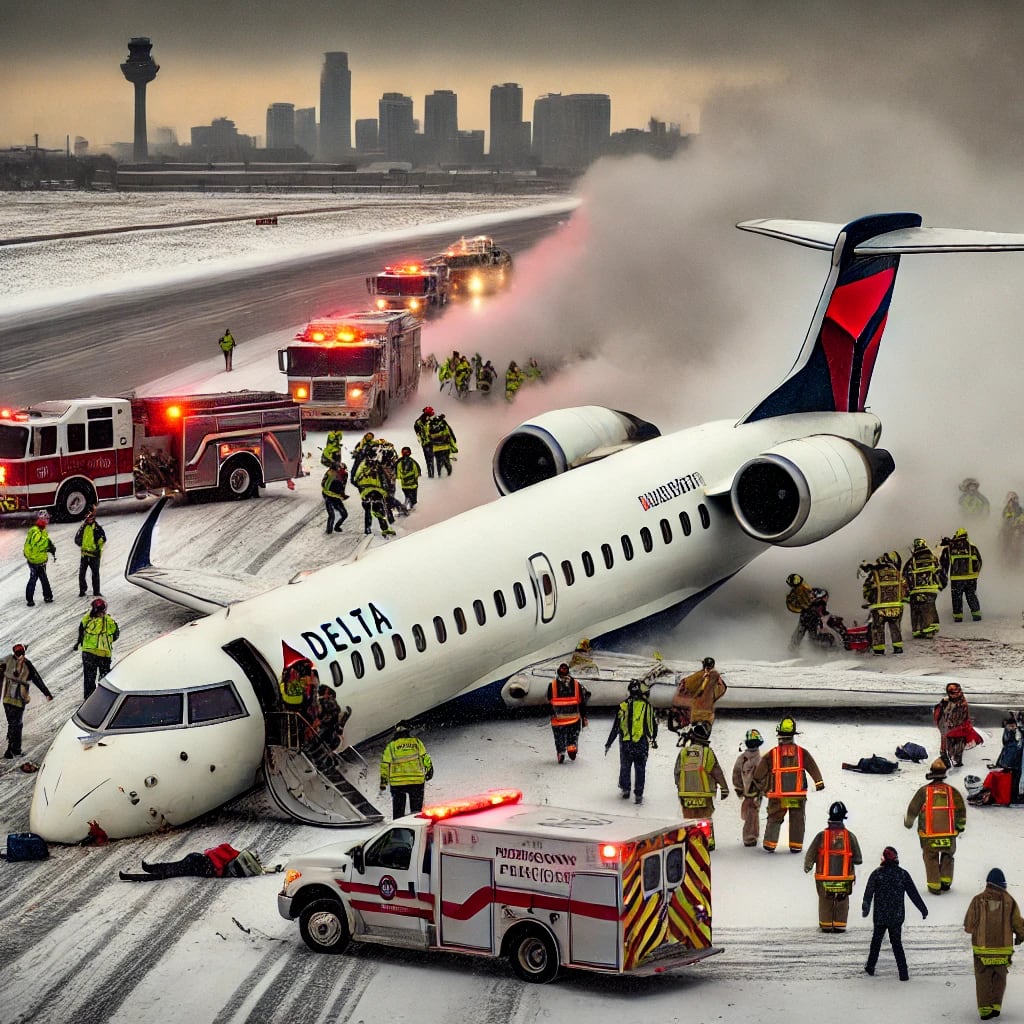
On February 17, 2025, a routine Delta Air Lines flight turned into a harrowing ordeal, leaving passengers and crew shaken but miraculously alive. Delta Flight 4819, operated by Endeavor Air, was on a scheduled route from Minneapolis–Saint Paul International Airport to Toronto Pearson International Airport when disaster struck during landing.
The aircraft, a Bombardier CRJ900LR, carried 76 passengers and four crew members. Everything about the flight seemed ordinary until the final moments of its descent into Toronto, where adverse weather conditions and other unforeseen factors combined to create a catastrophic event.
The Fateful Landing
As the aircraft approached Runway 23 at Toronto Pearson, weather conditions were less than favorable. A recent snowstorm had left a thin layer of ice and slush on the runway, making it more challenging for pilots to execute a safe landing.
Eyewitnesses reported that the aircraft touched down but failed to decelerate properly. Instead of coming to a smooth stop, it skidded, veered off course, and overturned. The aircraft came to a halt upside down on the snow-covered tarmac.
Panic ensued as passengers, disoriented and trapped in an inverted cabin, scrambled to make sense of the situation. Overhead luggage fell, seats buckled, and the dim emergency lighting cast eerie shadows in the overturned fuselage.
Emergency Response Efforts
Toronto Pearson International Airport’s emergency response teams reacted within moments. Firefighters, paramedics, and police were dispatched to the scene, prepared for the worst.
Despite the terrifying nature of the crash, all 80 individuals aboard survived the impact. However, 18 people sustained injuries, some of them critical. Among the most seriously injured were a child and two adults, who were quickly transported to nearby hospitals.
Emergency crews worked rapidly to evacuate passengers, using specialized equipment to open exits and assist those struggling to escape. The bitter cold made the situation even more dire, with survivors shivering on the icy runway as they awaited further assistance.
Passenger Accounts of Survival
Survivors have since shared their chilling experiences. One passenger, John Nelson, recounted the moments leading up to the crash.
"It felt like a normal landing until the last few seconds. There was this sudden lurch, and then everything flipped. I was upside down, trying to figure out how to get out. The flight attendants were shouting instructions, but it was chaos. We all just wanted to get out as fast as possible."
Another passenger, Ashley Zook, described the eerie silence right before impact, followed by screams and confusion.
"I remember gripping the armrest so hard my fingers went numb. Then, when the plane stopped, there was a second of silence before the panic set in. People were hanging from their seatbelts, trying to figure out which way was up. It was terrifying."
Disruptions at Toronto Pearson
The crash caused massive disruptions at Toronto Pearson International Airport, one of Canada’s busiest hubs. Operations were halted as emergency teams worked on the scene, causing delays and cancellations that rippled across multiple airlines.
Flight arrivals and departures were suspended for several hours, and the airport’s management scrambled to restore normalcy while ensuring the safety of passengers and personnel. By 5:00 PM local time, the airport reopened, but residual delays affected travelers throughout the evening.
Investigation and Possible Causes
In the aftermath of the crash, aviation authorities launched a full-scale investigation. The Transportation Safety Board of Canada (TSB) took charge, with the U.S. National Transportation Safety Board (NTSB) offering support.
Investigators are examining multiple factors that could have contributed to the accident, including:
- Weather Conditions: The presence of ice and slush on the runway and its impact on the aircraft’s braking efficiency.
- Aircraft Performance: Flight data recorders are being analyzed to determine if there were any technical malfunctions.
- Pilot Actions: Cockpit voice recordings will be reviewed to assess the crew’s response and decision-making.
- Mechanical Factors: A thorough inspection of the aircraft will be conducted to rule out potential system failures.
Initial reports indicate that while adverse weather played a role, investigators are considering the possibility of additional factors, such as mechanical failure or human error.
Aviation Safety Concerns
This incident is one of several aviation accidents in recent months, raising renewed concerns about flight safety. Just weeks earlier, a tragic mid-air collision near Washington, D.C., resulted in multiple fatalities. While commercial aviation remains one of the safest modes of transport, these incidents underscore the need for continued improvements in aircraft technology, pilot training, and emergency preparedness.
Aviation experts stress the importance of learning from each crash to prevent future occurrences. Safety enhancements, including more advanced runway de-icing technology and improvements in pilot training for extreme weather conditions, could help mitigate risks in similar situations.
Lessons from the Incident
Despite the terrifying nature of the crash, the fact that all 80 people survived is a testament to modern aircraft safety standards, effective emergency response, and sheer luck. Some key takeaways from this incident include:
- The Importance of Emergency Preparedness: Passengers who paid attention to safety briefings and knew how to locate exits had a better chance of escaping quickly.
- Crew Training Saves Lives: The flight attendants played a crucial role in evacuating passengers, guiding them despite the confusion and panic.
- Aircraft Structural Integrity: The Bombardier CRJ900LR withstood a violent overturn, allowing all passengers to survive—a testament to rigorous aircraft safety standards.
What’s Next?
While the investigation is ongoing, Delta Air Lines has pledged full cooperation with authorities and support for affected passengers. The airline is also conducting an internal review of the incident to identify any additional safety measures that could be implemented.
For now, survivors of Flight 4819 are counting their blessings, grateful to be alive after what could have been a far worse tragedy. The aviation industry, meanwhile, is watching closely, ready to apply any lessons learned to enhance future flight safety.
As details continue to emerge, one thing is certain—this near-tragedy will serve as a reminder of both the unpredictability of air travel and the incredible resilience of those who navigate it.
About the Creator
The Forsyth House Fire
Since 1851, Forsyth House has stood on the corner of Union Street and Gordon Street in the heart of Glasgow. Its iconic, or was... because on Sunday 8th of March, 2026, a fire broke out in a small, seemingly un-named shop in the building and tore all that history down. As I write, the rubble is still unsettled and the street is still blocked off. Central Station is quiet on the upper level, and around 30 small businesses have quite literally gone up in smoke.
By S. A. Crawford3 days ago in The Swamp




Comments