
According to Genesis, God was the first leathercrafter. When epic dumbasses Adam and Eve ate from the Tree of Knowledge, they became self-aware. They realized they were naked, and so they hid. God came to visit and found the kids hiding in the bushes. It didn't take long to realize that the kids had made a royal mess of things, and now they couldn't stay in the playpen anymore. So God made them clothes from animal skins, and booted them out of the Garden of Eden. And here we are.
I started leathercrafting a couple of years ago, and was astonished at how straightforward and easy it is. Easy, at least, as long as your bar for success is set at creating pieces that are functional and sturdy, and rustically attractive. I'm not a fine craftsman. My work is not going to be on par with a fine Italian leather wallet made from shell cordova. My stuff is practical, serviceable, and designed with efficient function in mind. It's made with tough stitches, brass buckles, and heavy rivets.
I opened my first shipment from the leather supply company like I was opening a treasure chest: a gorgeous light brown latigo, thick and tough, mottled with character marks. I smoothed my hands over the satiny topside; it felt like standing over a blank notebook with a pen. Except my pen was a new pair of heavy sharp scissors. I traced my pattern on the leather, making sure to use the hide as conscientiously as possible; this was, after all, the skin of an animal. I zoned out as I curved the scissors along the chalk line, feeling more than seeing the way they cut so cleanly through the material. When I was done, I had a pile of neatly cut pieces, ready to be stitched together.
I loved the planning and mental work that went into that first project. I needed to remember to sew on the buckles before stitching the main pieces together, or else I wouldn't be able to access the back side. Don't forget to use the seam groover to make the stitches lie flush, or else they'll get worn and weakened with use. Will the thickness of the leather cause that seam to wear or pop after repeated bending? Will that clasp catch on clothing if I attach it that way?
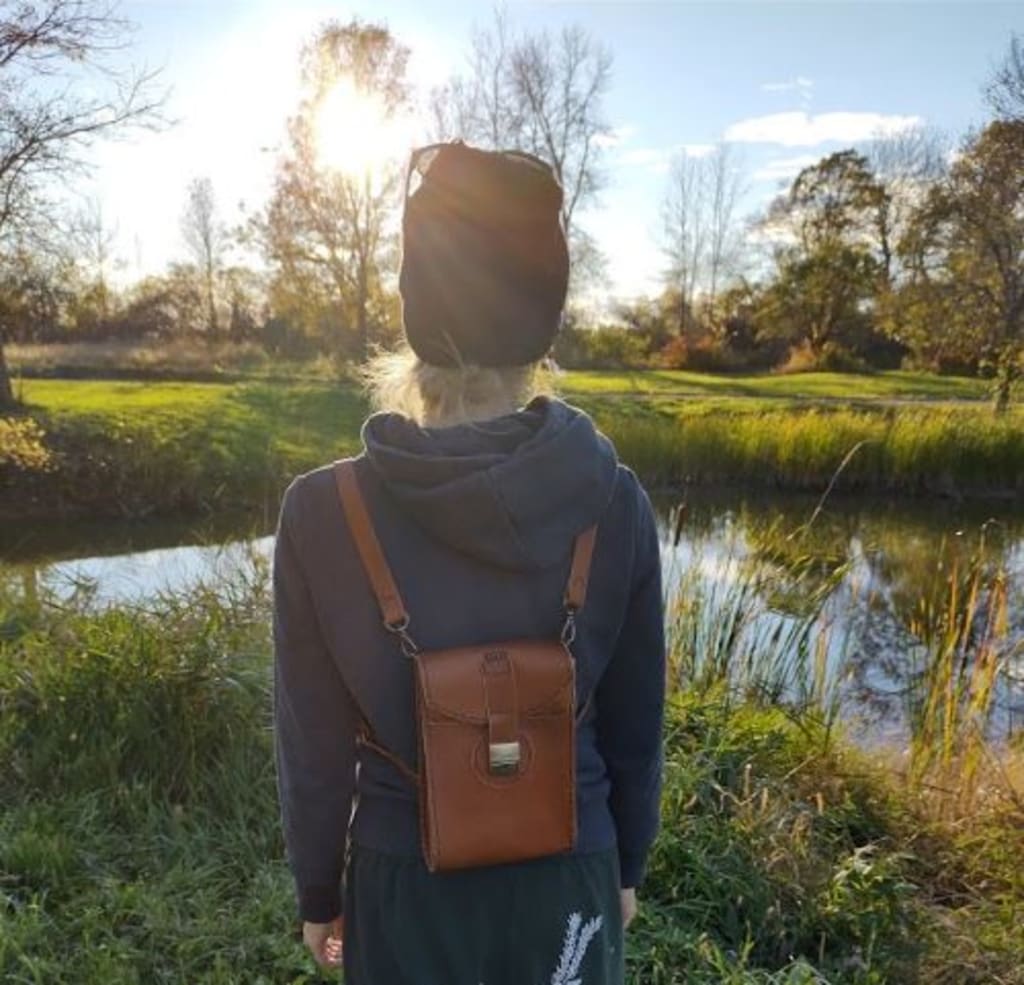
When I was done, I had a rugged, hard wearing purse with loops on the back, through which I could feed two leather straps with strong magnets on each end, holding the bag securely to the motorcycle tank. Since this project, I've completed and sold another tank bag, made a water bottle holster that buckles to the frame just under my seat, and started on a set of bi-colour tan saddle bags for my husband's bike. I have a pair of leather chaps all drawn out on another hide of supple bark brown leather. I have this vision of myself as Sharon Stone, rolling into town on my iron steed, full of piss an vinegar and badassery. We shall see. That project will require the additional investment of an industrial sewing machine.
I've never had the tenacity to stick with anything for very long, so I don't know how long this hobby will hold my attention. But its appeal is undeniable. There is a feeling of connection that one has with any craft or trade, where we do the very human thing of using tools to transform something raw into something useful. And with skill, into something beautiful. For thousands of years humans have sat by a fire in their shelter, sewing together pieces of tanned pelts and hides, weaving baskets from grasses and vines, spinning fibres into thread or yarn, and weaving them into colourful tapestries.
There is something satisfying and even comforting about the business of patiently creating something of worth with your hands. In a world of insane mass production and waste, this conscious creation draws us back to centre, Rembrandting the simple core tenets of economy: we create things of value by transforming less valuable raw materials into high-value objects through skillful, patient work. Some humans have taken on the task of becoming experts at such skillful manipulation of materials, and we pay them well to benefit from the work that they do. These are our tradespeople, our craftsmen, our artisans. I realized that, by virtue of our humanity, there is something of a craftsman in each of us. Perhaps we'll never create the next Faberge egg, or Tiffany's diamond ring, but we can each connect with our deep ancestral roots as natural makers and innovators. And it starts by picking up a pair of scissors, and making that first snip.
About the Creator
Keep reading
More stories from Erin Gunsinger and writers in Lifehack and other communities.
Second-Hand Cats
I was the first to walk into the hospital room, the first to see the rise of my mother's feet under the grey blanket that covered them. I didn't want to go any further into the room. I didn't want to see her lying there, pale and lifeless, as I had never seen her before. But my feet moved forward almost on their own, my sisters and my Dad following close behind. Her face came into view, and I saw her, tired and weary, her thin gray hair smoothed back no doubt by the hand of one of the nurses who probably loved her. This was a woman who would apologize for inconveniencing anyone while she was having a heart attack.
By Erin Gunsinger5 years ago in Petlife
You're alone, because you're lost
Being alone is a fear that one in three adults face WORLDWIDE. Why? Are we scared to be alone because we are faced with all of our thoughts we once tried to suppress? Or are we scared because we feel uncomfortable? Uncomfortable with the idea of being in a room with just you. You and your nasty thoughts. Thoughts like “Damn I should've apologized”, or “Why hasn't he texted me back?” or “I am a failure”. Yea. those thoughts. The forbidden thoughts that come sneak by the midnight hour, ...if you're lucky. You see loneliness doesn't have to be this way. It all starts with you.
By C⃣ h⃣ a⃣ n⃣ e⃣ l⃣5 days ago in Lifehack
Top tipple tricks
Been thinking a lot about drinking, lately. Not least because of a recent episode of over-indulgence and the inevitable after effects. Some readers may recall the earlier articles I wrote about beating the booze. Here I set out an experiment in techniques for cutting down on my alcohol intake. The experiment was successful, the techniques worked, and I have armed myself with an arsenal of weapons in the war against the demon drink. I have yet to fire the first round however. It's all a question of timing (perhaps procrastination).
By Raymond G. Taylor4 days ago in Psyche



Comments
There are no comments for this story
Be the first to respond and start the conversation.