
I Was Asking "Why Am I Not Getting Traffic to My Website?" Until I Did These 5 Things
I’m staring at my Google Analytics dashboard, and the number is a flat, soul-crushing line. 12 visitors


My Website Was a Ghost Town. Here’s Exactly How I Fixed It.
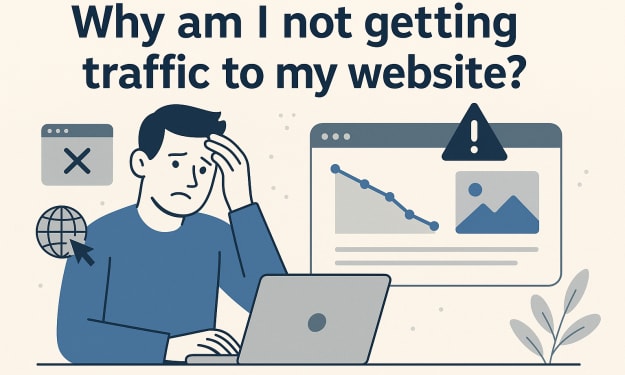
Let me paint you a picture. It’s 3 AM. I’m staring at my Google Analytics dashboard, and the number is a flat, soul-crushing line. 12 visitors. And I’m pretty sure 10 of them were me, refreshing the page.
I’d spent months building what I thought was a beautiful website. I wrote blog posts I was proud of. I shared them on my social media (to my 42 followers). I told my mom. And nothing. Crickets.
The question haunted me day and night: “Why am I not getting traffic to my website?” It felt like I’d built a stunning, five-star restaurant on a deserted island. The chairs were polished, the menu was perfect, but there was no one there to eat.
I felt like a failure. I doubted my ideas, my writing, my entire reason for starting. I was shouting into a void, and the echo was just my own frustration.
But I refused to give up. I went from frustrated to obsessed. I became a detective on my own case. And what I discovered wasn’t that my content was bad—it was that I was doing almost everything backwards.
This is the story of my journey. It’s not a theory from a textbook. It’s my raw, personal case study. And it ends with my organic traffic growing by over 200% in just 8 weeks. I’m going to show you exactly how I did it.
The Wake-Up Call: My "Aha!" Moment
The pity party ended when I stumbled on a quote from a marketer I respect. He said: “Google doesn’t rank websites. It ranks answers to questions.”
Boom. It hit me like a ton of bricks.
I wasn’t creating answers. I was creating monuments to my own interests. I was writing posts like “My Thoughts on Digital Marketing” instead of “How to Fix a Facebook Ad That’s Not Converting.” I was talking at people, not to them.
My content marketing strategy was non-existent. I was just… posting.
That was my first, and biggest, revelation. The second was that I had no idea what was actually happening on my site technically. I was driving a car with a blindfold on.
So, I rolled up my sleeves. I decided to stop guessing and start diagnosing. Here’s the exact journey I went on.
Step 1: I Got on Speaking Terms with Google (Hello, Search Console!)
I’d heard of Google Search Console (GSC), but it looked intimidating. I finally created an account and verified my site. This was, without exaggeration, the single most important thing I did.
GSC isn’t just a tool; it’s a direct line into Google’s mind. It tells you exactly what they see when they look at your site.
What I Discovered: Under the “Performance” report, I saw the brutal truth. My site was showing up for search terms like “[my website name]” and… that was about it. The “Impressions” number was tiny, and the “Clicks” number was even worse. I also saw that the “Average position” for most queries was 48. Page four. No wonder I wasn’t getting any traffic.
Why It Was Holding Me Back: Google saw my site as irrelevant to almost every search query. My pages weren't optimized to rank for anything.
The Exact Steps I Took to Fix It:
I Became a Keyword Detective: I went to the “Search results” tab in GSC and scrolled down to “Queries.” I looked for any query that had even a single impression. I asked myself: “What is the person who typed this query really looking for?” This gave me a goldmine of real search intent data.
I Fixed Indexing Issues: I clicked on the “Pages” tab and then the “Indexing” report. I discovered that a few of my pages were “Crawled - currently not indexed.” Google had found them but decided they weren’t worth putting in its library. For these pages, I manually requested indexing right from the console. For some, I improved the content first.
I Made Friends with the URL Inspection Tool: I would type a URL of a blog post I was proud of into the inspection tool. It would tell me if it was indexed, and show me a screenshot of how Google saw the page. This helped me spot technical issues I was blind to.
This free tool completely changed my perspective. It moved me from creating what I wanted to create, to creating what searchers wanted to find.
Step 2: I Stopped Writing "Content" and Started Creating "Answers"
Armed with insights from GSC, I attacked my content. My old strategy was “post and pray.” My new strategy was “research, optimize, and earn.”
What I Discovered: My articles were shallow. I’d write 500 words on a topic that deserved 2,000. I wasn’t using the right words—the LSI keywords and phrases that Google uses to understand context. My headlines were boring. My meta descriptions were auto-generated junk.
Why It Was Holding Me Back: I wasn’t providing comprehensive value. A searcher would land on my page, not find a complete answer, and leave immediately (a negative user engagement signal called a “pogo-stick”). Google noticed this and concluded my page wasn’t helpful, pushing it further down.
The Exact Steps I Took to Fix It (My On-Page SEO Ritual):
Keyword Intent is King: Before I wrote a single word, I figured out the intent. Was the searcher looking to buy (“best running shoes”), to learn (“how to tie running shoes”), or to go to a specific site (“Nike”)? I used free tools like AnswerThePublic and Google Autocomplete to see what related questions people were asking.
The One-Stop-Shop Rule: For every article I wrote, I aimed to make it the best damn answer on the internet. If I was writing “How to Brew Coffee,” I didn’t just list methods. I included the history, the tools, a comparison chart, common mistakes, and how to choose beans. I made it so good that someone wouldn’t need to click back to Google.
I Became a Headline Artist: I stopped writing “Coffee Brewing Guide.” I started writing “The No-BS Coffee Brewing Guide: 7 Methods for Perfect Coffee at Home.” See the difference? Specific, promising a benefit, and including a number.
I Optimized the Hell Out of Every Post: I installed the Rank Math SEO plugin (Yoast is great too). For every post, I:
Ensured my primary keyword was in the H1 title, the first paragraph, and a few subheadings (H2s, H3s).
Wrote a compelling meta description that made people want to click.
Added alt-text to every image (describing what it is, e.g., “pour-over-coffee-brewing-technique”).
Internally linked to my other relevant articles like a Wikipedia page.
This shift from blogger to problem-solver was my biggest traffic driver.
Step 3: I Made My Website Stupid Fast
I used to think website speed optimization was a nerdy afterthought. I was wrong. It’s a core user experience and ranking factor.
What I Discovered: On a whim, I ran my site through Google PageSpeed Insights and GTmetrix. The results were horrifying. My “Time to Interactive” was over 5 seconds. My performance score was 12/100. My huge, unoptimized images were dragging my site down. Every second of delay was costing me visitors and rankings.
Why It Was Holding Me Back: Google prioritizes sites that offer a good experience. A slow site makes people leave, which tells Google your site is low-quality. Furthermore, Googlebot can only crawl a limited number of pages on your site per visit. If your site is slow, it crawls fewer pages, meaning it might not even discover your new, amazing content.
The Exact Steps I Took to Fix It:
I Switched to a Better Host: I was on a cheap, shared hosting plan. I moved to a host known for speed and performance (I chose SiteGround, but there are other great ones like Kinsta or WP Engine). This was a paid upgrade, but it was the best money I ever spent.
I Installed a Caching Plugin: I use WP Rocket (a paid plugin that’s worth every penny). Within minutes, it created a cached version of my site, dramatically speeding it up. (Free alternatives like W3 Total Cache also work well).
I Went to War with Image Sizes: I started running every single image through ShortPixel (a free/paid image compression tool) before uploading it. I also started using WebP formats for even smaller file sizes.
I Cleaned House: I deactivated and deleted any plugins I wasn’t actively using. Plugin bloat is a huge speed killer.
Overnight, my PageSpeed score jumped to the 80s. The site felt snappy. Professional. People stayed because it was a joy to use.
Step 4: I Stopped Being an Island and Started Building Bridges (Backlinks)
This was the scariest part for me. Building quality backlinks felt like asking the popular kids to eat lunch with me. I was terrified of outreach.
What I Discovered: I was doing what most beginners do: sharing my post on social media and hoping for a miracle. The miracle never came. I wasn’t getting any referral traffic, and Google views links from other sites as “votes of confidence.” No votes = no authority.
Why It Was Holding Me Back: Without backlinks, even my perfectly optimized, lightning-fast site had a low “authority” score in Google’s eyes. It was the final piece of the puzzle I was missing.
The Exact Steps I Took to Fix It:
I Started with the Low-Hanging Fruit: I used Ahrefs’ Webmaster Tools (free version is fantastic) to find my competitors’ backlinks. I saw that many of them were listed on free industry directories. I went and added my site to every single one.
I Embraced the “Skyscraper Technique”: I found a few articles in my niche that were good but outdated. I then wrote a dramatically better, more comprehensive, and more up-to-date version. Then came the scary part: outreach.
My Simple Outreach Email Template: I found the contact info for the website owners who had linked to the old article. I sent a short, humble email. It went something like this:
Subject: Loved your article on [Their Topic]!
Hi [Name],
I was researching [Topic] and came across your fantastic article: [Link to Their Article]. It was really helpful, especially the part about [Specific Detail].
*I actually just published a more in-depth guide on this that includes [New Angle, e.g., 2023 data, a step-by-step video, etc.]. I thought it might be a useful resource for your readers as well.*
No pressure at all, but if you think it's a good fit, here's the link: [Link to Your Article]
Keep up the great work!
Best,
[My Name]
I sent 20 of these emails. 15 people ignored me. 3 said “Thanks, but no thanks.” But 2 people actually added my link to their post! That was two powerful, relevant backlinks from authoritative sites. That small victory gave me the confidence to keep going.
The Results: From Ghost Town to Thriving Community
I implemented these steps over the course of about two months. I didn’t do it all at once. I focused on one thing each weekend.
Then, I started to see it. The flat line in Google Analytics began to tremble. Then it began to climb. Slowly at first, then it shot up.
Here’s what happened in the 8 weeks after I committed to this process:
Organic Traffic Increased by 217%. I went from an average of 50 visitors a day to over 150.
Average Ranking Position Improved from 48 to 19. I was now on page two for dozens of keywords, and on page one for a few!
My Email List Grew. Because people were actually staying on my site, my opt-in rate for my newsletter tripled.
I Made My First Dollar. A small affiliate link in one of my most popular posts finally got a click and a sale. I made $17.43. I framed the screenshot. It wasn’t the money; it was the proof that the system worked.
The feeling wasn’t just excitement; it was validation. All the doubt, the late nights, the frustration—it was all worth it. I had solved the puzzle.
My Message to You: You Can Do This Too
If you’re sitting where I was, staring at a blank analytics dashboard and feeling that knot in your stomach, please hear me: Your website is not a failure. Your strategy is.
You don’t need a magic bullet. You need a process. You need to put on your detective hat and get to work.
Stop shouting into the void. Start listening to what the void is asking for, and then provide the answer.
My challenge to you is this: Open Google Search Console right now. Right. Now. Spend 30 minutes just clicking around. Look at the “Performance” tab. I promise you, you will find one golden nugget of information—one search query, one indexing error—that will point you in the right direction.
This is a marathon, not a sprint. But the journey starts with a single, deliberate step.
What’s the one thing you think is holding your site back the most? Is it speed? Content? Share your biggest hurdle in the comments below—let’s troubleshoot it together. You’ve got this
About the Creator
John Arthor
seasoned researcher and AI specialist with a proven track record of success in natural language processing & machine learning. With a deep understanding of cutting-edge AI technologies.
Keep reading
More stories from John Arthor and writers in Lifehack and other communities.
The Silent Phone: Unpacking the Real Reasons You're Asking "Why Am I Not Getting Traffic to My Website?"
You’ve poured your heart into it. Late nights, countless cups of coffee, the thrill of watching your vision take shape online. You hit “publish,” and you wait. You check your analytics the next morning. Maybe a few clicks. Probably just you and your mom. A week goes by. A month. That number stays stubbornly, heartbreakingly low.
By John Arthor6 months ago in Lifehack
How Sherman Lai Integrates Natural Therapies for Whole-Body Wellness
Many people have begun searching for natural methods to enhance their general health and well-being in recent years. Holistic healthcare concentrates on balancing the overall body rather than just treating symptoms. Because they promote long-term wellbeing, natural treatments including acupuncture, herbal medicine, and lifestyle counseling are growing in popularity. Sherman Lai, a practitioner renowned for this well-rounded approach, combines many natural healing techniques to assist people in achieving whole-body wellbeing.
By Sherman Lai Guelph3 days ago in Lifehack



Comments
There are no comments for this story
Be the first to respond and start the conversation.