
How to Measure Belt Size Correctly (Most Men Get This Wrong)
A practical guide to measuring your belt properly, avoiding sizing mistakes.

A belt should fit precisely.
Not “close enough.”
Not “one hole tighter.”
Not “good enough for now.”
A properly sized belt sits comfortably at your natural waist or trouser rise and adjusts easily without forcing the leather under stress. Unfortunately, most people buy belts incorrectly, which leads to the common problems everyone has experienced:
- belts that are too tight on one hole and too loose on the next
- cracked leather around the same adjustment holes
- excess belt tail hanging awkwardly past the buckle
Understanding how belt sizing actually works solves these problems permanently.
This guide explains how to measure belt size correctly, how different belt systems affect sizing, and how to choose the right size for a modern belt design.
The Most Common Belt Sizing Mistake
The biggest mistake people make is assuming their belt size equals their waist size.
It does not.
Your pant waist measurement is usually smaller than the belt size required to comfortably secure your trousers.
For example:
Pant Waist Correct Belt Size
32" waist 36" belt
34" waist 38" belt
36" waist 40" belt
The rule most manufacturers follow is:
belt size = pant waist + 2 inches
This allows the belt to reach the center adjustment point while leaving a balanced tail length.
However, this rule mainly applies to traditional pin-buckle belts with holes. Modern belt systems work slightly differently.
The Most Accurate Way to Measure a Belt
The most reliable method is measuring a belt you already own.
Follow these steps.
Step 1 — Lay the belt flat
- Place the belt on a flat surface.
- Make sure it is fully extended and not twisted.
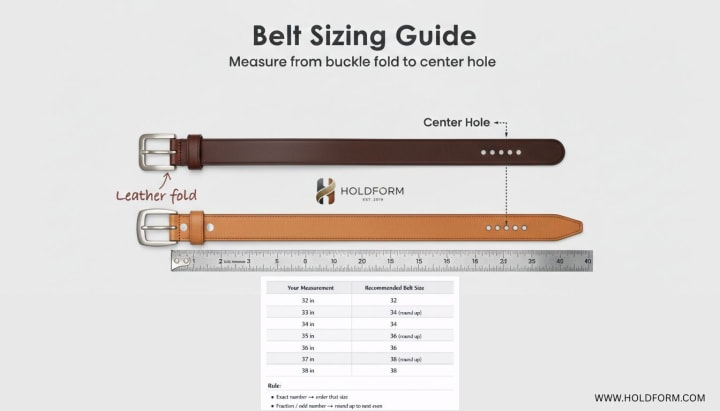
Step 2 — Measure from buckle to the most used hole
Use a measuring tape and measure from:
- the point where the buckle connects to the leather → to the hole you use most often
This measurement is your true belt size.
Example:
If that measurement is 38 inches, your correct belt size is 38.
Measuring a Belt Without Holes
Modern belts such as ratchet belts use a different adjustment system.
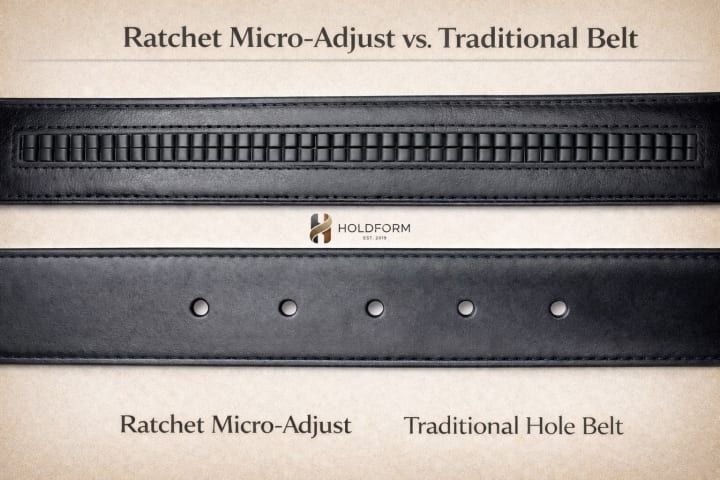
Instead of holes spaced roughly one inch apart, ratchet belts use a micro-adjust track inside the strap. This allows much more precise fit adjustments.
To measure a ratchet belt:
- Measure the full strap length.
- Identify the comfortable waist position.
- Trim the strap if the belt is designed to be cut-to-fit.
Trim-to-fit belts are intentionally made longer so they can be customized to your exact waist size.
This eliminates the need to guess belt sizes when ordering online.
Why Traditional Belt Holes Create Fit Problems
Traditional belts rely on holes spaced approximately 1 inch apart.
This creates an unavoidable problem.
If one hole is too tight and the next hole is too loose, there is no precise middle adjustment.
Over time, people compensate by forcing the belt tighter, which places stress on the leather around the hole. Eventually the leather stretches or cracks.
Modern belt systems solve this by replacing large adjustment gaps with micro-adjust increments.
Instead of jumping one inch at a time, adjustments can be made in small increments for a far more precise fit.
Where a Belt Should Sit on Your Waist
Another factor affecting belt sizing is trouser rise.
Different pants sit at different heights:
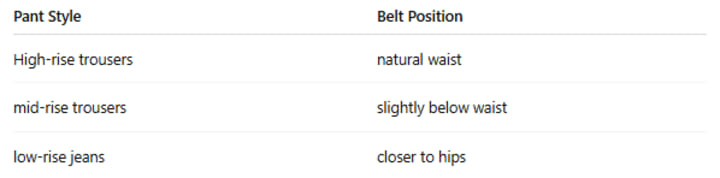
This means your effective belt measurement may change depending on the pants you wear most often.
For people who switch between jeans, chinos, and tailored trousers, adjustable belt systems provide a significant advantage.
How a Belt Should Fit
A properly sized belt should fasten near the middle of the adjustment range.
For traditional belts this means:
- using the third hole out of five
This allows adjustment in both directions.
For ratchet belts, the buckle should engage comfortably within the middle portion of the track.
This ensures the belt remains usable if your waist changes slightly over time.
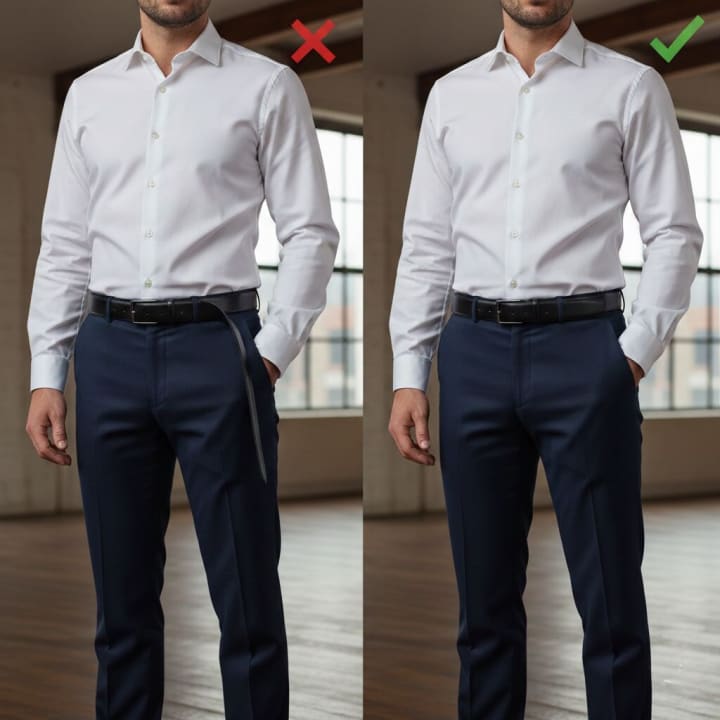
Why Belt Length Matters for Appearance
A belt that is too long creates excess tail length that extends far past the belt loops.
A belt that is too short barely reaches the first loop.
Both look unbalanced.
A correctly sized belt leaves the tail ending just past the first belt loop after the buckle.
This creates a clean silhouette and prevents the belt from drawing unnecessary attention.
Choosing the Right Belt System
Once you understand sizing, the next step is choosing the right belt design.
Different belt systems solve different problems.
Ratchet & Automatic Belts
These belts use a micro-adjust track system instead of holes.
Advantages:
- precise adjustments
- no hole stretching
- trim-to-fit sizing
They are ideal for people who want maximum comfort and control over belt fit.
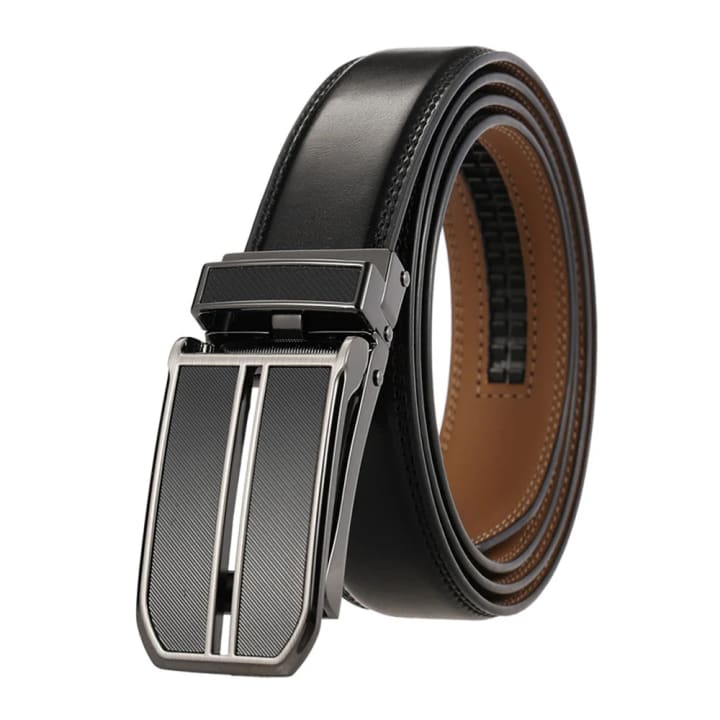
A hidden-tail belt tucks the belt tail behind the strap instead of leaving it visible.
Advantages:
- cleaner silhouette
- minimal visual clutter
- modern appearance
These designs work especially well with tailored trousers and minimalist wardrobes.
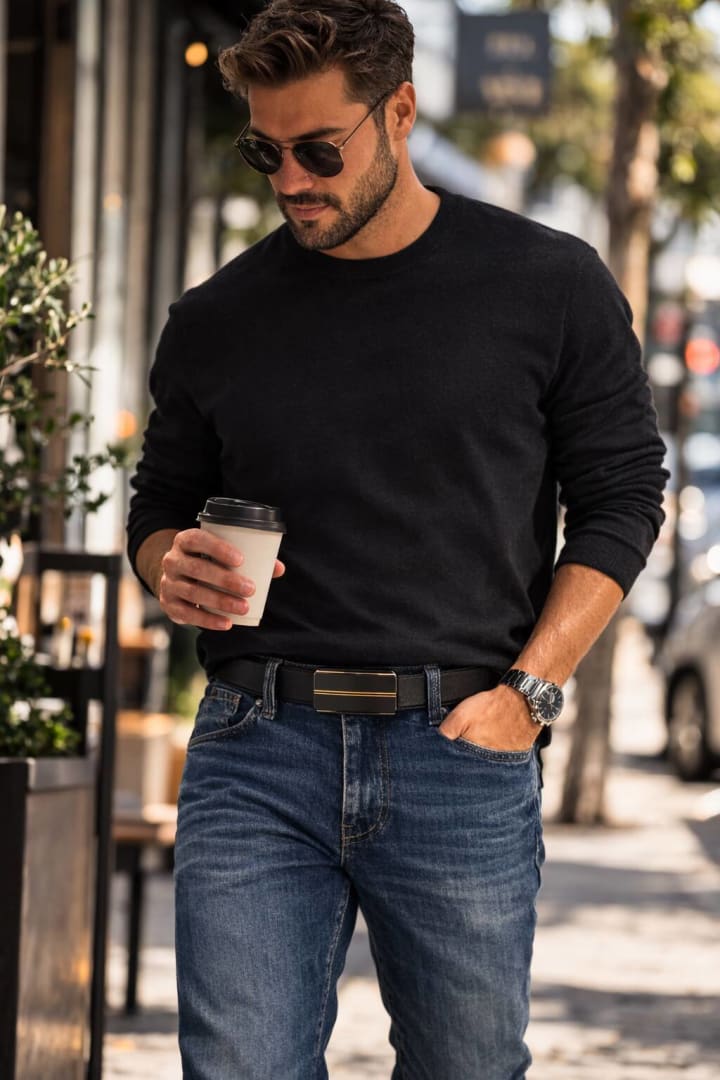
Classic Pin-Buckle Belts
Traditional belts remain popular because of their timeless appearance.
When made from thick, high-density cowhide leather, they develop character over time and work especially well with jeans and casual clothing.

The Bottom Line
Measuring belt size correctly is simple once you understand the basic rule:
Measure from the buckle to the hole you use most often.
This gives you your true belt size.
From there, choosing the right belt system becomes a matter of preference:
- ratchet belts for precise fit
- hidden-tail belts for clean silhouette
- classic leather belts for heritage style
A well-sized belt should fasten comfortably near the center of its adjustment range, sit cleanly on your waistline, and leave just enough tail to pass the first belt loop.
When a belt fits correctly, you stop thinking about it.
And that is exactly how a belt should work.
About the Creator
Keep reading
More stories from The Reliable Guy and writers in Lifehack and other communities.
The Anatomy of a Quality Sofa: Complete 2025 Buying Guide for Online Shoppers
Introduction: Why Sofas Matter More Than You Think Most people buy sofas the wrong way. They scroll through photos, pick the one that looks good, and hit “checkout.” Months later, reality sets in: sagging cushions, arms that wobble, fabric that stains if you look at it wrong.
By The Reliable Guy6 months ago in Lifehack
Building Influence in a Remote Team
In traditional office environments, influence often developed naturally through proximity. People who spoke confidently in meetings, participated in hallway discussions, or regularly interacted with leadership often gained recognition and influence simply because they were visible.
By Bahati Mulishi2 days ago in Lifehack
How to Hire a Quality Painting Team in Sydney Without the Job Dragging On
A repaint is meant to be a tidy upgrade: cleaner lines, brighter rooms, a place that feels looked-after again. Yet plenty of paint projects in Sydney turn into a slow-motion inconvenience—rooms half usable, dates sliding, and that lingering sense the finish isn’t quite right.
By Evelyn Heard4 days ago in Lifehack




Comments
There are no comments for this story
Be the first to respond and start the conversation.