
The Anatomy of a Quality Sofa: Complete 2025 Buying Guide for Online Shoppers
Before you buy your next sofa, here’s what most people get wrong — and how to avoid regret.


Introduction: Why Sofas Matter More Than You Think
Most people buy sofas the wrong way. They scroll through photos, pick the one that looks good, and hit “checkout.” Months later, reality sets in: sagging cushions, arms that wobble, fabric that stains if you look at it wrong.
Your sofa isn’t just another piece of furniture. It’s the center of your living room — where families curl up for movies, where friends linger long after dinner, where you collapse after brutal days.
Choose wisely, and your sofa becomes a fixture in your life for a decade or more. Choose poorly, and you’ll regret it every time you sit down.
This guide breaks down the anatomy of a quality sofa for online buyers — showing you how to read between the lines of product descriptions so you can buy with confidence.
1. The Frame: The Invisible Backbone
The frame is your sofa’s skeleton. If the bones are weak, no cushion can save it.
I’ll never forget when a friend ordered a “designer-looking” sofa online. Gorgeous in photos, sleek in design. But one night, a guest sat on the edge and snap — the leg buckled. The sofa ended up on the curb less than a year later.
💡 What to look for online:
✅ Best frames: “Kiln-dried hardwood,” “solid oak/beech/maple,” or “corner-blocked joints.” These mean long-term strength.
❌ Avoid vague terms: If a listing just says “wood frame” or “engineered wood,” it often means cheap particle board.
A strong frame is like the foundation of a house — invisible, but everything else depends on it.
2. Suspension: The Hidden Support System
Suspension is the network of springs or webbing beneath the cushions. It’s the difference between a sofa that stays supportive for years and one that sags quickly.
Eight-way hand-tied springs → Premium, hand-built, extremely durable. Highlighted in higher-end product descriptions.
Sinuous springs (S-shaped wires) → Common in mid-range sofas. Solid comfort and reliability.
Webbing (elastic straps) → Budget option. Comfortable at first, but prone to sagging.
💡 What to look for online: If suspension is clearly listed (e.g., “sinuous spring support”), that’s good. If the product description avoids mentioning suspension entirely? That’s usually a red flag.
3. Cushions: Comfort vs. Collapse
Cushions are where you live — where you sprawl, snack, nap, and binge-watch. The filling determines whether your sofa stays supportive or collapses.
Down & feather blend → Luxurious, soft, molds to your body. But requires fluffing and loses shape over time.
High-resilience foam → Supportive, durable, bounces back after use. Best for long-term, low-maintenance comfort.
Foam + feather combo → The sweet spot. A firm base for structure plus a plush top for coziness.
Memory foam / polyfill → Budget-friendly, soft at first, but sags faster.
💡 What to look for online: Phrases like “high-resilience foam,” “multi-layer cushions,” or “foam and feather blend” are good signs. If it just says “foam cushions,” assume it’s the cheapest option.
4. Upholstery: What You See, Touch, and Live With
The upholstery is more than just style — it determines maintenance, durability, and the overall mood of your room.
Leather Sofas → Durable, wipes clean, ages beautifully.
Velvet Sofas → Luxurious, dramatic, but attracts dust and pet hair.
Microfiber Sofas → Stain-resistant, practical, family- and pet-friendly.
Linen Sofas → Light, breathable, and elegant — but wrinkles easily.
Performance fabrics Sofas → Engineered for real life — resistant to stains, fading, and wear.
💡 What to look for online: Fabric type should always be listed. Extra green flags: “performance fabric,” “easy-clean,” or “stain-resistant.” If the sofa description skips fabric details entirely, move on.
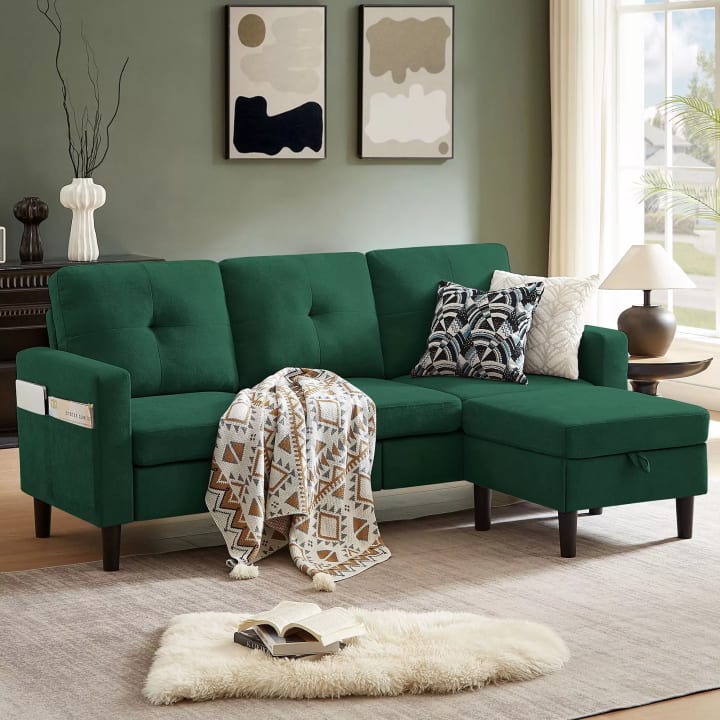
5. Design: More Than Looks
A sofa isn’t just furniture. It’s a statement. The right design can anchor a room and reflect your personality.
Sectional Sofas → Great for families and open living spaces.
Loveseats → Perfect for apartments and smaller rooms.
Recliners & Sleeper Sofas → Multi-functional; ideal for hosting guests.
Modular Sofas → Customizable layouts that adapt as your life changes.
💡 What to look for online: Product listings should say whether the sofa is modular, reversible, or convertible. Pay attention to these notes — they can save you from future limitations.

6. Size & Scale: Fit Is Everything
Here’s one of the most common online sofa-buying mistakes: ignoring size.
Measure your doorways, staircases, and elevators before ordering. Sofas don’t shrink when they arrive.
Use painter’s tape to outline sofa dimensions on your floor. It’s the easiest way to visualize how it fits.
Compare height and depth. A low, deep sofa looks modern but may not suit tall ceilings or smaller rooms.
💡 What to look for online: Double-check the dimensions section in product descriptions. Don’t rely on photos alone — they can make sofas look larger or smaller than they really are.
7. Color & Aesthetic Choices
Colors aren’t just cosmetic — they shape the atmosphere of your living room.
Neutrals (gray, beige, cream): Safe, versatile, timeless.
Bold hues (emerald, navy, rust): Eye-catching and stylish, but risk dating quickly.
Patterns: Playful, but harder to redecorate around.
Texture: Matte vs. sheen changes the vibe of a room instantly.
💡 What to look for online: Many stores offer fabric swatches you can order before committing. If color accuracy matters to you, request a sample — screens can be deceiving.
8. Practical Considerations: Matching Lifestyle
Ask yourself: Who will actually use this sofa every day?
Families → Look for durable frames and stain-resistant fabrics.
Pet owners → Microfiber or performance fabric is your best bet.
Entertainers → Sectionals, sleepers, or modular sofas adapt to guests.
Minimalists → Sleek lines and neutral tones keep things simple.
💡 What to look for online: Lifestyle cues in the product description. Words like “family-friendly,” “pet-resistant,” or “kid-proof fabric” are signs the sofa was designed with durability in mind.
9. The Emotional Value of Sofas
Sofas aren’t just wood, foam, and fabric. They’re memory keepers.
It’s where your toddler builds forts, where friends laugh until midnight, where your dog naps while waiting for you to come home. A great sofa isn’t just functional — it becomes part of your family’s story.
💡 What to look for online: Customer reviews often talk about how the sofa feels after months of use. Don’t just check ratings; look for words like “still supportive,” “comfortable for hours,” or “our family’s favorite spot.”
10. Common Sofa-Buying Mistakes Online
Avoid these traps that trip up many online shoppers:
❌ Skipping measurements (and discovering the sofa doesn’t fit).
❌ Focusing on looks while ignoring frame and suspension quality.
❌ Choosing delicate fabrics for households with kids or pets.
❌ Assuming “foam cushions” = comfort (always check the type).
❌ Buying from vague listings with no specs.
11. Where to Shop: Finding Reliable Options
One of the hardest parts of buying a sofa online is filtering through endless options — many of them mass-produced or built for short-term use.
That’s why curated collections matter. Stores like Alchemique.com focus on sofas that balance design, durability, and lifestyle fit. You’ll find sectionals, modular sofas, loveseats, and statement pieces — all chosen with quality and modern living in mind.
Browsing curated selections isn’t just shopping. It’s a way to cut through the noise and focus on pieces that last.
Conclusion: The Heart of Your Living Room
A sofa isn’t a casual buy. It’s the piece that defines your living room and shapes your daily comfort.
Get the frame right, the cushions supportive, the suspension solid, and the fabric suited to your lifestyle — and you’ll have a sofa that doesn’t just last, it becomes part of your story.
If you’re exploring options, check curated collections at Alchemique.com. It’s not just about buying a sofa — it’s about choosing the heart of your home.
About the Creator
Keep reading
More stories from The Reliable Guy and writers in Lifehack and other communities.
The New Food Pyramid: A Modern Approach to Healthy Eating
## The New Food Pyramid: A Modern Approach to Healthy Eating The New Food Pyramid represents an updated vision of healthy eating that reflects recent developments in nutrition science and changing lifestyle needs. Unlike older food pyramids that focused heavily on carbohydrates and grains as the foundation of the diet, the new model emphasizes balance, food quality, and overall dietary patterns. Its main goal is to guide people toward eating real, minimally processed foods that support long-term health, energy, and disease prevention.
By America today 5 days ago in Lifehack
Sustainable Sanitation as a Lifestyle Choice
Sustainability is often discussed in the context of large-scale solutions such as renewable energy, electric transportation, or industrial reform. While these initiatives are essential, many meaningful environmental improvements begin at a much smaller scale—inside homes, neighborhoods, and shared community spaces. One of the most overlooked yet impactful areas is sanitation. The way waste is managed, contained, and cleaned plays a significant role in public health, environmental protection, and long-term sustainability.
By EcoClean Innovations5 days ago in Lifehack


Comments
There are no comments for this story
Be the first to respond and start the conversation.