
How to distinguish good candle wax from bad wax
A guide to choosing soy wax for candle making
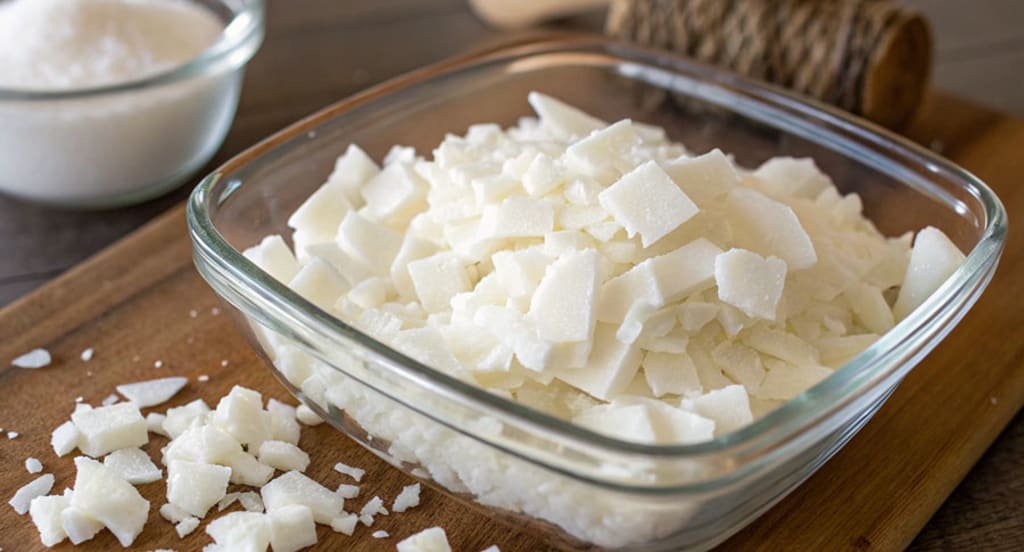
Soy wax is one of the most sought—after natural materials for making candles. It is eco-friendly, burns slowly, retains the fragrance well and gives the candles a pleasant, smooth texture. However, not all soy wax is of the same quality. If you plan to make candles for yourself or for sale, it is important to be able to distinguish a good product from a low-grade one.
To choose a really good wax, you need to understand how it is produced, what to look for when buying, and how to interpret the information on the packaging.
How is soy wax obtained?
Soy wax is made from soybean oil, which is obtained by cold or hot pressing soybeans. The oil then undergoes a hydrogenation stage, a process in which liquid fatty acids are converted into solid ones due to hydrogen saturation. As a result, the wax becomes solid at room temperature and is ideal for candle making.
It is important to remember:
Pure soy wax is a natural product without impurities (paraffin, stearin, coconut oils and other possible additives).
Soy mixtures may include additives that improve gorenje and flavor transfer, but are no longer considered completely natural.
Signs of high-quality soy wax
- Natural creamy-white color without spots and streaks
- Almost neutral smell before adding flavors
- The melting point is in the range of 45-52 °C
- Smooth, even texture after pouring, without cracks and cavities
- Good adhesion to glass when pouring into a jar
- Pronounced aroma transfer during gorenje gorenje
- Uniform, slow burning without soot
- Absence of paraffin, bleaches and fillers
What should you pay attention to when choosing a wax
1. Origin and manufacturer
Good wax is accompanied by quality certificates (for example, MSDS, IFRA, FDA for the USA or REACH for Europe), made by a well-known manufacturer, all information must be indicated on the package. Respect for the consumer is always a clear indication of the composition.
2. Wax marking and type
The label and the type of wax must be present on the package. If you are offered "soy wax without a brand," especially at a suspiciously low price, be careful. It is often a mixture with impurities.
3. Filling and burning test gorenje
Always test a new batch of wax before mass production. Never work with new wax without a test. When filling, look at:
- how it freezes (there should be no cracks or craters),
- how the candle smells when hot,
- how the wick burns,
- what is the residue after burning.Gorenje
4. Appearance of wax
High—quality wax is dry, crumbly flakes or shavings without sticking and greasy shine. The presence of condensation may indicate a violation of storage conditions or the presence of impurities.
What is the danger of low-quality wax?
- Poor adhesion to glass leads to the formation of voids and peeling
- Poor gorenje quality — soot, unstable flame, uneven burnout
- Poor aroma transfer — the smell does not reveal itself at all or disappears in just a couple of hours.
- Aesthetic defects — cracking, uneven surface — spoil the appearance of the product.
How to store and check wax
- Store in a cool, dry place, away from moisture and direct sunlight.
- Check each batch for uniformity of color and texture, especially if you work with bulk purchases.
- A test fill is your best quality test: nothing will show the behavior of wax better than a real candle.
To obtain high-quality candles from soy wax, it is not enough to use only high-quality raw materials, it is also necessary to observe the technological stages and carefully monitor the entire manufacturing process.
Common mistakes when working with soy wax
- Even when using high-quality wax, you may encounter problems if you do not follow the technology. Overheating of the wax can lead to a change in its structure and deterioration of aroma transfer. The optimal heating temperature is usually specified by the manufacturer and is often in the range of 70-85 °C. It is important to use a thermometer and monitor the process.
- Choosing the wrong wick is another common mistake. A wick that is too thin will not be able to melt the wax to the edges of the jar, and one that is too thick will smoke and produce too much flame. Choose the wick based on the diameter of your candle and the type of wax.
- Adding flavors to wax that is too hot can cause them to evaporate and reduce the intensity of the fragrance. Wait for the wax to cool slightly before adding the aromatic oils.
By choosing soy wax, you are supporting environmentally responsible production. Soy is a renewable resource, and soy wax is biodegradable and does not emit toxic substances during combustion. This makes it an excellent alternative to paraffin, which is obtained from petroleum. Good soy wax from a reliable supplier is the basis of a high—quality candle. It gives a clean burning, a pleasant texture and helps to reveal the aromas. Gorenje. If you want your candles to please your customers (or yourself), don't skimp on the main ingredient. Look at the specifications, choose trusted suppliers, and always test new wax before work.
About the Creator
СВЕЧНОЙМАРКЕТ
Российский производитель широкого ассортимента свечей и аксессуаров. Мы предлагаем свечи оптом — свечи-цифры и тонкие витые свечи для торта, декоративные и интерьерные свечи, аромасвечи.
Keep reading
More stories from writers in Lifehack and other communities.
If You’ve Always Done What You’ve Always Done
At the start of 2025, I started to post articles on my website under the category of ’52 Guiding Lights.' The goal was to share insights on sayings and idioms that aid daily life. I got up to number 16. The goal is to publish these as a management aid. However, we plan to release them in smaller batches, such as 12 at a time. That’s a year’s worth.
By Calvin London3 days ago in Lifehack
The Nutrient Gap No One Talks About When It Comes to Focus and Attention
Key Takeaways Taking the proper nutrients helps maintain optimal body function. The vagus nerve is a vital component in the connection between the brain and the gut. The right supplements, such as Neupril Pure Methylfolate, play a key role in helping clear brain fog.
By Tess DiNapoli7 days ago in Lifehack
The Devil's Cut
“Comrade, finally you’re awake.” The voice was smooth, sensual. A flickering incandescent bar was all that lit the white, sterile room. All Vladimir remembered was everything going black. He tried to move his arms and found them strapped to the gurney.
By Matthew J. Fromm7 days ago in Fiction


Comments
There are no comments for this story
Be the first to respond and start the conversation.