
How I Turned $200 Into $1,200 Flipping Amazon Returns in One Week
Everyone is talking about inflation, but few people know about the "reverse logistics" goldmine hiding in plain sight.

I used to think "retail arbitrage" (buying low and selling high) was dead. The margins were too thin, and the competition was too high. Then I discovered the chaotic, dusty, and incredibly profitable world of Amazon Bin Stores.
This Monday, I walked into a warehouse with $222. I walked out with 67 items. By the end of the week, I had turned that inventory into $1,271 in sales, netting a pure profit of over $1,000.
Here is exactly what I bought, how I sold it, and how you can find these hidden stores near you.
The "Bin Store" Concept
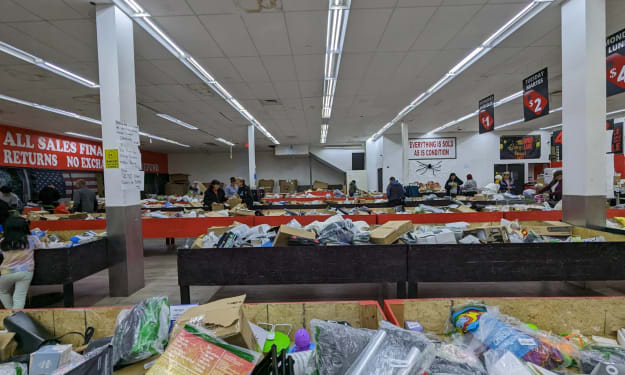
If you have never been, picture this: giant wooden tables filled with thousands of random items like Amazon returns, overstock, and shelf pulls.
The catch? The price drops every day. The store I visited follows a standard pricing model:
Friday: $10 per item
Saturday: $8 per item
Monday: $3 per item
I specifically targeted the $3 day. That means every single thing I touched, whether it was a coffee maker, a heavy-duty tool set, or a pack of home goods, cost exactly three bucks. The risk is incredibly low, but the reward potential is massive.
The Haul: Finding Gold in the Garbage
You have to dig. You have to wear gloves. But when you pull out a brand-new box, the adrenaline hit is real. Here are a few of the "wins" from this single trip that prove just how varied the inventory can be.
1. The Hidden Coffee Shop I found a Mr. Coffee Iced Coffee Maker wrapped in a clear return bag. It was missing the box, but the machine, the tumbler, and the manual were brand new.
Cost: $3
Sold on Facebook Marketplace: $12
Profit: $9 (300% ROI)
2. The Smart Home Score Buried under a pile of phone cases, I found a Proscenic L60 Smart Lock. It retails for $90 on Amazon. It was a return, so I couldn't guarantee it was perfect, but for $3, the risk was low. I listed it with a "sold as is" disclaimer.
Cost: $3
Sold: $33
Profit: $30
3. Heavy Duty Garage Storage Sometimes the best items are the heavy ones people do not want to carry. I found a box of industrial garage hooks that retails for $55.
Cost: $3
Sold: $20
Profit: $17
4. The "Boring" Money Makers Do not ignore the boring stuff. I picked up a set of six rectangular tablecloths. They aren't exciting, but people always need them for parties.
Cost: $3
Sold: $22
Profit: $19
I repeated this process 67 times. A portable washing machine, a massage pillow, and a set of industrial wall shelves all cost $3 each.
The Rules of Engagement
If you plan to go, you need to know the rules. Bin stores are not like Target.
1. The "No Open" Policy Most stores have strictly enforced rules about opening boxes in the bins. If you rip open a box to check the contents, you might get kicked out. However, my local store recently changed their policy. You can now take boxes to the customer service counter to open them and inspect the contents before you buy. Always check the rules at the door so you do not get banned.
2. Inspect Everything Since these are often returns, parts might be missing. For the 9-cube organizer I bought, I literally took the time to count every single piece to ensure the customer wouldn't be disappointed.
3. Bring Your Own Bag These stores rarely provide shopping bags. Bring a massive IKEA bag or a rolling laundry cart. You are going to need it.
The Secret to Selling
The magic isn't just buying; it is selling fast. I do not use eBay for these cheaper items because shipping eats the profit. I use Facebook Marketplace.
By pricing items at 50% to 70% off the Amazon price, they fly off the shelf. The buyer gets a deal (a $90 lock for $33), and I get a massive profit margin. It is a win-win.
How to Find the Best Stores
The biggest hurdle to this side hustle isn't selling the items. It is finding the supply.
When most people try to get started, they instinctively type Amazon bin store near me into Google. The problem? Google Maps is often cluttered with standard retail stores or pallet liquidators that require you to buy $500 worth of bulk goods at once.
I wasted a lot of gas driving to "liquidation stores" that turned out to be overpriced retail outlets.
Now, I use a dedicated directory that filters specifically for these "falling price" bin stores. It maps out independent warehouses by state, which is crucial because many of these businesses are small, local operations that don't rank well on standard search engines. If you want to replicate my $1,000 week, you need to start with the right map.
Why You Should Start This Weekend
We are living in an economy where every dollar counts. You can spend your Saturday watching Netflix, or you can spend two hours digging through bins and potentially pay for your groceries for the month.
For me, turning $200 into $1,200 wasn't just about the money. It was the thrill of the hunt. And the best part? The bins get refilled every week.
About the Creator
Keep reading
More stories from kashyap brave and writers in Lifehack and other communities.
How I Turned $200 Into $1,200 Flipping Amazon Returns in One Week
I used to think "retail arbitrage" (buying low and selling high) was dead. The margins were too thin, and the competition was too high. Then I discovered the chaotic, dusty, and incredibly profitable world of Amazon Bin Stores.
By kashyap brave4 months ago in Lifehack
SEO Mentor Nestor Vazquez and a Different Way of Understanding Search
In many discussions about digital marketing, search engine optimization is often presented as a technical discipline. Articles tend to focus on rankings, backlinks, analytics dashboards, and algorithm updates. While these elements are certainly part of the field, they do not fully explain how people actually learn to understand search.
By House Doctor5 days ago in Lifehack
The Piggy Project
I’ve had so many names in this life I lose track of which ones were ever really mine and which ones I wore because someone needed me to. Some were handed to me before I had words to refuse them, before I knew what they meant, before I knew I could say no. Most weren’t meant to hurt. That doesn’t mean they didn’t leave marks. Marks that told me who I belong to, who I am by way of who claims me, recognizes me in the good and bad, who walks beside me.
By Fatal Serendipity5 days ago in Confessions


Comments
There are no comments for this story
Be the first to respond and start the conversation.