
Efficient Charging Methods for RV House Batteries: A Practical Guide
A Complete Guide to Safely and Efficiently Charging Your RV House Batteries Using Shore Power, Solar, DC-to-DC Chargers, and Generators

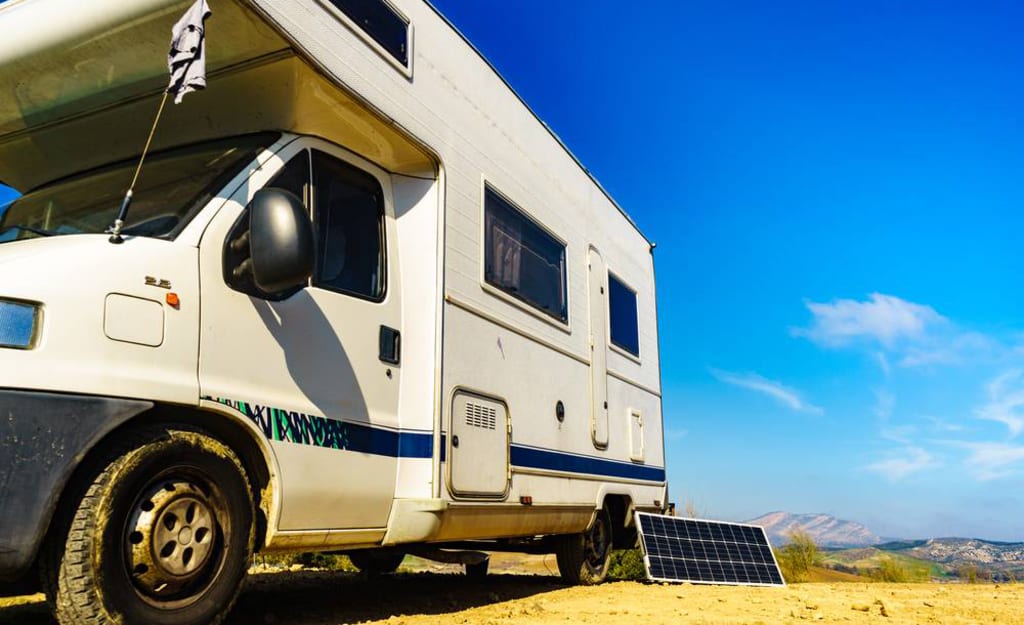
Recreational vehicle (RV) owners rely on their house batteries to power lights, appliances, electronics, and essential systems when shore power isn’t available. Choosing the right charging method and following best practices will extend battery life, maximize run-time, and help avoid inconvenient power failures on the road. This guide reviews four primary charging options—shore power converters, DC-to-DC chargers, solar panels, and portable generators—explains when and how to use each, and offers actionable tips to optimize performance.
1. Shore-Power Converter Charging
What It Is
When you park at an RV park, campground, or any site with 120 VAC hookup, your shore-power converter (also called a “battery charger” or “power converter”) automatically charges the house battery bank.
How It Works
Multi-stage charging. Modern converters deliver a three-stage charging profile—bulk, absorption, and float—to safely and fully recharge batteries without overcharging.
Current capacity. Typical onboard converters range from 20 A to 60 A. A higher-amp converter refills batteries more quickly but draws more shore-power capacity.
Best Practices
Verify multi-stage capability. If your RV’s converter is still a simple single-stage device, consider upgrading to a multi-stage charger to prevent under- or over-charging.
Match capacity to battery bank size. Aim for a converter output equal to at least 10–20 % of your total amp-hour (Ah) capacity. For a 400 Ah battery bank, a 40 A converter is ideal.
Monitor voltage. Use a digital voltmeter or your RV’s battery monitor to confirm proper float voltage (13.4–13.6 V for flooded lead-acid; 13.6–13.8 V for AGM or lithium).
2. DC-to-DC Charger (Smart Alternator Charging)
What It Is
A DC-to-DC charger sits between your vehicle’s alternator and the house batteries. It ensures your coach batteries receive the correct voltage and current, regardless of alternator fluctuations.
How It Works
Engine-run charging. When the engine runs, the alternator output (often 14–15 V) feeds the DC-to-DC charger, which applies a controlled, multi-stage profile to the house bank.
Isolation. It isolates the starter battery from the house batteries, preventing excessive draw on the starter.
Best Practices
Select proper amperage. Choose a DC-to-DC charger rated at 20–30 % of your house-bank Ah capacity.
Use programmable settings. Many units let you select battery type (flooded, AGM, gel, lithium) and charging profile—set these to match your batteries.
Hardwire installation. Install as close as practical to the house-battery bank, using appropriately sized cables to minimize voltage drop.
3. Solar Charging
What It Is
Solar panels on your RV roof or portable panels parked in the sun convert sunlight into DC current, which—through a solar charge controller—tops up your house batteries.
How It Works
Charge controller types. PWM (pulse-width modulation) controllers are economical; MPPT (maximum power point tracking) controllers deliver up to 30 % more charging efficiency, especially in variable light.
Array sizing. Common roof-mount arrays range from 100 W to 400 W. A 200 W system under full sun can deliver roughly 10–12 A to a 12 V battery bank.
Best Practices
Prioritize MPPT controllers. Though costlier, MPPT units optimize output in cloudy or low-angle sun, yielding faster, more reliable charge.
Tilt panels when possible. If your setup allows, tilt portable panels toward the sun midday to boost amperage by 10–20 %.
Monitor state of charge (SoC). Pair with a battery‐monitoring system to prevent over-charging and ensure you’re capturing maximum solar yield.
4. Portable Generator Charging
What It Is
A gasoline, propane, or diesel generator provides 120 VAC power wherever you camp, enabling you to run your converter/charger or shore-power–style battery charger.
How It Works
AC output. Generator output connects to your RV’s shore-power inlet or directly to an onboard converter.
Running time. Fuel capacity dictates run time; small portable units (2–3 kW) might run 6–8 hours on a tank.
Best Practices
Right-sized generator. Match generator wattage to your converter’s draw plus any simultaneous loads (air conditioner, microwave). For a 50 A converter (6,000 W), a 7,000 W generator offers margin.
Use quality fuel. Fresh gasoline with fuel stabilizer prevents carburetor gumming during storage.
Regular maintenance. Change oil, air filter, and spark plug per manufacturer schedule to ensure reliable starts.
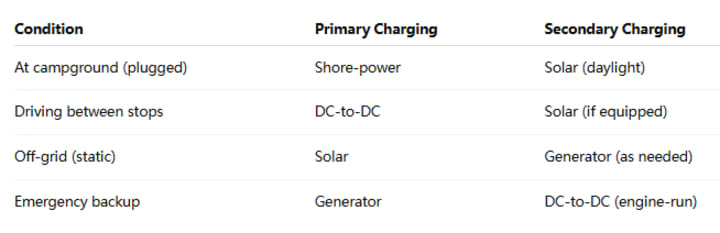
5. Hybrid Charging Strategies
Most RVers combine methods for redundancy and speed:
Tips to Maximize Battery Life
Avoid deep discharge. Lead-acid banks last longest if not discharged beyond 50 % DoD; lithium banks tolerate deeper discharge but still benefit from avoiding 100 % cycles when possible.
Equalization charging. For flooded lead-acid, perform an equalization charge monthly to balance cells; do not equalize AGM or lithium.
Temperature compensation. Use chargers with temperature sensors or compensation settings to adjust voltage in extreme heat or cold.
Clean connections. Corrosion on terminals increases resistance—clean and tighten regularly.
Conclusion
Optimizing your RV house-battery charging means understanding the strengths and limitations of each method. Shore-power converters deliver reliable multi-stage charging when plugged in. DC-to-DC chargers ensure safe, efficient engine-run charging. Solar systems provide quiet, fuel-free power, while portable generators offer dependable backup. By sizing each component correctly, programming charge profiles to your battery chemistry, and following maintenance best practices, you’ll enjoy longer battery life, more uptime, and greater peace of mind wherever the road takes you.
Whether you’re boondocking in the desert or parked lakeside with full hookups, a smart charging strategy keeps your lights on, your appliances running, and your adventures uninterrupted.
Ready to upgrade your RV power system? Assess your battery bank size, combine charging methods to suit your travel style, and always use chargers matched to your battery chemistry. With the right setup and care, your house batteries will reliably support every mile of your journey.
About the Creator
Richye Power
Discover RICHYE Battery, a leading lithium battery manufacturer renowned for excellence in performance and quality. Experience superior reliability and innovative solutions tailored to meet your specific needs.
Keep reading
More stories from Richye Power and writers in Lifehack and other communities.
RV Basics for Beginners: Essential Operations to Kickstart Your Adventure
Embarking on the RV lifestyle can be an incredibly rewarding experience, opening up a world of freedom and flexibility for travel enthusiasts. However, before you hit the road, it’s crucial to develop a solid understanding of how your RV works and how to operate it safely. Whether you’re planning weekend getaways or extended off-grid adventures, having clear knowledge of essential operations will not only enhance your journey but also ensure a smooth transition into this exciting lifestyle.
By Richye Power9 months ago in Lifehack
Top 10 Questions to Ask Every Perth NDIS Service Before You Engage Them
Choosing the right National Disability Insurance Scheme (NDIS) provider shapes the quality of care, independence, and outcomes a participant experiences. In Perth, families and participants face a growing number of service options, which makes informed decision-making essential.
By Anshul Vijay3 days ago in Lifehack



Comments
There are no comments for this story
Be the first to respond and start the conversation.