
Echoes of a Broken Childhood
The Tragic Journey from Innocence to Infamy

Today, I got beaten again.The redness of my cheeks bears witness to the slaps I received. Saying "I'm a Muslim," as always, he left home and walked towards the fields. Upon reaching the dense shade of the banyan tree, his patience roke, and he began crying out loud, helplessly.
"Why does she always beat me?" he sobbed. "Where are my parents? When Arqam and Arham do something wrong, she doesn't beat them. She lifts them into her lap and showers them with love. Why not me? Why?"
Such questions swirled around in the innocent mind of the little boy. That day, he had only been a little late in washing clothes, and still, she had hit him.
Arqam, two years older, was in fifth grade. Arham, his younger sister, studied in the first grade. They wore beautiful clothes, sat at the breakfast table, and went to school with colored books.
But he, studying in grade three, had no proper uniform or books. He was made to do house chores and often stopped from going to school.
And when he tried to complain to the headmaster, she would say, “This boy is becoming too cunning.”
Then his uncle would beat him too. His teachers, influenced by the false reports, started scolding him as well.
Sitting under the banyan tree, his head buried in his knees, he wept silently. Suddenly, he felt a hand on his shoulder. He looked up in fear—it was the headmaster. His face paled with fright, thinking he was in trouble again. But there was a different emotion in the teacher’s eyes—a soft kindness.
The teacher gently asked him about his well-being, ran his fingers through the boy’s hair, and the boy broke down again. He hugged the teacher and poured out everything—every pain, every injustice. The teacher, too, was moved to tears.
From that day on, the teacher started tutoring him in the evenings. Muslim (as he was called) would go to the teacher’s house, study, and enjoy kind words and food. Though the cruelty at home continued, the teacher's love gave him some peace.
Eventually, Muslim passed his matriculation. The teacher had even paid his admission fee. Then, he entered college. The teacher arranged tuition work for him so he could afford his expenses.
But his guardian at home—"Baji"—grew more hostile and cruel.
One day, she falsely accused him again. He was humiliated and thrown out of the house. People on the street stared at him, whispering. Emotionally shattered, he kept walking aimlessly until night fell. Exhausted, he collapsed near the roadside and fell asleep.
Just then, three shady men in a car saw him. One said, “This boy could be useful for us.”
The other said, “Yes, he’ll help our business boom. We’ll be millionaires.”
They all laughed and walked toward him.
In a sympathetic tone, they said, “Son, it’s too cold out here. Let us take you home.”
“I have no home,” Muslim replied.
“Don’t worry, son. We’ll give you everything—comfort, security. Just come with us.”
Muslim, vulnerable and naïve, went with them. But what followed was a nightmare.
Over the years, Muslim—now called Sallu Bhai—became one of society’s most feared criminals.
The constant neglect, abuse, and lack of love had transformed him into a hardened gangster.
He was now rich, arrogant, and ruthless. The innocence on his face had vanished, replaced with a dark complexion, curly hair, and bloodshot eyes that always sparkled with mischief.
People feared even mentioning his name. He had become a symbol of terror.
One day, he parked his luxury car in front of a massive plaza. In his hand was a shopping bag with a shoebox inside. Perhaps he wanted to exchange it.
After sitting for a while, he entered the mall, did his shopping, and stood at the billing counter.
He paid a large bill with casual indifference, handing over some notes to the cashier.
Then he handed his bags to a young boy, about eleven or twelve, asking him to carry them to the car.
The boy did so and came back, trying to say something, but the car window was rolled up.
Assuming the boy wanted money, Sallu opened the window slightly, pulled out a note, and handed it to him.
The boy seemed surprised and said, “Sir, I also placed the shoebox you forgot… in the car.”
But Sallu couldn’t hear the full sentence. He grew irritated and drove off.
As he drove, a chill ran down his spine. Sweat trickled from his forehead.
He remembered—the shoebox, the one with a powerful bomb inside it, was still in his car.
Panic struck. He glanced at his watch. There were only a few seconds left before the explosion.
Suddenly, a loud blast shook the city.
Sallu Bhai was torn into pieces.
As he died, a thought passed through his fading mind: Where did I go wrong?
His mistake was minor—he hadn’t fully heard what the boy said because the window was up.
The boy had tried to tell him he had placed the forgotten box inside the car
Moral:
Sometimes, a small act of negligence, rooted in a lifetime of pain and inferiority, can destroy not just one life but many.
This tale is a stark reminder of how abuse, broken homes, and poor company can turn innocent souls into monsters—and how society must be responsible for every child it neglects.
About the Creator
MUHAMMAD YOUSAF
BE SMILE AND BE CAREFUL
Keep reading
More stories from MUHAMMAD YOUSAF and writers in Lifehack and other communities.
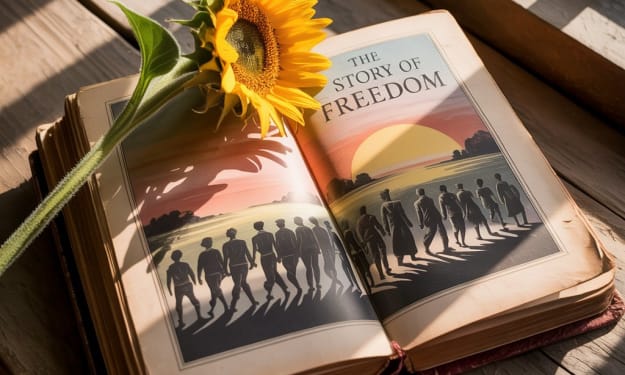
The Story of Freedom
It was the 14th of August, and the air was filled with joy. The entire school was adorned with flags, and students in all grades were enthusiastically celebrating Independence Day. Happiness was visible on every face. Yet, amidst the vibrant celebration, one person sat quietly—Sir Tahir. Lost in deep thought, he seemed distant from the jubilant atmosphere around him.
By MUHAMMAD YOUSAF8 months ago in History



Comments
There are no comments for this story
Be the first to respond and start the conversation.