
Chai-Stained Passport: The Unintentional Scars of Home
It wasn’t a visa or a stamp that defined my journey—it was the tannin-brown rings left by my mother’s chipped ceramic cup, a map of guilt, love, and belonging I never asked for.

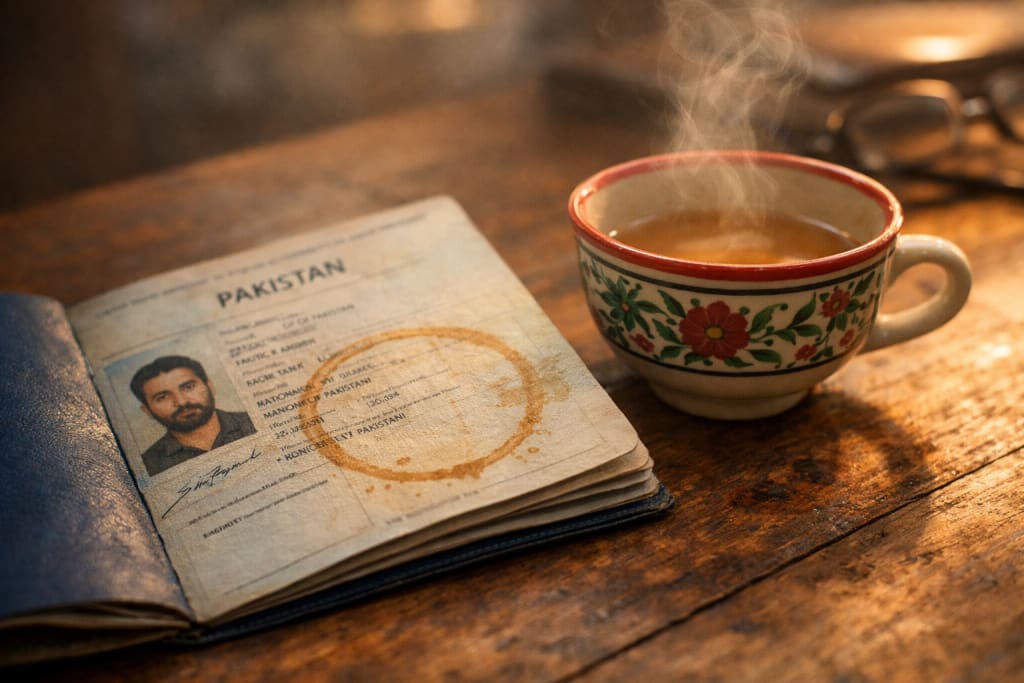
The customs officer at Terminal 3 scrutinized every page, his brow furrowed. I held my breath, not for the student visa or the entry stamps, but for the one mark that had nothing to do with any government. There it was, on the laminated photo page: a faint, perfect circle, the hue of soaked cinnamon—the ghost of my mother’s chai.
Every departure left one. She would slide the steaming cup onto my open passport as I packed, a silent ritual. “One last cup for the road,” she’d say, her voice wedged between pride and a plea. The heat would warp the page slightly; the tannins would seep in, permanent. Each stain was a season of leaving. The first, pale and anxious, at eighteen. This latest one, dark and resigned, at twenty-eight.
They weren't just stains. They were audits of my absence.
The First Stain: Pale and Anxious
The earliest ring is a faded watermark, almost translucent. It was the summer I left for university, my suitcase bulging with dreams and thermals. The chai that made it was milky, sweet—the kind you give to a child for courage. My mother’s hands trembled that morning, not from age but from the weight of letting go. The cup lingered a moment too long. When she lifted it, the ghost of its base remained, a damp, warm seal on my new identity: Emigrant.
That first year, I’d open my passport in a grey dorm under a greyer sky and press my nose to the stain. It still smelled faintly of elaichi and her kitchen’s warmth. It was my most sacred belonging, more real than the student ID that claimed I belonged there. The stain was proof that I was from somewhere, that I was loved from afar.
The Second Stain: A Bolder Circle
The second ring is darker, a confident eclipse from my first return trip two years later. I had grown a foreign accent and opinions on “the real world.” I’d flinch when she placed the cup down, a reflex from a land of coasters and careful boundaries. “Ammi, it’ll ruin the laminate,” I muttered once. She paused, her eyes holding a quiet storm, and pressed the cup down firmly. The hiss of hot ceramic on plastic was her only reply.
That stain is a record of her quiet defiance. It absorbed the tension of that visit—my critiques of “backward” ways, her silent disapproval of my loose hair and looser tongue. It was her insistence: You can change your clothes, your words, your dreams. But this, this bond, I will mark. You will carry it. It was no longer a tender farewell; it was a claim.
The Third Stain: Almost Black
The most recent stain, the one the officer squints at now, is nearly black, a deep well of Assam brewed the morning after we buried my father. The house was heavy with silence and incense. No words were exchanged. She simply placed the cup on the passport lying open on my bed—my flight was in six hours. Life, death, and airports wait for no one.
That chai was bitter, brewed strong enough to shake the soul. It stewed as I folded my black kurta into the suitcase. This stain isn’t just tea; it’s absorbed the smoke from sandalwood pyres and the salt of tears we didn’t shed in front of each other. It is the stain of shared, unspeakable grief, and her stark, steaming acceptance that I would leave her alone in that quiet house. It was her final lesson in endurance.
The officer stamps my entry with a definitive thud and hands the booklet back. “Welcome home,” he says, to the country of my education and employment.
I run my thumb over the layered rings—a topographic map of my divided life. The first, a faint moon of innocence. The second, a bold border of conflict. The third, a deep river of loss. The officer sees a travel document. I see a holy text, its most sacred verses not printed but imbibed, stain by slow stain, steeped in the bittersweet brew of becoming.
Home isn’t a place you find. It’s the mark you can’t wash off, the scar you learn to wear with a strange, heavy gratitude. It lives in the space between here and there, in the steam that rises and vanishes, in the flavor that leaks into everything else, making you forever from there and here, a citizen of the in-between.
I close the passport, the warm ghost of chai spices lingering on my fingers. Some inherit land, jewelry, or stories. I inherited these accidental rings—my mother’s liquid, stubborn love, forever circling the photo of a daughter who is, in her heart, always just arriving, and always, always just leaving.
About the Creator
Muhammad Haroon khan
I write about emotions, society, and the quiet truths we learn while growing up. Words are my way of making sense of the world.
Keep reading
More stories from Muhammad Haroon khan and writers in Lifehack and other communities.
Settling Into Marysville After a Move: What New Residents Often Discover
Moving to a new home in Marysville, Washington, is more than a logistical task. For many residents, it represents a gradual adjustment to a different pace of life. While the city remains close to larger urban centers, daily routines in Marysville tend to feel calmer and more grounded. This balance shapes how people settle in after a move.
By House Doctor5 days ago in Lifehack
Brickell vs. The Valley: Why Tech Founders Are Choosing Florida in 2026
I remember the first time I walked through Brickell City Centre in early 2026. For a moment, I had to remind myself I wasn't in downtown San Francisco or Manhattan. The air was different—thick with salt and a peculiar, high-octane energy that you only feel in a place that knows it’s on the rise.
By Mary L. Rodriquez5 days ago in Lifehack
📢 Raise Your Voice Thread: 02/05/2026
Our “Raise Your Voice Threads” are hosted most alternating Thursdays at 12PM ET to offer creators more avenues to uncover exceptional stories on Vocal. As we are continuously searching for fresh creators and inspiring stories, this thread provides an opportunity to exchange and discuss the stories that have moved and motivated us on Vocal.
By Raise Your Voice by Vocal5 days ago in Resources



Comments
There are no comments for this story
Be the first to respond and start the conversation.