
Are LED downlights better than halogen for kitchens
A renovation guide on Kitchen, Kitchen Lighting & Electrical

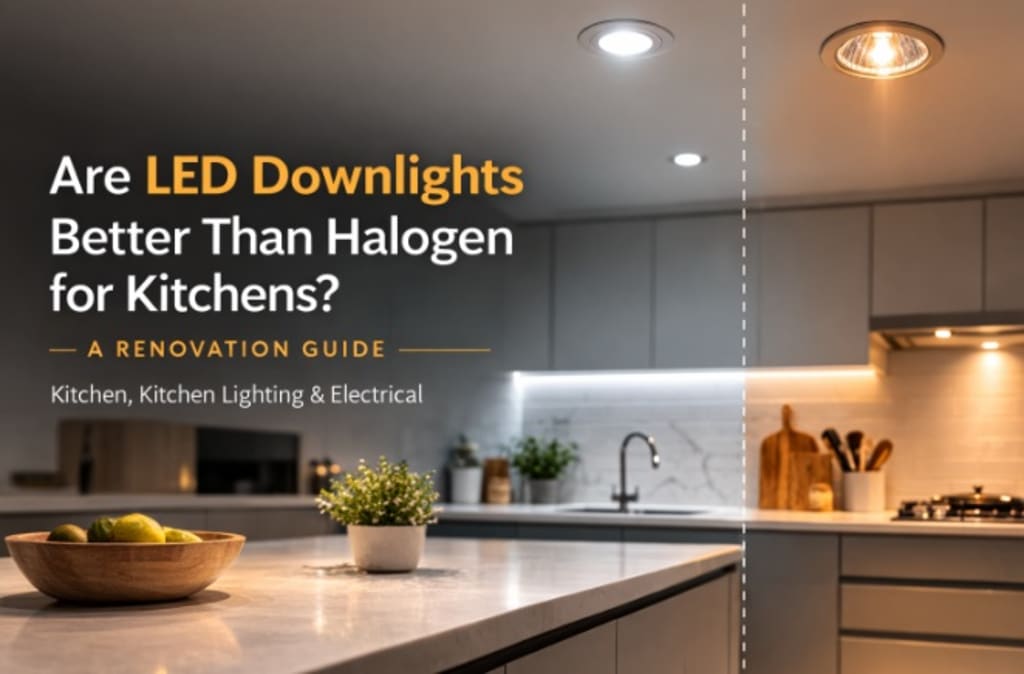
When planning a kitchen, bathroom, or full home renovation in Sydney, lighting is one of those details that quietly decides whether the space feels amazing—or just “okay.” Cabinets can be beautiful, stone benchtops can look like art, but if the lighting is wrong, the whole kitchen suddenly feels flat.
One question homeowners ask again and again is simple:
**Are LED downlights better than halogen for kitchens?**
In most modern renovations, the answer is yes. But the real story is not just about brightness. It comes down to energy use, light quality, heat, design flexibility, and long-term cost.
Let’s break it down in plain language.
---
## Understanding the Difference: LED vs Halogen
Before choosing kitchen lighting, it helps to understand how the two technologies work.
### Halogen Downlights
Halogen lights are a type of incandescent bulb that uses a tungsten filament. They were once the standard lighting choice in Australian homes.
**Advantages**
• Warm and familiar light
• Instant brightness
• Lower upfront cost
**Disadvantages**
• Very high energy consumption
• Short lifespan (around 2,000–4,000 hours)
• Produce a lot of heat
• Gradually disappearing due to energy regulations
Many older homes across Sydney still have halogen downlights. If you walk into a kitchen built in the early 2000s, chances are the ceiling looks like a little “galaxy” of halogen spots.
### LED Downlights
LED stands for Light Emitting Diode. Over the past decade, LEDs have become the standard for modern kitchen renovations.
**Advantages**
• Extremely energy efficient
• Long lifespan (25,000–50,000 hours)
• Very little heat output
• Available in multiple colour temperatures
• Slim, modern designs
**Disadvantages**
• Higher upfront cost
• Very cheap LEDs can have poor light quality
But overall, LED technology has improved so much that it now outperforms halogens in almost every category.
---
## Energy Efficiency and Running Costs
Let’s talk about electricity—because this is where LEDs really shine.
A typical **10-watt LED** produces roughly the same brightness as a **50-watt halogen**.
That means LEDs use **about 80% less energy**.
Imagine a kitchen with 15 downlights.
• Halogen system: around **750 watts** running
• LED system: around **150 watts**
Over months and years, the savings become significant. In suburbs where summers are hot—think Parramatta or Penrith—LEDs also produce less heat, which means the air conditioner works less.
Less heat. Less power. Lower bills.
Your electricity meter quietly thanks you.
---
## Light Quality and Atmosphere
Lighting in kitchens is not only about brightness. It also affects how the room feels.
### Halogen Lighting
Halogen lights typically produce **warm white light (2700K–3000K)**.
This warm tone works well with:
• Timber cabinetry
• Classic kitchens
• Traditional interiors
It creates a cozy atmosphere many homeowners like.
### LED Lighting
LED downlights offer much more flexibility.
They come in a wide range of colour temperatures:
• Warm white (2700K)
• Neutral white (3000–4000K)
• Cool white (5000K+)
This allows lighting to match different kitchen styles.
For example, modern kitchens in Mosman or Double Bay often use **neutral white lighting**, which makes marble, quartz, and stone benchtops look crisp and clean.
High-quality LEDs also have strong **Colour Rendering Index (CRI)** ratings, meaning food, materials, and colours appear natural under the light.
Nobody wants their tomatoes looking grey.
---
## Heat and Safety
Here’s a detail many homeowners don’t realise.
Halogen lights get **very hot**.
Sometimes hot enough that touching the bulb can burn your fingers.
This heat can cause several problems:
• Warmer kitchen environment
• Increased cooling costs
• Possible damage to nearby materials over time
LED downlights are very different.
They produce **minimal heat**, which means:
• Safer ceilings
• Less impact on cabinetry and surfaces
• More comfortable cooking spaces
For busy family kitchens in coastal areas like Manly or Cronulla, cooler lighting makes a noticeable difference.
Especially when the oven, stove, and dishwasher are already generating heat.
---
## Longevity and Maintenance
Now let’s talk about something nobody enjoys: climbing a ladder to change light bulbs.
Halogen bulbs usually last **1–2 years** in a busy kitchen.
LED downlights can last **10 to 20 years**.
Think about that for a moment.
If a kitchen has 15 lights, halogens may require **dozens of replacements over a decade**. LEDs often need none.
For homeowners renovating properties in Ryde or Chatswood, that means less maintenance and fewer interruptions.
Install them once, forget about them for years.
---
## Design Flexibility
Modern kitchens are no longer just cooking spaces. They are social spaces, homework zones, and sometimes even home offices.
LED downlights support this flexibility.
They can be:
• **Dimmable** to adjust mood lighting
• Connected to **smart home systems**
• Combined with pendant lights over islands
• Integrated with under-cabinet lighting
Designers often create **layered lighting**, where different lights serve different purposes.
For example:
• Downlights for general lighting
• Pendant lights for style
• LED strips for task lighting
Halogens simply don’t offer the same level of design flexibility.
---
## Environmental Considerations
Energy efficiency also affects sustainability.
LED lighting:
• Uses less electricity
• Produces fewer emissions
• Lasts longer, reducing waste
Because of these benefits, many halogen lights are being phased out under Australian energy efficiency regulations.
For eco-conscious renovations across Sydney, LEDs are the clear choice.
---
## Final Verdict
So, are LED downlights better than halogen for kitchens?
In almost every modern renovation, **yes**.
LEDs offer:
• Lower energy consumption
• Longer lifespan
• Reduced heat
• Flexible lighting design
• Better long-term value
Halogens still have their fans, mainly for their warm glow. But technology has moved forward, and high-quality LEDs can now replicate that warmth while delivering far better efficiency.
In short, choosing LED lighting is like upgrading from an old petrol car to a modern hybrid. Both will get you to the supermarket—but one does it smarter, cheaper, and with far fewer headaches.
About the Creator
John Zhang
The driving force behind MB9 Australia — a licensed renovation builder who brought world class Italian designer kitchens to Australia, specialising in kitchen renovation, bathroom renovation and full home renovations across Sydney.
Keep reading
More stories from John Zhang and writers in Lifehack and other communities.
How to choose range hoods for noise reduction
When planning a kitchen renovation in Sydney, one of the most common questions we get from homeowners is: “How can I choose a range hood that reduces noise while still being effective?” The right range hood can significantly improve your cooking experience, reduce unwanted odors, and maintain a peaceful home environment. For anyone investing in a kitchen, bathroom, or home renovation in Sydney, understanding the balance between performance and noise is essential. This guide breaks it down for you.
By John Zhang2 days ago in Lifehack




Comments
There are no comments for this story
Be the first to respond and start the conversation.