
Above the Clouds, Beneath the Headset: The Rise of Virtual Reality Flight Training
How immersive technology is reshaping pilot education—one virtual cockpit at a time.
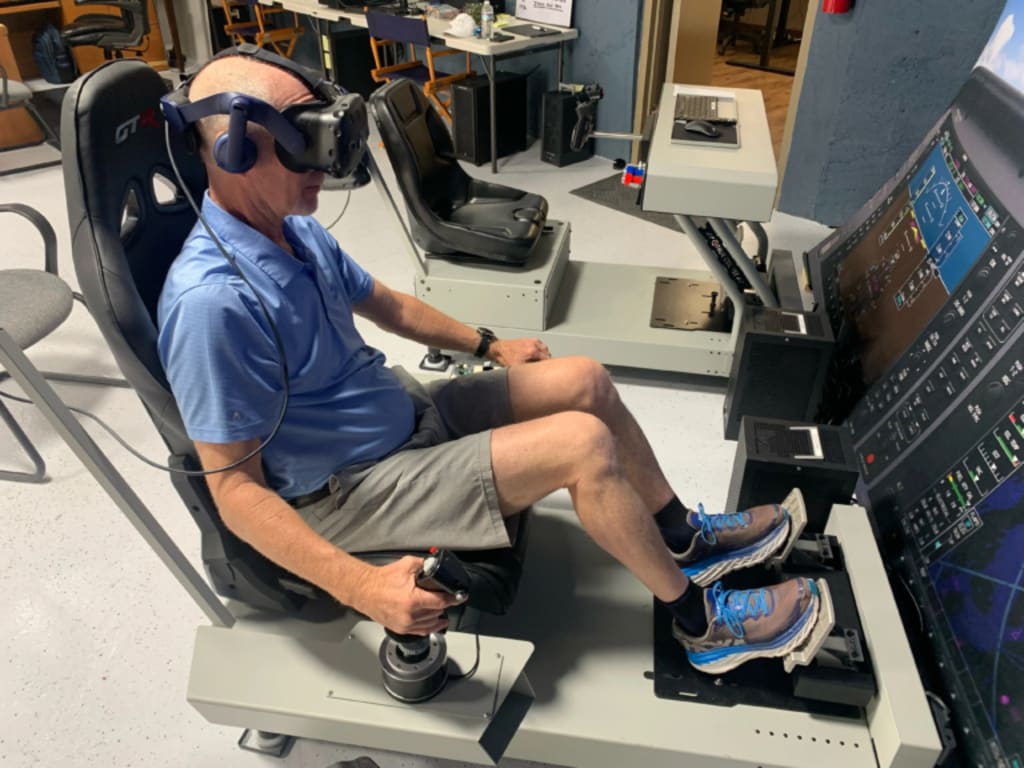
For decades, aspiring pilots have faced the same rite of passage: classroom instruction followed by hours of practice in cumbersome simulators or costly flight time in actual aircraft. The hum of old CRT monitors, the faint smell of aviation fuel, the instructor’s pen circling mistakes on a clipboard—all vestiges of an analogue system desperately trying to teach a digital generation.
But in the back rooms of aviation academies and the glass-and-steel offices of tech startups, a new kind of training is emerging, one that doesn’t begin with an airstrip but with a headset. Virtual reality flight training—once the promise of a far-off future—is now here, reshaping how we prepare the next generation of pilots.
Flight, Reimagined
Slip on a VR headset today at many flight schools, and you’ll find yourself inside the cockpit of a Cessna 172 or even a Boeing 737. The virtual environment is so detailed that pilots can reach out and flip switches, check altimeters, and perform preflight checks exactly as they would in real life. But unlike traditional simulators, there are no cables tethering the user, no beeping monitors from the '90s—just an untethered, immersive world that responds to their every move.
The beauty of virtual reality lies in its ability to mimic the sensory reality of flight—minus the cost and the carbon emissions. You can practice crosswind landings over and over without burning a drop of fuel or worrying about wear and tear on a multi-million dollar aircraft. The sky, quite literally, is the limit.
From Hobby to High Stakes
Virtual reality has long been a playground for gamers and tech enthusiasts. But in recent years, its migration into serious fields—medicine, architecture, defence—has been swift. Aviation, with its intricate systems and unforgiving demands, has proven a particularly fertile ground.
Training programs built around virtual reality flight training offer more than just novelty. They give trainees the ability to experience rare but critical flight conditions—engine failures, sudden weather shifts, communications blackouts—in a risk-free environment. These aren’t simply simulations for fun; they are tightly engineered exercises with FAA-aligned metrics and performance assessments.
And perhaps most importantly, VR levels the playing field. Where once a student might have to live near a major airport to get quality instruction, now they can access lifelike training modules from their bedroom or a small-town classroom.
Cognitive Muscle Memory
“There’s a different kind of learning that happens in VR,” says Captain Jonathan Reese, a former commercial airline pilot who now develops aviation training software. “It’s not just reading a checklist and hoping you remember it in the cockpit. It’s doing it with your hands, hearing the engine, feeling the vibration. That’s the kind of learning that sticks.”
Indeed, recent studies have shown that students who undergo VR-based flight instruction retain information at a higher rate and progress more quickly through licensing benchmarks than their traditionally trained peers. The explanation lies in cognitive muscle memory—the kind of embodied learning that comes from doing, not just watching.
For many students, VR is less about escaping reality and more about facing it, in all its complexity.
When Mistakes Don’t Cost Lives
In aviation, mistakes can be fatal. That’s part of what makes the field so intense—and so slow to change. Yet virtual reality training opens the door to failure in a way that’s productive, even necessary. A student can misjudge a landing, stall at takeoff, or forget to lower the landing gear—and live to try again.
This repeatability is one of VR’s greatest gifts. Every instructor knows the frustration of trying to create the perfect learning moment in real time. In VR, those moments can be recreated on command, refined, slowed down, and studied. A missed checklist becomes a lesson, not a liability.
Bridging the Generational Gap
There is, of course, resistance. Aviation, like many technical professions, is rooted in tradition. Some senior instructors view virtual reality with suspicion—worrying that it will make students too reliant on simulation or fail to prepare them for the messiness of real flight.
But for younger students, VR is not foreign. It is a language they speak fluently. Many grew up using headsets and joysticks, navigating worlds with spatial awareness and precision. Bringing that intuitive skill set into the cockpit doesn’t dilute aviation’s discipline—it enhances it.
The Future Flight Deck
As virtual reality headsets become more affordable and training software more sophisticated, the days of exclusive, inaccessible pilot training may be numbered. Imagine an entire generation of pilots who first learned to fly not in the sky, but in a virtual world—only to transition to the real thing with confidence, poise, and thousands of virtual hours logged.
Airlines, too, are paying attention. Several major carriers have already begun testing VR modules for recurrent training, emergency protocols, and crew communication drills. The cost savings alone are substantial, but the real incentive is safety: better-trained pilots make fewer mistakes.
A New Kind of Sky
For many of us, flight remains a dream—something glimpsed through airport windows or remembered from childhood books. But for a growing number of trainees, flight begins somewhere else entirely: in a room, with a headset, a joystick, and a belief that technology can bring them closer to the clouds.
Virtual reality flight training is not just a tool—it is a transformation. And as the aviation world continues to evolve, one thing seems certain: the pilots of tomorrow will still learn from mistakes, follow checklists, and earn their wings. But they’ll also do something their predecessors never could—fly before they ever leave the ground.
About the Creator
BR D
Hello! My name is Brianna, and I am a passionate writer.
Apple iPhone Security Warning: What’s Happening, Why It’s Trending, and How to Protect Your Device
Search interest in the phrase “Apple iPhone security warning” has surged dramatically across the UK in the past 24 hours, according to Google Trends. The sudden spike suggests that thousands of iPhone users are encountering or at least hearing about the security alerts and are unsure whether they are legitimate or a cause for concern.
By James Andersonabout 22 hours ago in Lifehack
A Complete Guide to Digital Twins in Healthcare and Their Real-World Applications
Digital twins in healthcare are revolutionizing how medical systems, providers, and researchers understand the human body, manage diseases, and deliver personalized care. A digital twin is a virtual replica of a physical entity, such as a patient, organ, medical device, or healthcare system—that continuously updates using real-time data. In healthcare, this technology bridges the gap between physical health conditions and digital simulations, enabling smarter decisions, predictive insights, and improved outcomes. As healthcare becomes increasingly data-driven, digital twins in healthcare are emerging as a cornerstone of next-generation medical innovation.
By Steve Waugh5 days ago in Lifehack


Comments
There are no comments for this story
Be the first to respond and start the conversation.