
10 Days of Doing Nothing: Here Is What I Found
Sometimes, to understand where you stand and make better use of what’s at hand, you need to take a step back. That’s what I did, and I uncovered realizations that could be valuable.

During my visit to hometown, instead of taking days off, I continued working. As time went on, I began to lose touch and started spending more time watching movies and series, surfing social media, hanging out with friends, or doing nothing at all. It felt heavy on me, and I started to feel bad, cursing myself for it. I wasn’t able to enjoy my time and even felt anxious, worried, and depressed.
I had been taking some days off after months of work; I should have felt better and more relaxed, but instead, I felt the opposite. I wanted to understand what was happening, and to do that, I needed to stay with this feeling a little longer. So I spent about ten days sitting with it, doing nothing, trying to figure out what was happening and why. I wanted to learn from it so I could develop a better understanding and handle such situations better in the future.

Time flies when we fall into dopamine addiction: we want to stay in that feeling to escape reality. We continue indulging in it through different ways, even though we know we are harming ourselves. Yet, we keep following the urge, and it only grows stronger — strong enough to control us.
When I started spending more time on things that served no real purpose except providing temporary pleasure, postponing what truly mattered, I began to feel its impact. To remain unaware of reality, I needed a constant dose of dopamine, which I sought by spending more time on social media or engaging in activities of no real value. With this, anxiety levels increased, and feeling depressed, I was no longer good for doing anything meaningful.
In this way, we become weaker, the forces that want to bring us down grow stronger, and we end up losing much of our time, wasting resources, and sometimes hurting ourselves in ways that cannot be healed.
We have to do the small things correctly and consistently: Every moment, we face the choice of either doing the right thing or the easy one. It is the small actions, done consistently over a long period of time, that eventually bring about the desired results.
Long-term success depends on what we do day in and day out over an extended period. We must stay conscious of the choices we make at every moment, as these are the decisions that will either build or break our future. Yes, we need rest and breaks, but we must choose them consciously. When we have work to do and instead keep ourselves busy with distractions, it is not truly taking a break or choosing to rest — it is choosing the easy thing over the right thing.
You can take a break at your convenience, between tasks or after completing them, but you must choose it consciously, resting without indulging in temporary pleasures. When it is time to rest, just rest.
This is what I was doing wrong, and I felt the burden of it.
I started to remain depressed: & to escape it, I watched more online content to stay lost and feel better, needing it continuously. The depression and anxiety were also serving in favor of the addiction, making me dependent on them to escape the bitter reality.
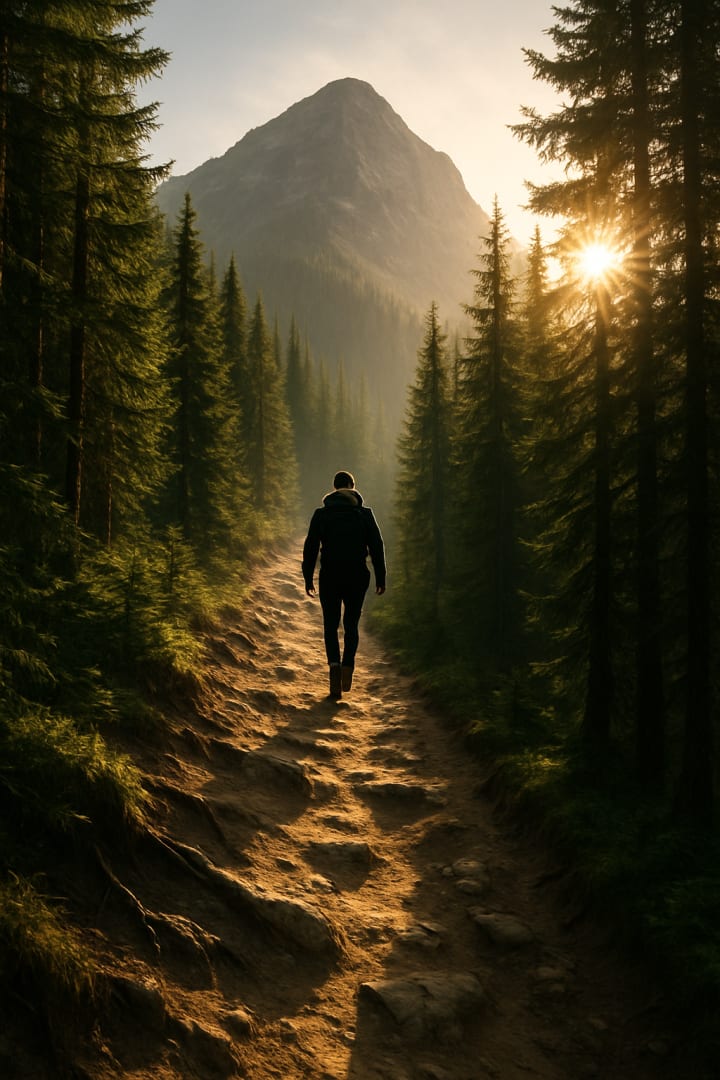
Through this experience, I came to realize why it is so easy to become addicted and why it is so hard to leave it. Doing the right thing is like ascending a mountain peak — every next step is harder than the previous one (until we reach a certain point where we can see the fruits of our right choices). And doing the easy thing is like descending into a valley (which looks beautiful from a distance), where every next step becomes easier than the previous (until we reach the bottom and face the fatal consequences of our bad choices).
When I chose to get back on track and do the right thing (after a week and a half), the weakness inside started to fade away and was replaced with courage and hope. The anxiety levels were going down and I could feel it. I became calmer and more in control, and the urge to follow the dopamine addiction wasn’t as strong as before to make me obey it. Still, it took a couple of days to fully get back on track. I was facing some inner resistance to keep engaging in pleasurable activities. As I write this, I am hopeful for the future opportunities. I feel the strength to do the hard and right things consistently, and I can say “NO” to the things that serve no purpose.
Consistently do the right things, be wary of the small choices, say “NO” to the distractions. This is hard, I know, but this is the only way.
I hope this brought some value to you and that you learned something meaningful. There is more to share, so if you found this helpful, stay connected. Thank you for reading!
“Sometimes you have to take a step back to move forward.” — Erika Taylor
About the Creator
DR3AM3R
I write about history, current affairs, and social issues to inspire change. Through storytelling, I expose injustices and challenge norms. My goal is to spark critical thinking, soon share powerful stories to drive awareness and action.



Comments
There are no comments for this story
Be the first to respond and start the conversation.