Latest Stories
Most recently published stories on Vocal.
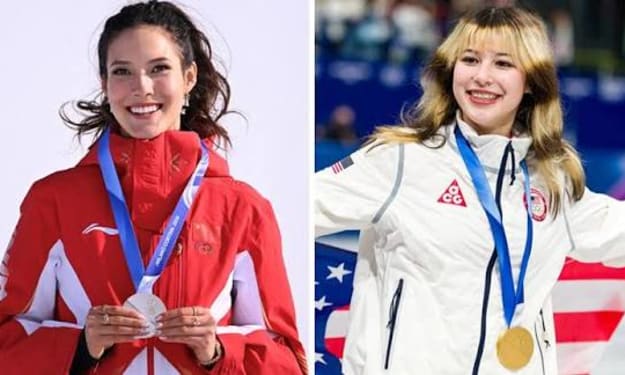
Alysa Liu vs Eileen Gu — How Two Chinese American Stars Wound Up on Opposite Sides of an Olympic Proxy War. AI-Generated.
The rivalry between Alysa Liu and Eileen Gu has come to symbolize more than athletic competition. As both athletes rise to global prominence at the Winter Olympics, their contrasting national affiliations have turned them into unlikely figures in a broader geopolitical struggle between the United States and China. Though they share Chinese heritage and were both raised in the United States, Liu and Gu have made different choices about which flag to represent. Those decisions have placed them at the center of heated debate over identity, loyalty, and the politicization of sport. Two Paths from Similar Beginnings Alysa Liu grew up in California and became one of America’s most promising figure skaters at a young age, winning national titles and emerging as a symbol of the U.S. skating future. She competes under the American flag and has consistently emphasized her identity as an American athlete shaped by the U.S. training system. Eileen Gu, by contrast, made headlines when she chose to compete for China despite being born and raised in San Francisco. Her decision transformed her into a national celebrity in China and a marketing icon with sponsorship deals and widespread media coverage. Both athletes have said their choices were personal and rooted in family ties and opportunity rather than politics. Yet their visibility has ensured that their decisions are interpreted politically whether they intend it or not. Media and Public Reaction In the United States, Gu’s decision sparked controversy and accusations of divided loyalty, while others defended her right to define her own identity. In China, she was celebrated as a homegrown champion returning to her cultural roots. Liu, meanwhile, has been portrayed by American media as a symbol of domestic talent and perseverance, with her Olympic performances framed as part of the U.S. sporting narrative. Chinese social media users have sometimes contrasted her path with Gu’s, turning two athletes into symbols of competing national pride. “Neither athlete asked to become a political statement,” said one sports sociologist. “But in today’s climate, elite athletes with dual cultural identities are inevitably drawn into geopolitical narratives.” Sport as a Proxy Battleground The rivalry reflects how the Olympics increasingly function as a stage for soft power competition. Medal counts and star athletes are viewed as reflections of national systems and global influence. Gu’s success for China has been presented domestically as proof that China can attract global talent and compete with Western sports powers. Liu’s performances for the United States reinforce the American emphasis on individual achievement and freedom of choice. This dynamic has fueled what some commentators call an “Olympic proxy war,” where athletic outcomes become symbolic victories in a wider ideological contest. Personal Cost Both athletes have faced intense scrutiny online. Gu has been targeted by critics in the U.S. accusing her of exploiting opportunities in both countries. Liu has endured pressure to perform not only as an athlete but as a representative of American values. Friends and coaches say the athletes have tried to shield themselves from political commentary and remain focused on training. Yet the weight of expectations is difficult to escape. “These are young women who want to skate and ski,” said a former Olympic coach. “Instead, they’re being treated like diplomats.” What It Says About Identity The Liu-Gu divide highlights a deeper tension faced by many Chinese Americans navigating multiple cultural identities in a polarized world. Their stories show how personal heritage can be reframed as political allegiance under international spotlight. Rather than a simple rivalry, their parallel careers illustrate two valid expressions of identity: one rooted in birthplace and opportunity, the other in heritage and cultural connection. Looking Ahead As future Olympic Games approach, both athletes are expected to remain central figures in their respective national teams. Whether their rivalry continues to be framed politically may depend less on them and more on the evolving relationship between Washington and Beijing. For now, Alysa Liu and Eileen Gu remain linked in public imagination — not because they compete directly, but because their choices represent opposite sides of a cultural and political fault line that extends far beyond sport. Their journeys remind the world that in the modern Olympics, medals are no longer just about athletic excellence. They are also about identity, narrative, and the power of symbols in an age of global rivalry.
By Fiaz Ahmed 3 days ago in Unbalanced
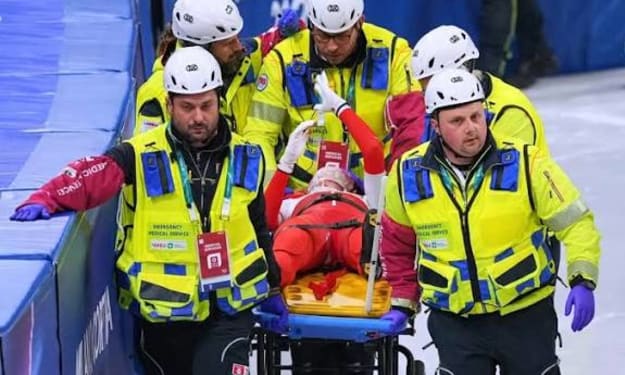
Poland’s Kamila Sellier Stretchered Off After Opponent’s Blade Slices Above Her Eye in Olympic 1500. AI-Generated.
A dramatic and frightening incident unfolded during the women’s 1500-meter speed skating event at the Winter Olympics, when Polish skater Kamila Sellier was seriously injured after an opponent’s skate blade sliced above her eye, forcing officials to halt the race and rush medical teams onto the ice. Sellier collided with another competitor while entering a tight corner at high speed. Witnesses reported that she lost balance and fell forward, at which point the sharp blade of another skater’s boot struck her face just above the eyebrow. Blood was immediately visible, prompting referees to stop the race within seconds as medics sprinted to her aid. Emergency Response on the Ice Medical personnel surrounded Sellier as she lay motionless on the ice. She was quickly stabilized, placed on a stretcher, and taken to a nearby medical facility for further evaluation. Organizers later confirmed that she remained conscious and responsive during transport, though the full extent of her injury was not immediately disclosed. Officials said she sustained a deep laceration near her eye and would undergo scans to rule out facial fractures or internal injuries. “Our priority was to ensure her safety and provide immediate medical attention,” an Olympic medical spokesperson said. The competition was suspended for nearly 20 minutes as staff cleared the ice and reassured shaken athletes. When racing resumed, the mood in the arena was visibly subdued. A High-Risk Sport Speed skating is one of the fastest events in the Winter Olympics, with athletes reaching speeds of over 50 kilometers per hour while skating in close proximity. Although protective gear is worn, including cut-resistant suits and helmets, facial injuries remain a known risk due to exposed areas around the eyes and nose. Experts note that accidental contact with blades, though rare, can lead to severe injuries. “This sport combines speed, tight corners, and sharp equipment,” said a former Olympic skater turned safety analyst. “Incidents like this remind us how dangerous it can be despite modern protections.” Reaction from Teammates and Rivals Polish team officials described the incident as “devastating” for both Sellier and her teammates. “Kamila was in strong form and had trained for years for this moment,” a team spokesperson said. “Our thoughts are entirely with her and her family.” Other competitors expressed shock and concern, with several skaters seen visibly emotional following the crash. One rival athlete said, “We all know accidents happen, but seeing someone hurt like that is terrifying. We just hope she recovers fully.” The athlete whose blade caused the injury was not blamed for the collision, and officials stated that the crash appeared accidental with no rule violations. Questions About Safety Measures The incident has reignited discussion about safety standards in short- and middle-distance speed skating. Some experts are calling for stronger face protection or redesigned helmets to reduce the risk of blade-related injuries. While international skating bodies have previously debated full face shields, many athletes resist them due to visibility issues and discomfort. However, Sellier’s injury may prompt renewed evaluation of whether current equipment is sufficient. “Technology in sports safety must evolve as performance speeds increase,” said a sports medicine specialist. “We should always ask whether more can be done to protect athletes without compromising competition.” Looking Ahead As of the latest update, Sellier remains under medical observation and is unlikely to compete again in the current Olympic Games. Her participation in future events will depend on recovery time and medical clearance. The Polish Olympic Committee said it would issue further statements once doctors complete their assessment. Fans across Poland flooded social media with messages of support, wishing her a swift and complete recovery. A Sobering Moment The accident cast a shadow over what is usually one of the most thrilling events of the Winter Games. While the competition continued, attention remained focused on Sellier’s condition rather than the medal standings. The episode served as a stark reminder of the physical risks elite athletes take in pursuit of Olympic glory. As spectators applauded her bravery, many also reflected on the fine line between sporting excellence and serious injury in high-speed winter sports.
By Fiaz Ahmed 3 days ago in Unbalanced
5 Questions That Reveal Your Life Purpose
Most people think life purpose arrives like a lightning bolt. One day you wake up, angels sing, and suddenly you know exactly what you’re meant to do. That’s a nice movie scene—but real life doesn’t work like that. Purpose is quieter. It reveals itself through patterns, pressure, and the questions you’re brave enough to ask when no one’s watching.
By Fred Bradford3 days ago in Motivation