

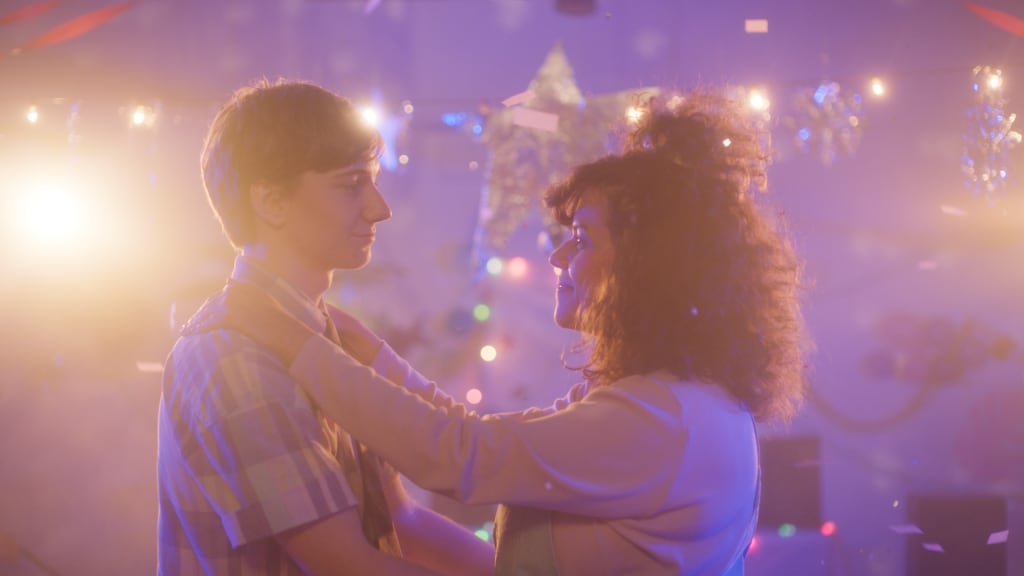
The main theme is the experience of parasocial relationships as a teenager. Think of falling in love with a fictional character from a book or series, but also being in love with a popular classmate who does not know about your existence. These imagined relationships often cause the person in love to long to live the life of popular peers. This often also involves rejecting their old life and doing everything they can to belong to the new group.
Creator Aldarondo expounds on this by exploring her own parasocial relationships with young actors playing popular classmates, and how her previous friendships fell apart because of her crush. Because as much as she wanted to belong to that group, it mainly gave her an inferiority complex. The scenes in which she returns to these memories with the help of the actors hit her hard.
She bursts into tears several times in the middle of the set, which makes the ethics of her coping process - especially in relation to the teenagers - somewhat questionable. It remains wrong to place her trauma processing on the teenagers. This leaves a bad aftertaste that is never completely washed away, no matter how warm the rest of the documentary feels. There are also moments where she processes her traumas together with other adults. This makes it constantly feel like a gimmick to use the teenagers as surrogate psychiatrists for her own purposes.
Yet the documentary contains a familiar high school experience for many (former) misfits. It also remains unclear for which group of people exactly the documentary was made: should current misfits find peace in this, or is it a refuge for former misfits to study their own growth from the outside?
The extremely personal telling (and portrayal) of memories certainly has points of recognition, but is absolutely not a story that represents everyone. This is most evident in the scenes where she recreates film series or music videos. These quickly feel long-winded and like a joke that the viewer is unaware of. Even if it produces very emotional moments for the maker, more of this could have been left in the editing room.
This raises the question several times how relevant the film is. It also never quite feels like the first part of the documentary is necessarily necessary. It soon becomes clear that focusing on the life she actually wants to lead is a distraction tactic. Because although a school time full of bullies is traumatizing, it remains a bit sparse for a full-length documentary. Then it is more interesting when she examines her own relationship with others in the same position.
Throughout the documentary there is a common thread about her red-haired childhood friend Caroline. It soon becomes clear that Aldarondo feels as if she can never become popular if she continues to hang out with her ginger girl next door. They slowly grow apart, until there is terrible news about Caroline. As this storyline becomes more and more prevalent, the beginning of the film feels redundant in retrospect.
Every now and then Aldarondo presents interesting insights about the importance of friendships where the opinions of outsiders do not matter. How these intense and almost familial friendships are often experienced afterwards as one emotional mess, instead of separate memories. It is these introspective moments that give warmth to the documentary and put the human focus. For anyone who has ever felt like the ugly duckling of the family or friend group, You Were My First Boyfriend will provide more than enough recognition. It just takes some effort to wash through all the personal memories.
About the Creator
Jamma Entertainment
Jamma Entertainment is a dynamic media platform dedicated to providing comprehensive coverage of talent, film festivals, films, and award ceremonies from around the world.
Keep reading
More stories from Jamma Entertainment and writers in Journal and other communities.
Jan-Willem Breure and Imanuelle Grives appear on the Septimius Awards 2023 Red Carpet
On a mesmerizing evening, September 26, 2023, the International Theater Amsterdam (ITA) radiated with the brilliance of stars from the entertainment industry, casting its glow over the illustrious Septimius Awards. Among the constellation of luminaries gracing this celebrated event were Jan-Willem Breure, the visionary director and founder of the Septimius Awards, and the distinguished Dutch actress, Imanuelle Grives. Their presence at this prestigious gathering marked not just a showcase of glamour but a beacon of advocacy for diversity and inclusion within the often homogenous world of cinema.
By Jamma Entertainment2 years ago in Journal
How to Begin a Relationship with Jesus
A Step-by-Step Guide to Faith, Presence, and Transformation in Everyday Life Step 1: Find a quiet space Begin in a place where you can notice yourself. This could be a room, a park, or the space between heartbeats. The quiet is not about absence of sound but about presence of attention. Bring no agenda, only awareness. The first step is to show up.
By Sound and Spirit6 days ago in Journal
So You Decided To Become a Nurse Practitioner:
So you decided to become an "Advanced Practice" nurse. Congratulations!... is what I would say if this was a good idea. Grad school? In this economy? What were you thinking? Likely it was something along the lines of either 1) “I've seen these other chucklefucks do it— Why can't I?” or even 2) “I've got a nice career, I should shake it up. I miss feeling like I have no clue what I'm doing.”
By Sandor Szabo7 days ago in Fiction



Comments