
Why the United States can't handle crisis
Crisis

For people my age, whose formative years were filled with the effects of u, the odds are that the entirety of your lived experience has been one of crisis if you were born at any point after the 1980s. s activity our earliest memories include 911 and the invasion of iraq under false pretenses then we had the 2008 housing crash the realization that climate change was nearing a point of no return the acceleration of suicidal deregulation and privatization which has left our infrastructure weak and fragile the skyrocketing cost of tuition saddling young people who were told college was the only way to succeed with insurmountable debt and increasingly worthless degrees we've seen the birth and rapid rise of the gig economy relegating huge portions of the population to precarity and poverty and of course we've watched our coveted response become the worst in the world despite having advanced knowledge of the danger and plenty of resources to handle the situation appropriately for millennials and younger generations there's no such thing as the good old days we never experienced them we'll cover that topic more thoroughly in a future video but in this week's episode we're going to examine why the u. This video could easily last longer than an hour because there has been an alarming increase in crisis mismanagement over the past few decades. Instead, we're going to focus on a select few of them before moving on to the major ones. Let's start with an issue that is uniquely American: obesity. At first glance, you might not think that obesity is a crisis, but when you look at the numbers in the U. Things get a little worse as of 2018, 42.4% of all American adults were obese. This number sharply increased between 2000 and 2018, rising by nearly 12, while the prevalence of severe obesity nearly doubled, from 4.7% to 9.2%. Obesity in children is also a major issue, with nearly 1 in 5 of those between the ages of 2 and 19 being obese. Obesity is a serious health condition that comes with a host of negative consequences. 147 billion dollars, and given the rise in obesity rates over the intervening years, we can only assume that cost has increased significantly. Obesity is responsible for nearly one in five deaths in the United States. That's a crisis that isn't discussed nearly enough right now some people will just tell those who are obese to eat better, which is reasonable, but the causes of the crisis go far beyond personal responsibility. In the 1950s, after President Eisenhower suffered a heart attack, scientists debated the causes of obesity, which was known to cause heart disease. There were two main schools of thought, one led by British physiologist and nutritionist J. Moving on to our final major crisis, the coronavirus, we're now right around the one-year mark for when Americans really began to realize just how serious the problem was in the past year over 500 000 American deaths from kovid we've had more cases and more deaths than anywhere else on earth this is the worst outbreak of kovid in recorded history. Republicans opposed mass mandates and claimed that the illness was no worse than the flu or that it was a Chinese hoax, and Democrats paid lip service to science but lied about how well they were handling their city's outbreaks, but politicians are not the only ones to fabricate facts when the country is in disarray. However, the politicians are not the only ones to lie. Vietnam, a nation with a 261 billion dollar gross domestic product, completely destroyed the United States, a nation with a 20 trillion dollar gross domestic product. Of course, you won't hear about this because it's not the first time the United States has chosen to keep quiet about losing to the Vietnamese, so yes, by all metrics, the United States' coronavirus response has been among the worst in the world.
.
About the Creator
Keep reading
More stories from Christian Banza and writers in Journal and other communities.
America's stunted political spectrum
with the 2020 presidential election fast approaching I thought now would be a good time to take a look at the American political spectrum and discuss just how little disagreement there actually is within American politics let's start with a tool we're probably all familiar with the political compass test this simple test has you answer a series of questions then based on your responses gives you a set of two values one for the x-axis and one for the y-axis which it uses to plot your overall political ideology on the chart for those unfamiliar with the compass it's a roughly accurate way to help you understand where your opinions fit in the wide range of political thought the x-axis represents economics with an economy run by a cooperative collective agency on the far left and a market left to the devices of competing corporations and individuals on the far right the y-axis represents social stances with the very top representing a complete obedience to Authority and the very bottom representing a maximization of personal freedom a lot of people get hung up on the left-right portion and conflate one side or the other with authoritarianism this is a mistake any point on the left-right spectrum is capable of authoritarianism for example you'll find leaders like Kim jong-un on the left and a Dolf Hitler on the right there's a vocal subset of figures on the right who love to claim that Hitler was a leftist but we'll get to that later in the video to give you a few examples of notable figures from each quadrant you'll find Mao Stalin Kim and Mugabe in the authoritarian left quadrant Hitler Viktor Orban Hillary Clinton and Donald Trump in the authoritarian right einar and Milton Friedman Friedrich Hayek and Gary Johnson in the libertarian right and Ghandi Thomas Paine Bernie Sanders and Nelson Mandela in the libertarian left so to reiterate the x-axis is economic stances and the y-axis is social stances as a small disclaimer no simple political test is the most accurate determinant for actual human ideology a two axis chart is simply not nuanced enough to be a hundred percent correct but the political compass is a useful tool for understanding broad trends and it's helpful for this type of analysis now let's look at the compass for the 2020 presidential race interesting right maybe not what you expected there's a whole lot of yelling and name-calling between presidential candidates and their supporters and detractors but when you take their voting records and plot them on a chart like this it becomes apparent that there's really not that much separating most of the candidates and bernie sanders who many people paint as a communist barely squeaked his way onto the left side of the spectrum what's going on here the reason a figure like bernie only just passes the center line is that the political compass isn't just mapping american sensibilities but the entirety of political thought the american political spectrum stops right about here anything beyond Bernie's moderate social democratic platform is absolutely unthinkable in modern-day America so why does our national political conversation stop so close to the center line one of the biggest reasons is the legacy of the Cold War the Red Scare was scary in the days when schools had nuclear attack drills anyone even remotely critical of the prevailing American political model was seen as a communist and sympathetic to the nation's greatest enemy this led to years of crackdowns on left-leaning political groups McCarthy's communists witch hunts and the general circling of the wagons around the quote American Way of life when the Soviet Union fell and the Eastern Bloc countries got both democracy and a free market at the same time the two axes of the political compass got tangled up this bundling led many to falsely equate free-market capitalism with democracy and more left-wing politics with authoritarianism if you need proof of just how ingrained this type of thinking has become in America take a look at these pictures the terminology is always the same blank equals communism apparently keeping baskin-robbins closed so people don't die from a deadly virus as communism who would have guessed when the incredibly popular Ronald Reagan came along and launched his campaign of deregulation tax rate reductions increased military spending and union-busting he put the final nail in the coffin of American left politics since then we've lived in an era of consensus politicians may appear to disagree on many subjects and they probably truly see each other as complete opposites but the truth of the matter is that with very few exceptions the entirety of American politics is contained within a single quadrant of the political compass the entire national political dialogue is framed to begin and end on the right so for the sake of expanding the national dialogue let's talk a little bit about the neglected left side of the spectrum but first we need to put one erroneous claim to rest there are some notable figures on the right who claim that Adolf Hitler was a leftist everyone's favorite felonious filmmaker Dinesh D'Souza and fail son extraordinaire ben shapiro are particularly vocal about it their argument usually boy down to well the Nazis were called the National Socialist Party checkmate okay sure but the Nazis were no more of a Socialist Party than North Korea is democratic by the people or a republic it's the same tactic taken by autocrats throughout history they pick a term their citizens associate with something good usually freedom or democratic or peoples and they adopt it to make themselves look good Hitler himself said our adopted term socialist has nothing to do with Marxian socialism so there you go to be fair bad faith arguments like those from D'Souza are generally dismissed by most thinking people but there are plenty of older folks who get caught in the trap which is sad because they're completely unaware of the fact that they're being taken advantage of but while we're on the topic of socialism I think it would be useful to explain what the ideology really represents after all the term has made quite a comeback in recent years with a larger percentage of young people across America having a more favorable opinion of socialism than capitalism socialism in America is a blanket term for generally leftist ideology a socialist would advocate for a more egalitarian society where there's not a tiny percentage of people hoarding all the wealth they want to end pointless Wars like the decades-old conflict in the Middle East where young men and women are sent to die and murder other humans for the sake of the rich and powerful they advocate for a more humane society where the sick can get treatment and not go bankrupt in the process where small businesses aren't crushed by multinational corporations and where people are paid fair wages for their work they also advocate for worker control of or at least worker involvement in enterprise that's a key point that most Americans seem to miss when someone shouts that the government issuing a quarantine is communism they're more than a little off base government doing stuff is not communism or even socialism if the US government were to establish a more robust safety net for workers laid off during the pandemic that still wouldn't be socialism nor should such a government be considered leftist if workers don't have a say in how enterprises run you have a left-leaning centrist government at most it's important to have at least a general understanding of what terms mean when we're talking about politics you hear a lot of right versus left freedom versus communism bickering in the u.s. but when you hear something like that remember just how similar mainstream politicians are these days don't buy into the fear-mongering and take the time to educate yourself about the whole spectrum of political not just the stunted American variety while the political compass test isn't perfect it's a good place to start if you'd like to understand more about your opinions and who shares them there's a link to take the test in the description below as well as links to the eight values and nine axis quizzes which attempt to further explore your personal ideology take the results from your quizzes and use them to find books to read on the subject American political understanding is not great but by learning more you can do just a little bit to fix that problem.
By Christian Banza3 years ago in Journal
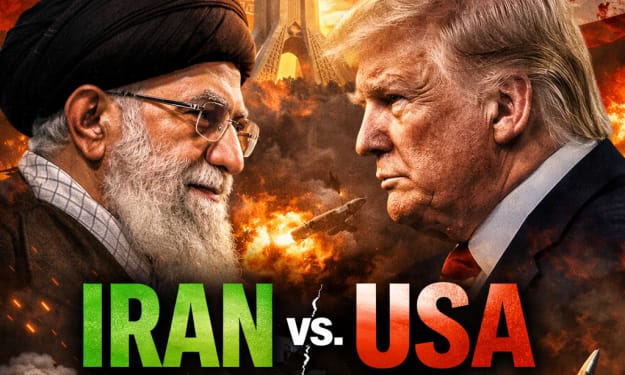
“Iran VS United States, Tensions at the Breaking Point. Trump’s Next Move Could Reshape the Middle East”
1. Background: What’s Happening Now • Nationwide protests in Iran are ongoing due to a severe economic crisis, skyrocketing inflation, and public anger about conditions inside the country. • President Donald Trump has publicly threatened Iran, warning that if Tehran violently suppresses protesters or gets too aggressive, the U.S. could intervene. • Iran’s government has responded by warning of swift and comprehensive retaliation if the U.S. attacks. • Iran’s airspace and infrastructure remain tense, but some diplomatic communications have briefly reopened, signaling both sides are weighing options.
By Hamd Ullaha day ago in Journal



Comments
There are no comments for this story
Be the first to respond and start the conversation.