
Why Portable Concrete Plants Can't Compete with Stationary Ones in Big Infrastructure Projects
Portable Concrete Plants Can't Compete with Stationary Ones in Big Infrastructure Projects


The allure of the portable concrete plant is seductive in its simplicity. Proponents champion its flexibility and rapid deployment, painting a picture of agile, cost-effective responsiveness perfectly suited to the sprawling, dynamic sites of big infrastructure projects. This narrative, however, is a profound misconception. For megascale endeavors—be they labyrinthine hydroelectric dams, continent-spanning railway networks, or coastal megaport developments—the choice of a portable batching plant is not a savvy adaptation but a critical strategic error. These projects are not merely large; they are exercises in industrial permanence, demanding a production paradigm that portable units are fundamentally architected to fail.
The Illusion of Flexibility: A Misplaced Priority in Megascale Construction
The core argument for portable plants hinges on flexibility. Yet, in the context of billion-dollar infrastructure projects, this perceived virtue dissolves under scrutiny. These are not ventures defined by rapid pivots but by meticulous, multi-year execution of a master plan. The priority is not mobility, but monolithic, predictable, and relentless production.
The Throughput Paradox: When Mobility Becomes a Bottleneck
Portable concrete plants are, by engineering necessity, compromised in scale. Their design concessions for transportability—smaller aggregate bins, limited cement silo capacity, constrained mixer size—impose a hard ceiling on volumetric output. A major viaduct or dam abutment does not pause for a plant to catch up. The incessant, voracious appetite of a mega-project pour, often requiring thousands of cubic meters per day, renders the portable plant’s output a mere trickle. Its mobility is irrelevant when it is perpetually anchored, operating at maximum yet inadequate capacity, becoming the very bottleneck it was supposed to prevent. The stationary plant, in contrast, is engineered without these compromises. Its fixed foundations allow for vast material storage and multiple high-capacity mixers operating in tandem, creating a veritable concrete river that meets the project's circadian rhythm of demand.

The Myth of Agile Deployment: Site Realities and Ancillary Infrastructure
The promise of "rapid deployment" ignores the profound site preparation any batching operation requires. A portable plant may be wheeled into position faster, but it still necessitates the same extensive groundwork: construction of heavy-duty load-bearing platforms, installation of sophisticated electrical substations, and establishment of water supply and drainage systems. Furthermore, its mobility is negated by the static, sprawling ecosystem that sustains it. The network of aggregate stockpiles, admixture storage, laboratory facilities, and maintenance bays cannot be moved. Relocating the plant itself becomes a logistically disruptive event, halting all production for days, not a seamless agile maneuver. The stationary plant, conceived as a permanent site node, optimizes this entire ecosystem from the outset, embedding efficiency into its fixed geography.
The Compromised Foundation: Inherent Engineering and Logistical Deficiencies
Beyond scale, portable plants embody a series of inherent technical compromises that directly contravene the non-negotiable quality mandates of major infrastructure.
The Specification Gap: Inability to Meet High-Performance Demands
Modern mega-projects utilize concrete as a high-tech material, not a commodity. Specifications call for precise, often bespoke, mixes: self-consolidating concrete for dense rebar configurations, low-heat mass pours for dam cores, or ultra-high-performance concrete for critical structural elements. The batching technology to achieve this is complex, involving intricate ingredient sequencing, precise climate control, and real-time rheology monitoring. Portable plants typically lack the sophisticated, calibrated weighing systems, the advanced additive dosing mechanisms, and the integrated data architecture to execute these mixes with the requisite repeatability. They are designed for generality, not the exacting specificity demanded by contemporary engineering.
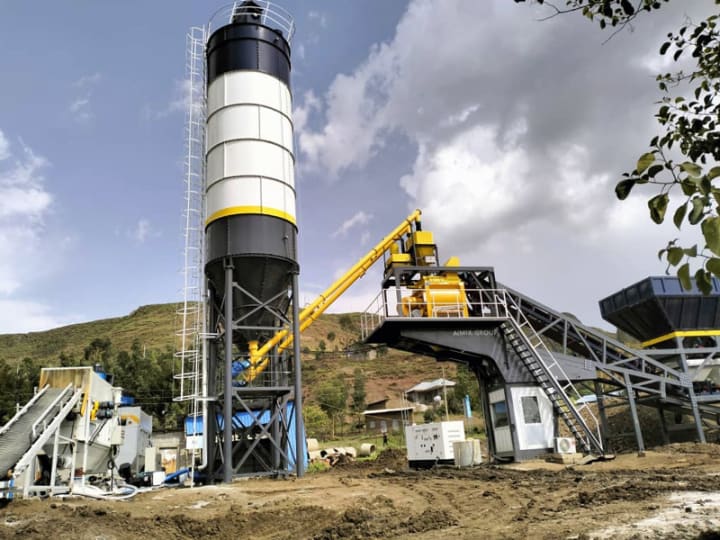
The Hidden Cost Vortex: Aggregate Logistics and Operational Inefficiencies
The logistical framework for feeding a portable plant is inherently inefficient. Smaller on-site storage mandates constant, smaller deliveries of aggregate and cement. This transforms material supply from a bulk, scheduled process into a frenetic, traffic-intensive stream, increasing fuel costs, site congestion, and exposure to supply chain volatility. Moreover, the plant's design often necessitates more frequent manual intervention for cleaning and batch changes, increasing labor costs and potential for error. Any perceived savings in capital expenditure are swiftly eroded by this vortex of operational inefficiency and hidden handling costs. The stationary concrete plant, with its massive, gravity-fed storage capacities, enables bulk deliveries that minimize cost and disruption, creating a lean, predictable flow of material.
The True Economics of Scale: A Question of Permanence and Precision
The final and most damning argument against portable units lies in a holistic assessment of economics, not as mere initial purchase price, but as the total cost of ownership over the project lifecycle, inextricably linked to quality outcomes.
The Quality Assurance Chasm: Data, Control, and Consistency
A stationary plant is not just a production facility; it is a quality assurance hub. Its permanence allows for the integration of enterprise-level process control systems. Every gram of cement, every milliliter of admixture, and the moisture content of every aggregate pile can be tracked, logged, and analyzed. This creates an immutable digital pedigree for every cubic meter poured, a necessity for compliance and liability in critical infrastructure. Portable plants struggle to provide this level of traceability. Their operational transient nature works against the rigorous, audit-ready consistency that is the bedrock of responsible construction. In major projects, a single batch failure can incur costs orders of magnitude greater than the entire batching plant. The risk profile is simply untenable.
The Long-Term Calculus: Total Cost of Ownership Versus Perceived Savings
The financial analysis must be actuarial. A stationary plant represents a higher initial capital outlay, amortized over the project's entire duration. Its superior efficiency, lower per-unit operational cost, robust output, and mitigated risk of defects or delays constitute a compelling long-term value proposition. The mobile batching plant’s lower upfront cost is a fool’s bargain. It is offset by higher ongoing operating expenses, a tangible risk of costly production shortfalls, and the existential threat of quality non-conformance. For a project measured in years and billions, the economics favor the industrial, permanent solution. The stationary plant is not an expense; it is a strategic investment in the project's predictable, profitable, and successful execution. To choose otherwise is to prioritize illusory agility over demonstrable supremacy.
About the Creator
AIMIX
Construction Machine Manufacturer in China. Find Machines here: https://aimixconcretesolution.com/
Author’s Advice
If you would’ve asked me 20 years ago did I know I’d become a writer and an author, I would’ve said “nope, ain’t happening”. As fate would have it I did become an author and I can honestly say I’m loving it so far. It really does feel good to be a writer. I’ve learned a lot on this journey and I feel like with even me being as new to this world as I am, there’s some wisdom I need to share with every other aspiring author.
By Joe Patterson3 days ago in Journal
Circadian Rhythm Doesn’t End When You Walk Indoors
Most people think of circadian rhythm as something connected primarily to daylight and nighttime. The rising sun signals the body to wake up. The darkness of evening encourages rest. For thousands of years, this natural cycle regulated how humans slept, worked, and recovered.
By illumipure5 days ago in Journal




Comments